Mobile Councilman Floats ‘Noise Flags’ as City Weighs Tighter Noise Rules
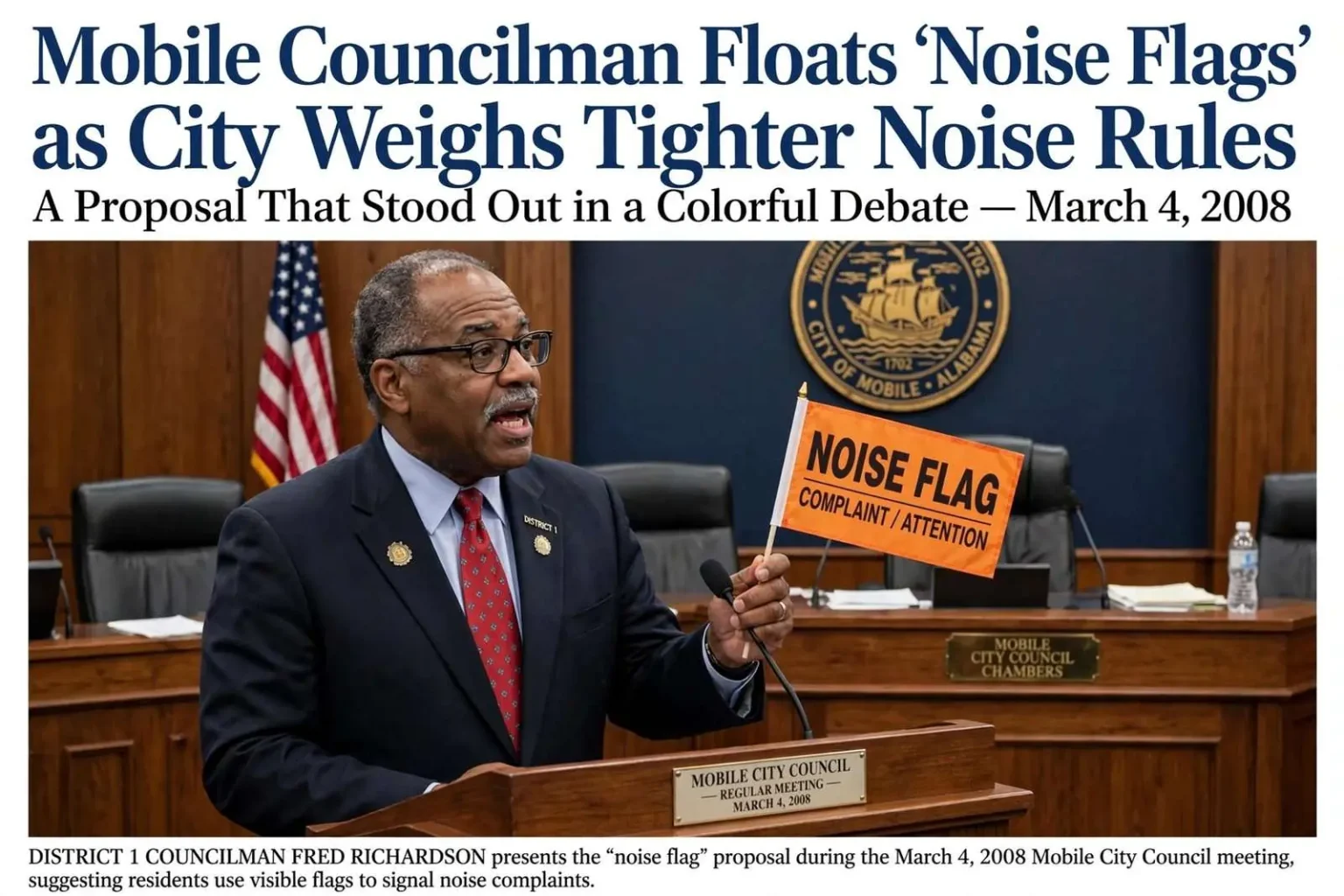
The Mobile City Council debated a rewrite of the city's noise ordinance on March 4, 2008, where Councilman Fred Richardson floated the idea of 'noise flags' to help flag problem noise levels in real time.
A Proposal That Stood Out in a Colorful Debate
Mobile’s City Council took up a proposal at its March 4, 2008 meeting to rewrite the section of the city code governing noise, part of a broader municipal effort to give residents and businesses clearer, more enforceable standards for how loud is too loud. The review touched one of the most persistent friction points in any growing city: the line between a lively evening and a genuine nuisance. Council members were weighing not just where to set limits, but how those limits could actually be enforced once written into law.
As with a number of the council’s more colorful debates over the years — from arguments over confetti and MoonPie drops at City Hall to the finer points of parade regulations — the noise discussion produced at least one idea that stood out from the usual back-and-forth over decibel limits and enforcement procedures. Mobile’s council has never been shy about mixing practical policy with homegrown improvisation, and the noise debate fit squarely within that tradition.
District 1 Councilman Fred Richardson pitched the idea of “noise flags,” a proposal aimed at giving residents and neighbors a simple, visible way to signal when noise levels in a given area had become a problem, rather than relying solely on police response or citations after the fact. The image was straightforward: instead of a frustrated caller waiting on hold with a dispatcher, a visible flag at a home or block would tell passing officers and neighbors alike that a complaint had been raised there.
Richardson’s flag idea did not come with full details on how the system would work in practice — whether it would rely on residents displaying a visible signal for patrol officers, or on some other mechanism, had not been spelled out when the proposal surfaced. Questions about cost, maintenance and who would be responsible for the flags also remained open. What the idea captured, though, was the core frustration at the heart of most noise complaints: by the time help arrives, the noise has usually stopped.
The concept reflects a recurring challenge for cities writing noise ordinances: decibel thresholds and formal complaint processes can be difficult for both residents and officers to apply in real time, especially in mixed residential-commercial areas where what counts as reasonable noise depends heavily on context, time of day and location. A sound level that is unremarkable outside a busy street at 10 p.m. on a Saturday can be intolerable at 2 a.m. on a weeknight, and the same block can host a quiet family home and a busy commercial spot within a few hundred feet of each other.
Objective standards carry their own complications. Measuring a decibel reading requires equipment and training, and readings can be affected by wind, traffic, distance from the source and reflections off nearby buildings. Many cities therefore pair numeric limits with a plainer standard — noise that is plainly audible from a certain distance, or that unreasonably disturbs a reasonable person — which is easier for an officer to apply on the spot but harder to define in a way that survives a court challenge. Drafting language that is specific enough to enforce and flexible enough to be fair is the central difficulty of any noise rewrite.
Enforcement adds another layer. Complaint-driven systems typically begin with a phone call, move to a warning from an officer, and only reach a citation after repeated or egregious violations. Each step takes time, and in the interval between the call and the arrival of a patrol unit, a party can end, a sound system can be turned down and evidence can disappear. Residents in neighborhoods near entertainment areas often describe the cycle of calling, waiting and hearing nothing as more frustrating than the noise itself.
The broader ordinance amendment considered by the council fits into a long-running tension in growing cities between commercial activity, nightlife and residential quality of life. Mobile, like many mid-sized Southern cities, has periodically revisited its noise rules as development patterns shift and as downtown and Midtown neighborhoods see more mixed residential and entertainment uses in close proximity. As older commercial corridors add apartments above shops and as nightlife concentrates along established streets, the number of people living within earshot of late-night activity keeps growing.
Getting those rules right matters both to residents who want a predictable, quiet home environment and to business owners who depend on evening foot traffic and outdoor seating to draw customers. A restaurant or music venue that invests in a downtown location does so expecting to operate in the evening; the family that buys a home a few blocks away does so expecting quiet nights. When those two expectations collide, the ordinance is what determines whose expectation carries the day.
For businesses, the fear is a standard vague enough to be applied inconsistently — one that lets a single determined complaint shut down outdoor music or force a venue to change its format. For residents, the fear is the opposite: a rule with generous thresholds, or with enforcement so slow that the thresholds hardly matter. Both groups have a stake in standards that are clear, predictable and applied the same way every time.
Noise is not only a matter of comfort, either. Public health researchers have long linked chronic noise exposure to disrupted sleep and elevated stress, and persistent noise disputes are among the most common sources of neighbor conflict that escalate to police involvement. Cities that settle on workable noise rules often find they prevent a category of smaller disputes from consuming disproportionate amounts of police time.
What Happens Next
An ordinance rewrite of this kind typically moves through introduction, public comment and committee review before a final council vote, giving both sides a chance to weigh in on where limits should fall and how violations should be handled. Residents and business owners alike were expected to follow the drafting process closely, since the details — measurement standards, hours, penalty levels and any role for something like noise flags — would determine the practical effect of the amendment.
The flags proposal, whatever its ultimate fate, underscored the point that enforcement design matters as much as the numbers written into the code. A limit that cannot be applied in the moment does little good, and cities across the country continue to experiment with complaint systems, decibel monitoring and community notification tools as they search for approaches that work on real streets rather than only on paper.
For Mobile, the debate fit a familiar pattern. The city’s calendar is built around public celebration — its Mardi Gras heritage is among the oldest in the country, and its streets fill with parades, concerts and festivals for much of the year — so questions about how much noise a city should tolerate are never abstract there. Council members balancing tradition, commerce and neighborhood quiet were effectively negotiating where celebration ends and nuisance begins.
As the review moved forward, both residents and businesses shared the same practical interest: a rule that tells them clearly what is allowed, when it is allowed and what happens when the line is crossed. Whether that rule arrives with decibel meters, plainly-audible standards or a flag flying outside a neighbor’s door, the measure of success will be the same — fewer unanswered calls in the night and fewer disputes left to fester between people who share a street.
The geographic and economic makeup of a city like Mobile shapes how these disputes play out, too. Neighborhoods that were once solidly residential can find themselves adjacent to thriving commercial strips within a single decade, and the people who moved to a street expecting one character often stay long after the street has taken on another. That turnover is exactly what makes a one-size-fits-all decibel number so difficult: the standard has to serve the longtime resident on a quiet side street and the bartender pouring drinks on a corner where the music runs until midnight, without making either feel the rules were written for someone else.
Timing rules are one common way cities split the difference. Ordinances frequently set stricter limits during overnight hours and more permissive ones during daytime and early evening, recognizing that a lawn mower at noon and a live band at 1 a.m. are different questions entirely. Some communities also write special provisions for permitted events — festivals, parades and holidays — so that a celebration with a permit is not treated the same as a backyard gathering that runs past midnight every weekend. How Mobile’s drafters handled those distinctions would say a great deal about how the amended code worked in daily life.
There is also the question of what happens after a citation is written. Fines that are too small can be absorbed as a cost of doing business by repeat offenders, while penalties that are too steep can turn routine complaints into drawn-out municipal court fights. Many cities build in escalating penalties for repeat violations within a set period, reserving the harshest sanctions for businesses or residents who show they will not adjust. The structure Mobile ultimately adopted would need to walk that line if the rewrite was to reduce complaints rather than merely move them from the street to the courtroom.