Mobile County Judge Orders Statewide Shutdown of Clinics Tied to Injury Treatment Scheme
A Mobile County circuit judge ordered three additional Alabama injury clinics closed, saying they were running the same scheme that shut down a Mobile clinic accused of steering car accident victims into unnecessary treatment to boost settlement payouts.
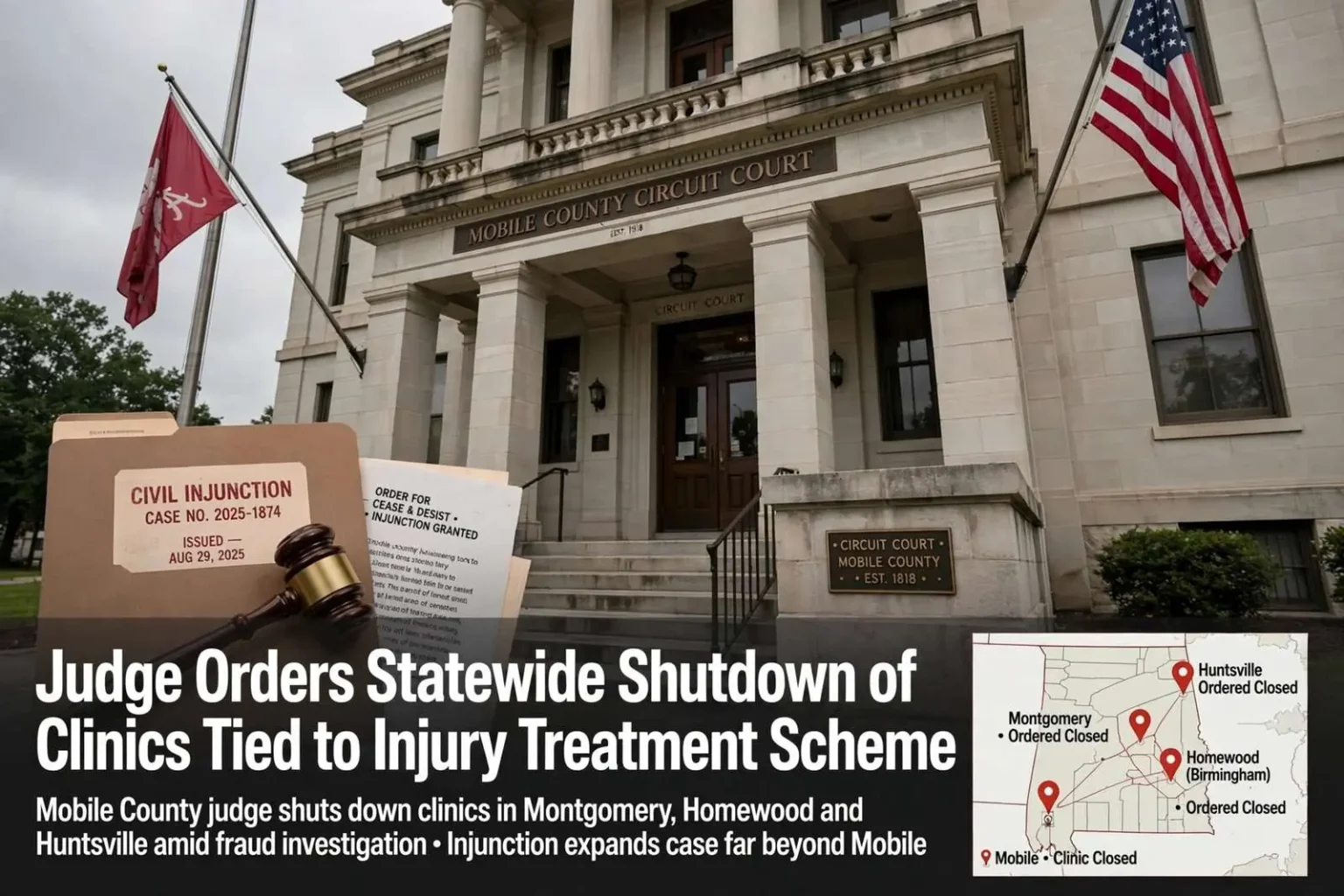
A Mobile County circuit judge has ordered three more Alabama injury clinics to close, expanding a legal fight that began with a Mobile clinic accused of running a scheme to inflate car accident settlements.
The order pushes a Mobile County prosecution far beyond its home jurisdiction, reaching into three Alabama cities hundreds of miles from the Gulf Coast. It marks an escalation in what prosecutors describe as a coordinated effort to turn accident victims into revenue — a scheme that law enforcement officials say combined telemarketing, medical treatment, and legal representation into a pipeline designed to drive up the value of personal injury claims, often at the expense of the very patients the clinics claimed to serve.
The shutdowns also highlight the unusual legal tool being used: civil injunctions issued by a trial judge, allowing investigators to close clinic doors while a criminal investigation continues, rather than waiting for charges and convictions that could take years.
From Old Shell Road to three cities
Judge Michael Windom issued the order Friday morning, telling the clinics’ owners that “they’re breaking the law.”
Windom, a veteran Mobile County circuit judge, issued the order from the bench in Mobile, extending a case that has unfolded in his courtroom since prosecutors first moved against a single clinic. His message to the owners was blunt, and the ruling that followed was broader than anything the case had produced so far: not just the Mobile clinic, but three affiliated operations in other parts of the state would have to stop treating patients.
The case traces back to August 2025, when the Mobile County District Attorney’s Office shut down South Alabama Medical & Rehab on Old Shell Road. Prosecutors alleged the clinic was part of a larger operation involving telemarketers and law firms that pushed car accident victims into expensive treatment plans designed less for patients’ health than to maximize the settlement value of their claims. A lawsuit filed in July 2025 claimed accident victims, sometimes contacted within hours or days of a crash, were being steered into treatment meant to maximize the value of their claims in negotiations before a lawsuit was ever filed.
The Mobile County District Attorney’s Office has made fraud and public corruption cases a signature part of its docket, and the Old Shell Road clinic was among its most aggressive moves into the world of personal injury medicine. According to prosecutors, the operation worked like this: telemarketers solicited car accident victims, often shortly after their crashes; those victims were steered into treatment plans at the clinic; and the treatment itself was designed with an eye not to recovery but to building up medical billing that could inflate the eventual insurance settlement, with law firms in the loop to convert that billing into claims.
The pattern, if proven, victimizes twice — first the insurance system, which absorbs inflated claims, and then the patients themselves, whose treatment records become bargaining chips rather than medical care, and whose settlements can be consumed by liens for treatment they may not have needed.
The clinics ordered closed
Nearly a year after that clinic ceased operating, Windom ordered three related clinics outside coastal Alabama, located in Montgomery, Homewood and Huntsville, to shut down as well while the district attorney’s investigation continues.
The three cities span the state — Montgomery, the capital, in central Alabama; Homewood, a suburb of Birmingham in Jefferson County; and Huntsville, the Tennessee Valley’s largest city in the state’s far north. The geographic spread suggested the operation was never a local Mobile enterprise but a statewide network, with the Old Shell Road clinic only one node among several.
Assistant District Attorney Clay Rossi told the court that chiropractor Michael Kent Plambeck, a part owner of all four clinics — South Alabama Medical & Rehab, Montgomery Medical & Rehab, Homewood Medical and Huntsville Medical & Rehab — has a hand in their management.
Prosecutors say that after the Mobile clinic’s operators shut it down, they redirected its operations to the other three clinics, including a patient pipeline that had once supplied the Mobile location; Rossi said the Huntsville clinic in particular used that same pipeline.
That redirection is central to the state’s argument. In prosecutors’ telling, the closure of the Mobile clinic did not end the scheme; it relocated it. Patients who had been flowing into Old Shell Road were routed instead to Montgomery, Homewood and Huntsville, keeping the pipeline of accident victims, treatment plans, and settlement claims intact even as the original clinic’s doors stayed shut. Establishing that operational connection — through ownership records, management involvement, and the movement of patients — is what allowed the state to reach clinics that had never been part of the original Mobile case.
A defendant with a record
Plambeck was previously found guilty of violating the federal Racketeer Influenced and Corrupt Organizations Act in a similar scheme in 2013. His network of clinics and telemarketing firms has surfaced in local reporting since the late 2000s, when a federal RICO lawsuit detailed how the operation purchased police accident reports, cold-called crash victims and routed them into clinics and law offices; reporting has traced the clinic network across multiple states.
That history looms over the current case. The RICO Act, originally a federal statute aimed at organized crime, has been adopted in various forms by states and prosecutors to reach ongoing criminal enterprises — businesses that are not one-time frauds but continuing operations built to generate illegal proceeds. A 2013 RICO conviction in a similar scheme means Plambeck had already been through this territory once, and prosecutors argue the pattern of the 2025-era clinics is a continuation, not a fresh start.
For Judge Windom, the prior conviction was part of the context in which he weighed the state’s request for an injunction. For the clinics’ patients, it is a warning sign about the kind of operation they may have been dealing with. And for the investigation, it raises the stakes: an alleged repeat of conduct that has already resulted in a criminal conviction once before.
The injunction hearing
Windom said he had heard enough evidence to issue an injunction barring Plambeck and others from continuing to operate the clinics.
Civil injunctions of this kind occupy a middle ground in the law. They do not require a criminal conviction, only a showing that the operation of the clinics is likely unlawful and that the public interest favors stopping it while the case proceeds. In practice, for a clinic accused of systematic fraud, an injunction is often the decisive blow — closing the business now, before charges are filed or trials held, and preventing further patients from being drawn in during the months or years an investigation can take.
Plambeck’s attorney, Cole Gresham, objected, arguing the order was overly broad given that the other clinics were not part of the original lawsuit, but the judge stood by his decision. “We’ll see,” Windom replied, before adding that he believed the clinics were breaking the law.
The objection went to the heart of the legal question: how far a Mobile County judge’s authority should reach over businesses in Montgomery, Jefferson and Madison counties, none of which was named in the original complaint that started the case. Plambeck’s attorney argued the answer was not that far — that a court cannot simply shut down enterprises outside the scope of the litigation before them. Windom disagreed, evidently persuaded that the evidence tied the three clinics closely enough to the Mobile scheme that closing them was a reasonable extension of the order that began with Old Shell Road.
What it means for patients
For people who sought treatment at any of the four clinics, the case carries both reassurance and caution. The reassurance is that state authorities are treating the operations as a consumer protection problem as much as a criminal one, and that the judicial system moved quickly once the pattern became clear. The caution is that patients whose treatment was allegedly designed to inflate claims rather than to heal may find themselves with medical bills, treatment liens, and settlement records that reflect the clinics’ interests rather than their own.
Consumer advocates generally advise accident victims to be wary of unsolicited calls after a crash — the telemarketing that prosecutors say fed this pipeline is a common thread in injury-scheme cases across the country — and to choose medical providers and attorneys independently rather than accepting referrals from strangers who call first.
The investigation continues
With the three outlying clinics now ordered shut, the Mobile County District Attorney’s investigation continues. Whether criminal charges will follow — and against whom — remains to be seen, but the shape of the case so far suggests prosecutors are building toward a broad account of a scheme that stretched from Mobile’s Old Shell Road to the state’s largest cities, and that treated the medical system and the courts as instruments for profit.
Judge Windom’s order, issued on a Friday morning in Mobile, ensures that while that investigation proceeds, the clinics themselves will not treat another patient.
The Montgomery, Homewood and Huntsville clinics had not announced closures of their own as of the hearing. The closure order is a preliminary step rather than a final judgment: the underlying lawsuit remains pending, further hearings are expected as the District Attorney’s Office seeks a permanent resolution, and patients of the three clinics who believe they were affected may be contacted as the investigation widens.
How the scheme worked, in prosecutors’ account
The architecture described by prosecutors is a familiar one in fraud cases nationwide. It begins with solicitation: telemarketers reach out to people who have recently been in car accidents, offering help with medical care and compensation. It continues with treatment: the patients are routed to a clinic where examinations, therapy sessions, and diagnostic services accumulate on the bill. It ends with the claim: law firms file and negotiate settlements in which the medical billing is a central input, and the larger the billing, the larger the settlement demand.
Where the arrangement turns allegedly criminal is in the alignment of incentives. If treatment plans are built to maximize billing rather than to heal, patients undergo months of procedures they may not need, and the eventual settlement — which must cover medical liens before the patient is paid — shrinks accordingly. The insurer, meanwhile, pays claims padded by treatment that exists to inflate them. Everyone in the chain profits except the patient and the insurance pool that everyone’s premiums support.
Prosecutors say that is what the four clinics were built to do, and that the network’s structure — shared ownership, shared management, and a shared supply of telemarketed patients — shows it was an enterprise rather than four independent businesses that happened to share a part owner.
Why injunctions matter here
The speed of the state’s response is notable. A criminal prosecution of a medical billing scheme can take a year or more to reach trial, and an alleged operation can treat thousands of patients in that window. An injunction closes the pipeline immediately, at the cost of a lower evidentiary standard and the possibility that the order will be narrowed or reversed on appeal. Judges granting such orders weigh the risk of ongoing harm to the public against the business interests of the owners, and Windom’s willingness to reach clinics outside Mobile County shows where he came down on that balance.
For the district attorney’s office, the order preserves the status quo while the criminal investigation matures. Evidence gathered from the closed clinics — patient files, billing records, telemarketing scripts, communications with law firms — can now be assembled without the pressure of ongoing operations generating new patients and new claims.
The case is likely to remain in the courts for some time, whether through further injunction litigation, criminal charges, or both. But the immediate effect of Friday’s ruling is unambiguous: the network of clinics tied to the Mobile scheme, from Old Shell Road to Montgomery, Homewood and Huntsville, is out of business while the law catches up with it.