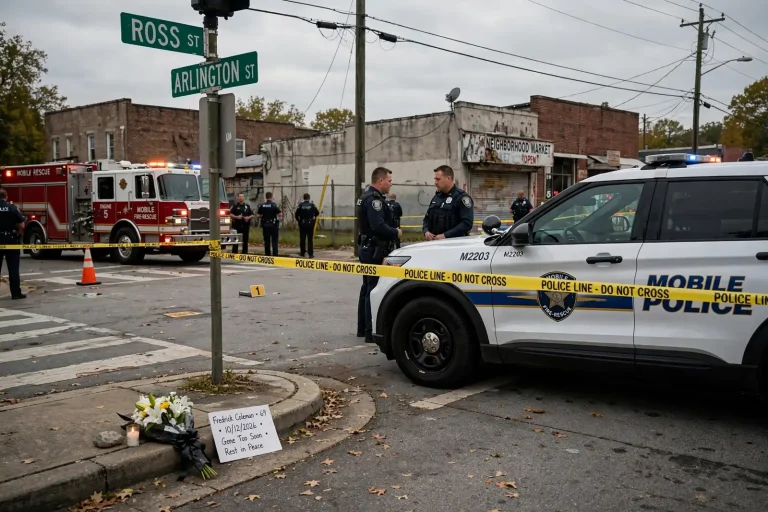
Mobile County schools locked down after report of armed, unstable man near campuses
All 90 Mobile County Public School System campuses went into a precautionary lockdown Monday after a sheriff's alert about a man who left a mental health facility; he was arrested at his home within the hour.
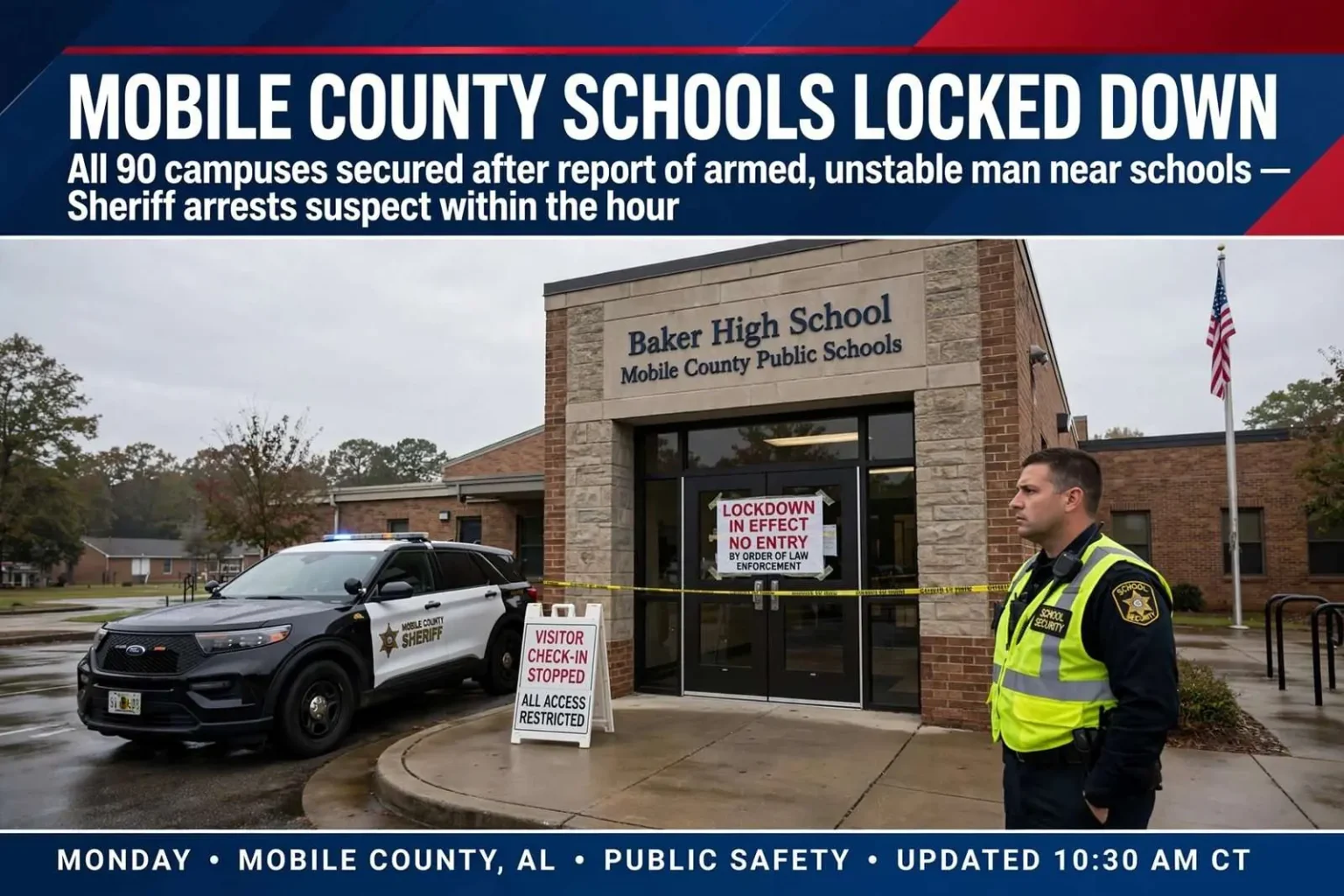
All 90 campuses in the Mobile County Public School System went into a precautionary lockdown Monday morning after the Mobile County Sheriff’s Office issued a public alert about a man who had left a mental health facility without notifying authorities. The action placed every school in the district — elementary, middle, and high school, from the city of Mobile to the county’s suburban and rural communities — under the same protective posture simultaneously, a measure the system reserves for threats it judges capable of touching any campus.
The school system, which serves roughly 53,000 students and employs about 7,200 people, notified families through social media shortly after 9:30 a.m., saying campuses were operating under heightened security “on the advice of law enforcement.” Doors were locked districtwide and outdoor activities such as recess and physical education classes were suspended until further notice. The notification reached parents on the platforms they actually monitor — the district’s social media accounts — a channel that has become the fastest reliable route for school systems communicating with tens of thousands of households at once.
A lockdown of that scope is a logistical undertaking that most families never see from the inside. Attendance desks stop admitting visitors; interior movement is restricted; administrators monitor entrances; and teachers carry on with instruction under rules that keep hallways clear and exterior doors secured. For a district the size of Mobile County’s — the largest school system in Alabama — applying those procedures uniformly across 90 campuses requires coordination between school administrators, the system’s central security staff, and the law enforcement agencies whose intelligence triggered the decision.
Who Prompted the Lockdown
The precaution followed an alert from the Sheriff’s Office identifying the man as 39-year-old Clint Austin Barnard. Deputies said Barnard had walked away from a hospital where he had been taken for a mental health evaluation, prompting concern serious enough to trigger the systemwide lockdown rather than action at a single school.
The decision to lock down the entire district rather than a handful of nearby campuses reflects the information position law enforcement was in: a man unaccounted for, with a history that included contact with school property, and no confirmed location. In that situation, security officials generally reason that the cost of a precautionary lockdown — disruption, anxious parents, a lost instructional day’s rhythm — is far outweighed by the risk of narrowing protection to the wrong geography.
By around 10:15 a.m., the Sheriff’s Office told the public that Barnard had been located and arrested at his home, less than an hour after the initial alert went out. The speed of the resolution — from public alert to arrest inside a single hour — meant the lockdown spanned the district’s morning arrival period, the hours when students are in transit and campuses are most exposed.
A Familiar Figure to the School System
A spokesperson for the Sheriff’s Office, Lori Myles, said the school system was not unfamiliar with Barnard. She said he had reportedly trespassed on school system property about a month earlier, and that parents had separately reported to authorities around that time that Barnard had made general threats against the school system.
Those earlier reports appear to have factored into how seriously Monday’s alert was treated. In school security practice, prior incidents are the variable that converts a general public-safety concern into a district-level protective action: a man with no documented connection to schools leaving a treatment facility is a matter for the Sheriff’s Office alone, but a man with a documented trespass history and reported threats against the school system changes the calculus entirely.
Myles said the chain of events leading to Monday’s lockdown began days earlier. On Friday, she said, Barnard’s mother called deputies asking that they pick him up, and he was subsequently transported to a nearby hospital for a mental health evaluation. He left that facility on his own before staff or law enforcement were alerted, which is what set off the sheriff’s public notice Monday morning.
The sequence — a family member seeking help, a voluntary transport for evaluation, and a departure before treatment could begin — illustrates the gap that families in mental health crises across Alabama routinely encounter. A hospital evaluation depends on a patient remaining present; a person who walks away is, absent a court order or an arrest, simply gone, and the responsibility for locating him falls back to law enforcement. That is the point at which a private family crisis becomes a public-safety notice, and in this case, a districtwide school lockdown.
What Happens Next: Involuntary Commitment
Following Barnard’s arrest, Myles said his family is now pursuing an involuntary commitment through Mobile County Probate Court, a legal process that can require a person to receive mental health treatment even without their consent when a judge determines they pose a risk to themselves or others.
Alabama’s involuntary commitment process runs through the probate courts, where family members or others with knowledge of a person’s condition can petition for an order requiring evaluation and, if the court finds the legal standard is met, treatment. The process exists precisely for situations like the one Monday’s alert described: a person in evident crisis whom the treatment system cannot hold voluntarily and whom family cannot compel to stay. It involves petitions, examinations by mental health professionals, and a judicial determination — safeguards that protect individual liberty but also mean the process takes time a family in crisis may feel it does not have.
For the Barnard family, the pursuit of commitment represents an attempt to close the loop that Friday’s transport left open. For the school system and the Sheriff’s Office, it is the outcome the day’s events pointed toward: an arrest to end the immediate alert, and a court process aimed at preventing the next one.
When the Lockdown Ends
School system officials did not immediately say whether the lockdown had been lifted following Barnard’s arrest, and it was not immediately clear how long enhanced security measures remained in place at the district’s schools Monday. That caution — keeping procedures in place after an arrest until officials have confirmed circumstances — is standard practice, since the protective value of a lockdown depends on acting on verified information rather than on the assumption that an arrest resolves every question behind it.
Parents spent the morning navigating the notifications, with some keeping children home and others watching for updates before lunch.
By the afternoon, the more consequential questions were the ones the morning had surfaced: how a man with a documented trespass history and reported threats had come to be out of custody and out of treatment, and what, procedurally, stands between such a person and a school campus in the weeks that follow.
A Rare Measure, Used When It Matters
Districtwide lockdowns of this scale are uncommon and reflect how seriously school officials and law enforcement treat reports involving individuals with a documented history of contact with school property, even when the underlying concern originates away from campus. The vast majority of the district’s security responses — a fight, a suspicious package, a utility failure — unfold at a single school. Extending protection across 90 campuses simultaneously is the exception, and its use Monday signals how the district and the Sheriff’s Office weighed the specific history involved.
The episode also underscored the interdependence of the agencies involved. The Sheriff’s Office issued the alert and made the arrest; the school system translated that intelligence into protective action across a district the size of a small city; and the probate court now becomes the third institution in the chain, holding the legal authority to accomplish what Friday’s voluntary transport could not. Each link functioned as designed Monday. The question the morning leaves open — for the district, for the Sheriff’s Office, and for the family now in probate court — is whether the system’s next intervention can come before, rather than after, the next alert.
What Families Can Take From the Morning
For district families, the episode is a reminder of how the notification chain works in practice. The alert moved from the Sheriff’s Office to the school system’s security staff to the district’s public channels and then, within the hour, back out again when the arrest was announced. Parents who followed the district’s official accounts received each turn in real time; those who relied on word of mouth spent the morning piecing the story together from fragments. School officials encourage families to monitor the system’s official notifications precisely because a lockdown morning moves at the speed of verified information, and unofficial channels rarely carry the corrections.
The morning also demonstrated the terms on which the district’s security decisions are made. The system locked down not because a threat was confirmed at a school, but because a documented history made the risk of being wrong too expensive. In the aftermath, with an arrest made and a commitment petition pending, the same logic works in reverse: officials will lift protective measures only when the information supporting them has been resolved, not simply when the immediate alarm has passed.