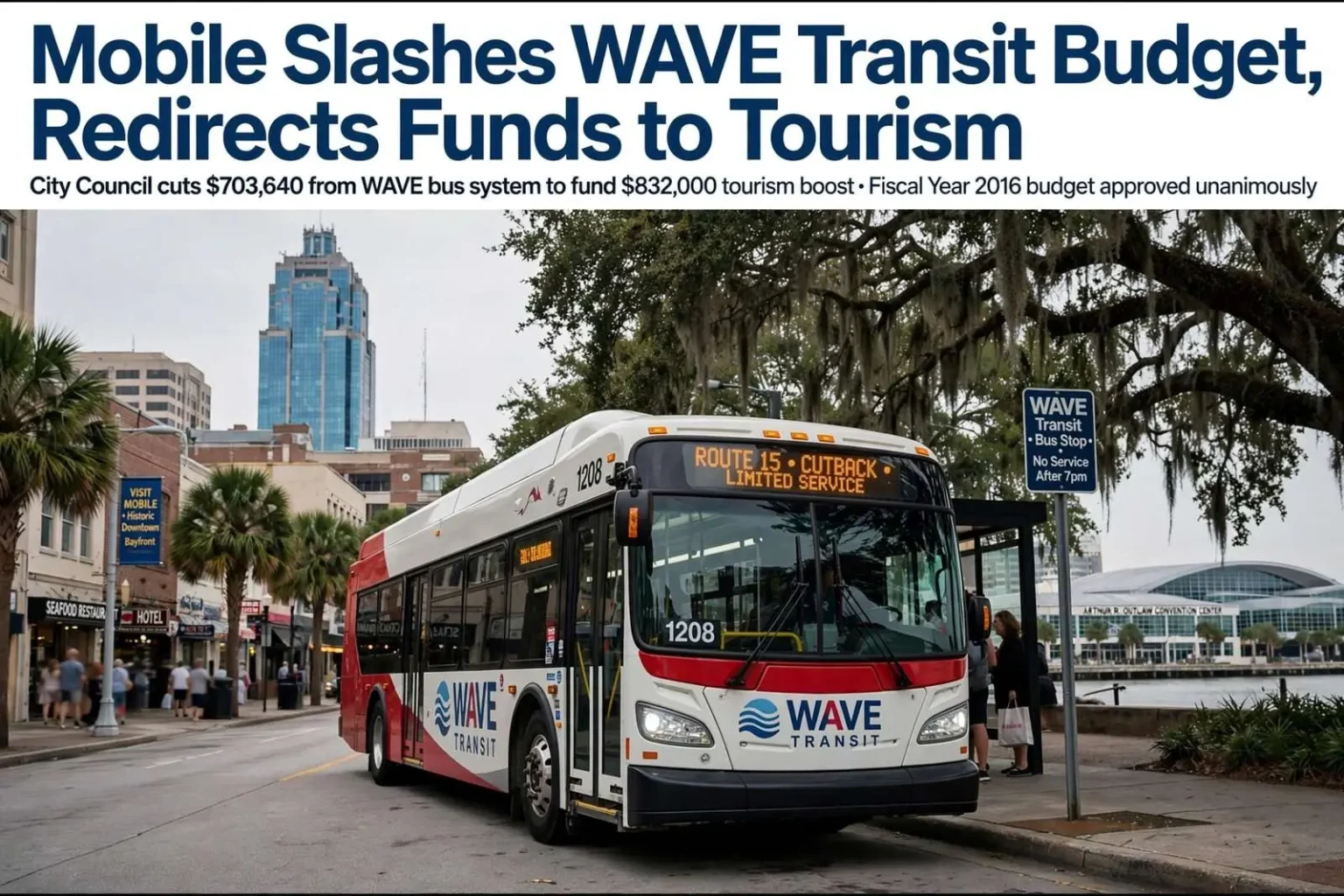
Mobile Slashes WAVE Transit Budget, Redirects Funds to Tourism
Mobile's city council cut more than $700,000 from its bus transit budget while boosting tourism funding, as the fiscal 2016 budget passed unanimously.
The Mobile City Council voted unanimously to approve a fiscal year 2016 budget that trims spending on the city’s public bus system while steering more money toward tourism promotion. The spending plan — the second full budget shaped by Mayor Sandy Stimpson’s administration — signals a clear set of priorities for the city: tightening recurring subsidies while investing in the visitor economy that fills hotels, restaurants and the convention center downtown.
Council members agreed to cut $703,640 from the WAVE Transit bus system’s budget, using part of that money to help fund an $832,000 increase for convention and tourism spending. The overall WAVE budget has fallen from about $6.76 million in fiscal year 2014 to roughly $5.5 million heading into fiscal year 2016, a reduction of nearly a fifth over two budget cycles that has left the bus system operating on its leanest footing in years.
The unanimous vote belied the tension surrounding the transit cut. Riders and advocates had followed the budget process closely as word spread that the bus system’s subsidy was being reduced, and council members acknowledged the concerns even as they voted to approve them. No council member ultimately broke ranks on the spending plan, a show of unity that officials attributed to the mayor’s argument that the transit system’s problems run deeper than any single year’s budget.
Mayor Sandy Stimpson said the bus system’s route structure has gone largely unchanged for more than two decades and that Mobile spends far more on public transit than comparable Alabama cities. The argument reframed the cut not as a retreat from transit but as pressure for reform: a system whose routes, schedules and coverage have not kept pace with how the city has grown and shifted since the 1990s, in the mayor’s telling, does not deserve to be funded indefinitely at historic levels.
The Numbers Behind the Debate
Figures presented during budget discussions showed Mobile’s transit spending topped $6.8 million in the prior year, more than double what Montgomery spends and roughly four times Huntsville’s transit budget. The comparison resonated with council members who have pressed every department for efficiency: two similarly sized Alabama cities were managing their bus systems on a fraction of Mobile’s outlay, without any obvious difference in service quality that the comparison accounted for.
The routes have not been changed in 22 years, Stimpson told reporters after the vote, adding that riders themselves recognize the system needs an overhaul. “When we compare ourselves with other cities, we are way behind,” he said, a statement that captured the administration’s central argument that the city’s transit dollars were buying a network designed for a Mobile that no longer exists.
The city’s job centers, shopping corridors and population have all shifted substantially since the current route map was drawn. Riders living in west Mobile and along major commercial corridors often face long or indirect trips, while the system’s hub-and-spoke design routes many trips through downtown even when both origin and destination lie elsewhere. Transit planners have long identified that mismatch as the chief reason ridership has lagged even as the metro area has grown.
Councilman Joel Daves, who chairs the council’s finance committee, backed the reduction, saying the city has been asking other departments to operate with tighter budgets and that public transit should not be exempt. Daves has led the council’s scrutiny of recurring subsidies — from museums to economic development agencies — and framed the WAVE cut as consistent treatment rather than targeting.
City officials did not detail how the cut would affect bus routes or service levels, and the transit system’s general manager did not respond to requests for comment. That silence left riders without a clear picture of whether specific routes, frequencies or weekend service would change, and advocacy groups urged the city to communicate any schedule adjustments well before they take effect so that riders who depend on the buses for work, school and medical trips are not stranded.
Where the Money Went Instead
On the winning side of the budget ledger, the Boys and Girls Club of South Alabama received an additional $35,000 to launch a summer youth program along the Dauphin Island Parkway corridor, an area officials said has gone without dedicated youth programming for years. Councilman C.J. Small pushed for that funding, arguing that the neighborhoods along DIP south of downtown have few structured summer options for young people and that a modest investment could pay dividends in safety and opportunity.
The Mobile Bay Convention and Visitors Bureau also came out ahead, receiving $352,000 in new funding for a rebranding and marketing push aimed at drawing more visitors to the city, plus roughly $98,000 in previously unspent funds originally earmarked for the BayFest music festival, which organizers canceled the prior week. BayFest, which had brought national acts to downtown Mobile each October for two decades, left behind unspent marketing dollars that the city redirected toward the bureau’s broader visitor campaign.
The bureau’s rebranding effort is intended to sharpen Mobile’s image against competing Gulf Coast destinations, marketing the city’s historic districts, museums, dining scene and waterfront to travelers who might otherwise pass through on the way to the beaches. Tourism officials have argued that every dollar of marketing returns multiple dollars in hotel occupancy and sales tax revenue, making the visitor economy one of the few city investments with a direct and measurable fiscal payoff.
The Arthur R. Outlaw Convention Center and Events Mobile also saw budget increases as part of the tourism-focused shift. The riverfront convention center anchors Mobile’s share of the meetings and group travel market, and administrators have pressed for operating support to compete with newer facilities along the Gulf Coast for conventions, trade shows and sporting events that fill hotel rooms on weekdays when leisure travel is thin.
The redistribution of roughly a million dollars from recurring subsidy to visitor promotion drew little opposition on the council, where members have argued that tourism revenue benefits every neighborhood through the city’s general fund. Transit, by contrast, serves a narrower ridership concentrated along fixed routes, and the council’s math favored the investment with the broader and more easily measured return.
A System Set for Rethinking
City leaders framed the transit cut not simply as a reduction but as a chance to rethink how Mobile delivers public transportation. Stimpson said the coming year offers an opportunity to study the system’s routes and costs in detail before deciding on longer-term changes, an analysis that would examine where riders actually live and work, which routes carry the most passengers, and what service model the city can sustain with the revenue it is willing to commit.
Transit experts say a comprehensive route study — the kind Mobile has not undertaken since its current network was drawn — typically takes a year or more and involves public meetings, rider surveys and ridership data analysis. The product is a redesigned network that concentrates service on high-demand corridors, adjusts frequencies to actual demand and eliminates or reroutes lines that carry few passengers, changes that can increase ridership even when budgets stay flat.
For the riders who depend on the WAVE daily, the study period brings uncertainty. Many transit users in Mobile are low-income workers, seniors and students without other transportation options, and any route changes — even well-designed ones — can disrupt carefully built routines. Advocates have urged the city to make riders full partners in the review process, holding meetings at transit hubs and in the neighborhoods the routes serve rather than only downtown.
The fiscal year 2016 budget passed with full council support, reflecting broad agreement among members that tourism investment and transit reform both deserved attention, even as the two priorities pulled city dollars in different directions. The coming year will test whether the administration can translate that consensus into a redesigned bus system that spends Mobile’s transit dollars as effectively as its neighbors spend theirs — and whether the riders who kept riding through the cuts find a system that works better for them on the other side.
What happens with the WAVE will also shape the region’s standing in federal transit programs, which require local matches for capital grants. Cities that maintain a stable local funding commitment are positioned to compete for buses, shelters and facility upgrades, while cities that cut their subsidies year after year can find themselves unable to claim federal dollars that require a local share. Officials studying the system’s future will have to weigh whether further reductions risk locking Mobile out of the very programs that could help it modernize — a consideration that could shape the council’s decisions when the next budget comes due.
For now, the WAVE continues operating on its long-standing routes, picking up riders on the same corridors it has served since the 1990s while the city’s review gets underway. Riders and officials alike will be watching for the study’s findings, which will determine whether the fiscal 2016 cut becomes the first step of a turnaround or simply a smaller version of the system Mobile has today.