New Alabama Law Cuts Taxes for Gulf Coast Commercial Fishermen
A new Alabama law signed by Gov. Kay Ivey will cut taxes on commercial fishing vessels, equipment and supplies starting in 2023, extending exemptions long enjoyed by farmers to Gulf Coast shrimpers, oystermen and other seafood harvesters.
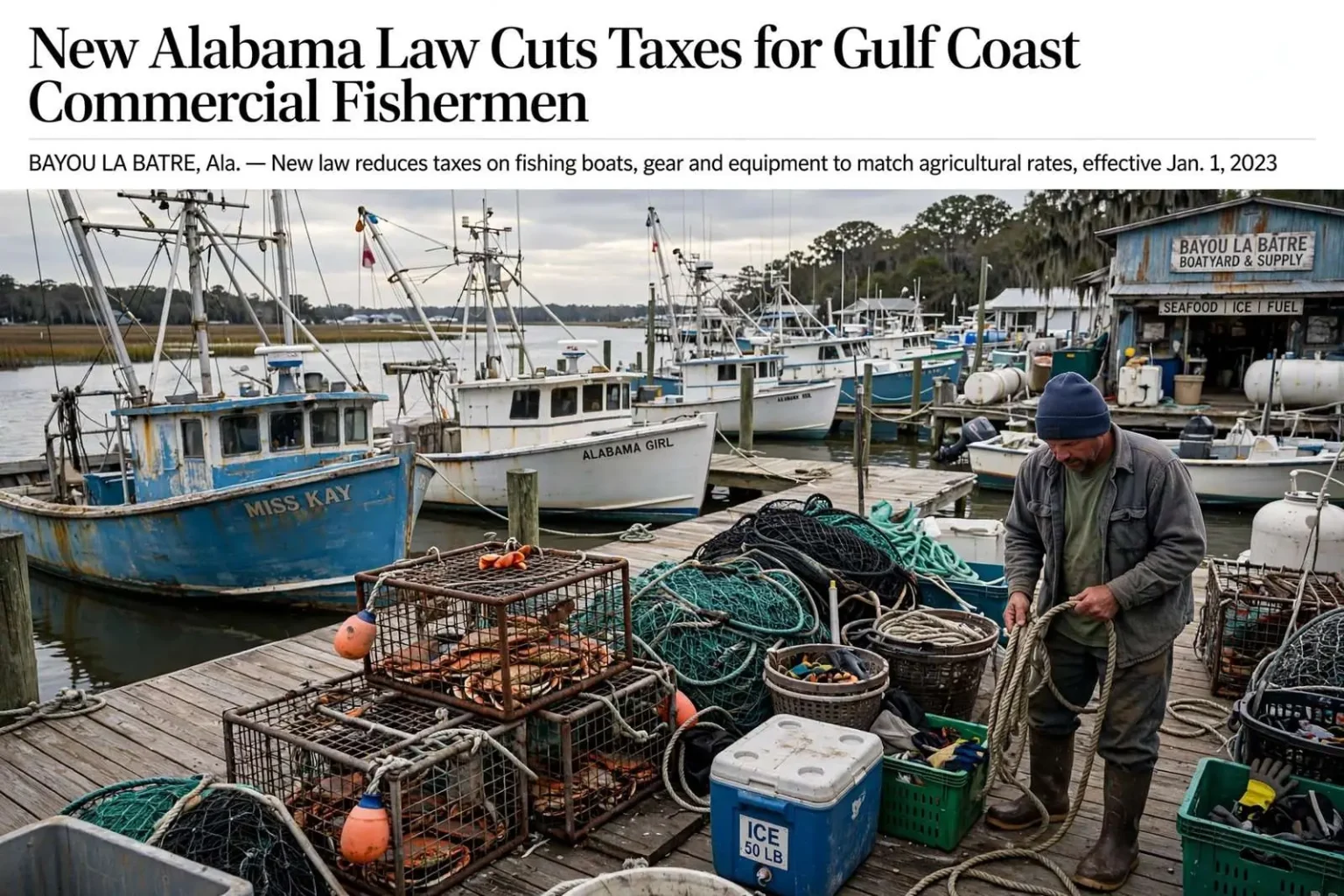
BAYOU LA BATRE, Ala. — Commercial fishermen and seafood businesses along Alabama’s Gulf Coast will soon see significant tax relief under a new state law aimed at putting the seafood industry on equal financial footing with traditional agriculture. Gov. Kay Ivey has signed the legislation, which takes effect Jan. 1, 2023, bringing what supporters describe as long-overdue tax fairness to an industry that has operated for decades under a heavier tax burden than land-based farming.
The measure was sponsored by state Rep. Chip Brown, who represents the Hollingers Island area, and carried through the Alabama Senate by Sen. David Sessions of Grand Bay. Both lawmakers represent portions of Mobile County, home to a large share of Alabama’s commercial fishing fleet and seafood processing operations, including the historic shrimping communities along Bayou La Batre and Mobile Bay.
Bayou La Batre, the small waterfront city best known as Alabama’s shrimp boat capital, anchors an industry that has supplied the state’s docks, processors and restaurants for generations. Its fleet works alongside ports and landings scattered around Mobile Bay and out to the Gulf, supporting oystermen, crab potters, net fishermen and the family businesses that service them — ice houses, boatyards, gear suppliers and seafood houses whose fortunes rise and fall with the fleet’s economics.
Supporters of the bill argue that commercial fishing operations have long been treated as a separate and less-favored category than other food producers, despite feeding the public from public waters at considerable expense and risk. Alabama’s tax code, written primarily around row crops, poultry and cattle, taxed fishing boats and gear as ordinary commercial property and equipment rather than as the tools of an agricultural trade.
What the Law Changes
Under current Alabama law, only vessels used in commercial shrimping qualify for an ad valorem tax exemption. The new law broadens that exemption to cover all forms of commercial fishing operating in the state, including oyster farms and hand-tonging operations that harvest oysters from Alabama’s public reefs and leased water bottoms.
The ad valorem piece matters most to boat owners. A working fishing vessel is taxed annually on its assessed value, and for shrimpers the old exemption had long recognized that a boat tied to the dock in the off-season earns nothing while its tax bill keeps running. Extending that exemption to oyster boats, crab boats, oyster farms and hand-tonging operations equalized the treatment across the fleet — a meaningful shift in an industry where profit margins are measured in single digits and a bad season can erase a year’s earnings.
The legislation also exempts bait, equipment and other materials used by commercial fishing operations from state sales and use taxes. Gear is a running cost in commercial fishing: nets, tong handles, pots, line, deck equipment and the consumables that wear out in salt water all previously carried the full sales tax at purchase. Farmers buying seed, fertilizer and implements had never paid the same burden, and the exemption brought the fisherman’s supply bill in line with the farmer’s.
Additionally, it reduces the sales tax on purchases of commercial fishing vessels, along with the equipment and machinery installed on them, to one-and-a-half percent — matching the rate already applied to farm and agricultural equipment purchases. A new shrimp boat or oyster vessel represents an investment that can run well into six figures, so every point of tax on the purchase price is real money in an industry financed largely through working capital and family credit rather than institutional lending.
A companion provision lowers the excise tax on the storage, use or other consumption of commercial fishing vessels and machinery to that same one-and-a-half percent rate, mirroring treatment given to the rest of Alabama’s agricultural sector. The excise piece catches transactions the sales tax misses — vessels brought into the state, equipment consumed in the business — and closing that gap meant no back door remained for taxing the fleet differently than the farm.
Why the Industry Asked
The equity argument carried the bill. Alabama’s constitution and tax code have treated agriculture as the state’s foundational economy for generations, and the list of exemptions that protect farm equipment, inputs and land is long and deliberate. Fishermen watched that structure work for their land-based counterparts while their own boats — likewise producing food, likewise exposed to weather, likewise subject to seasons and quotas — paid full freight.
The timing reflected an industry under pressure. Gulf seafood competes against imported product that has captured most of the national market, fuel and insurance costs climb annually, and the Alabama fleet has weathered hurricanes, the BP oil spill, and years of regulatory tightening on the oyster reefs. Each squeeze makes the marginal economics tighter for small family operations, and tax relief was the lever state government could pull without touching harvest quotas or federal waters policy.
The bill’s sponsorship map told the political story. Brown’s district around Hollingers Island and Sessions’ home ground in Grand Bay both sit in south Mobile County, where working waterfronts are neighborhood economics — where a vote for the fishing industry is a vote for the marina, the seafood house and the boatyard down the road. Carrying the measure through the Senate from that base gave the bill a pair of sponsors whose constituents would see the benefit directly.
The change also extends to the newer end of the industry. Oyster farming — raising oysters in cages and baskets on leased water bottoms rather than harvesting wild reefs — has grown in Alabama waters as the state and industry have worked to rebuild a fishery decimated by decades of habitat loss, freshwater inflow events and harvesting pressure. Oyster farm operations represent significant capital investment on the water: cages, floats, work boats and handling equipment, all of it previously taxable. Bringing those operations under the same exemptions as wild harvesting put the state’s incentives behind a segment it has been trying to grow, alongside the hand-tongers who still work the public reefs in the traditional manner.
What It Means for the Coast
Effective Jan. 1, 2023, the changes flow directly into the operating budgets of Alabama’s commercial fishing businesses. For a shrimper refitting for the season, the exemption on gear and the lower rate on vessel work translate to dollars that stay aboard. For an oyster farmer expanding a lease, the difference on new equipment lowers the barrier to growth. For the processor buying local product, a healthier fleet means more Alabama-caught seafood moving across the dock.
The fiscal cost to state and local governments is modest by the standards of the state budget, spread across the fleet’s property and purchases rather than concentrated in any one revenue stream, and the argument that carried the bill framed the revenue forgone as investment in a heritage industry whose multiplier runs deep through the coastal economy — docks, diesel, ice, processing, wholesale and the restaurants that sell Alabama seafood under the state’s brand.
For the communities along the bay — Bayou La Batre above all — the law is a statement as much as a tax cut: that Alabama counts its fishermen as farmers of the water, entitled to the same standing in the tax code as anyone who works the land. After decades of asking for parity, the fleet got it in writing, signed by the governor and effective with the new year.
The Industry Behind the Law
Understanding the relief requires understanding what Alabama’s commercial fleet actually is. The state’s seafood industry is dominated by small operators: single-family vessels, husband-and-wife crews, and owner-operators whose boat is simultaneously their workplace, their retirement account and, often, their collateral. Shrimping remains the flagship fishery, with boats working Mobile Bay, Mississippi Sound and the Gulf’s state and federal waters season by season. Around it operate the oyster harvesters working the reefs of the bay’s western edge, crab potters, finfish netters, and the processor houses in Bayou La Batre that give the small boats somewhere to sell.
Every link of that chain felt the old tax structure. The ad valorem bill on a vessel arrived whether the season was good or bad; the sales tax on nets and tong handles came due at the marine supplier’s counter; the purchase of a replacement boat or engine carried the full commercial rate. For land farmers, each of those categories had long since been carved out of the tax base as agricultural necessities. The bill’s sponsors presented the disparity less as a policy disagreement than as an oversight worth correcting — that Alabama had simply never extended to the water the logic it applies to the land.
Coastal legislators have carried versions of fishing tax relief in past sessions without success, and the industry groups that backed the effort this time pointed to the accumulating pressures the fleet had absorbed: imported competition holding dockside prices flat while diesel, ice and insurance costs rose, hurricane seasons that scattered the fleet, and the long recovery from the 2010 oil spill that kept many boats tied up through fishing closures.
The signing put Alabama alongside the other Gulf states in how it treats its fishing industry, and supporters argued the change would pay for itself in a healthier industry — more boats staying in the fleet, more young fishermen able to buy in, and more Alabama product moving through the state’s docks and onto its tables. The fleet’s side of the bargain, as its representatives framed it, is the work it has always done: harvesting public waters, supplying local seafood, and keeping Alabama’s working waterfronts working.