North Mobile County Landowner Got Two Free Driveways From ALDOT, and He’s Not the Only One
State records show ALDOT built two free driveway turnouts for a North Mobile County landowner and newspaper publisher last year, work the agency's own manual says should be billed to the property owner beyond the first driveway.
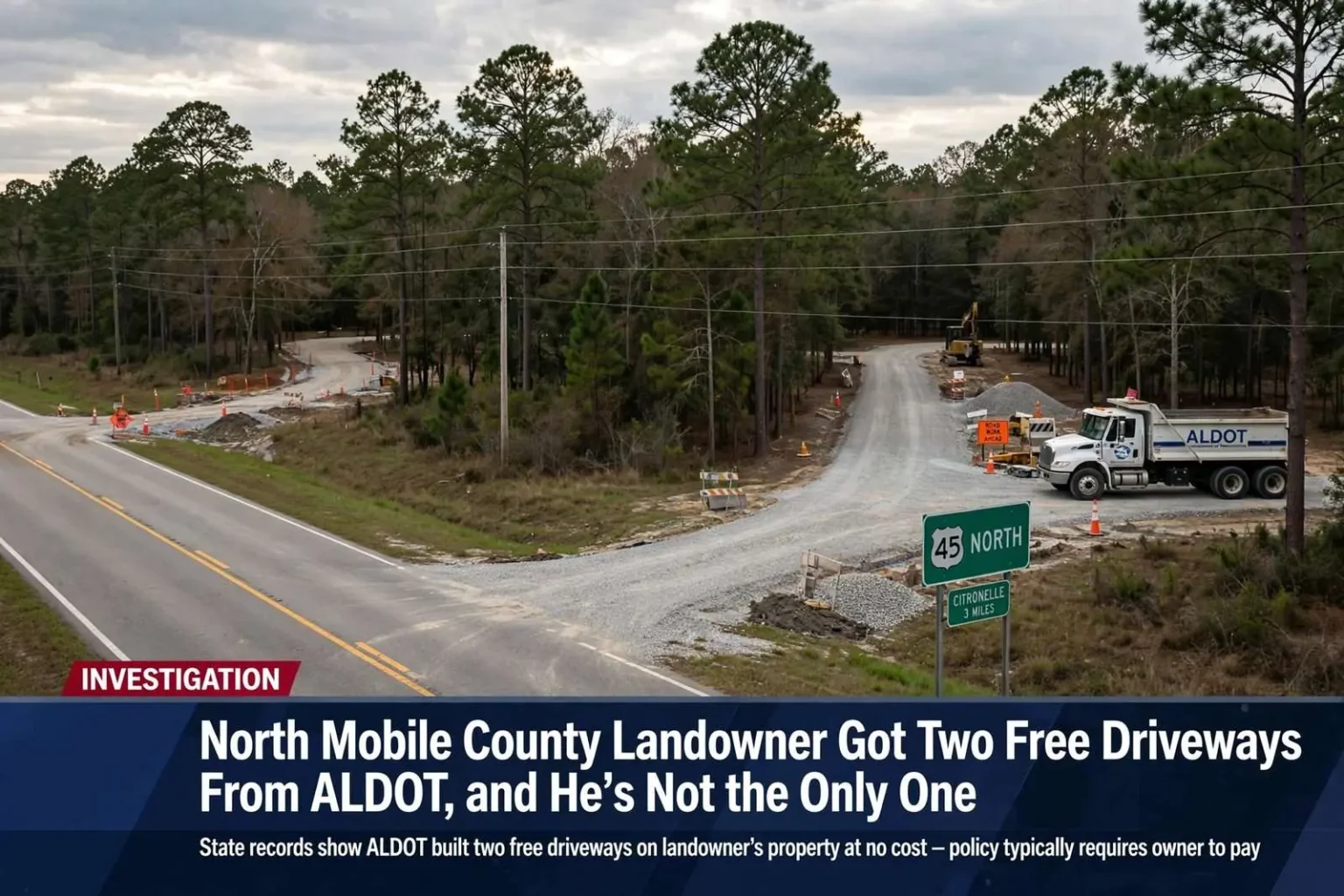
State records show the Alabama Department of Transportation performed thousands of dollars of driveway construction work at no cost to a North Mobile County landowner last year, work that agency policy generally requires private property owners to pay for themselves.
The property belongs to Willie Gray, publisher of Citronelle’s Call News and an unsuccessful 2018 candidate for the Alabama House of Representatives in House District 102. Gray is building a home on roughly 30 acres along U.S. Highway 45, land he owns as three contiguous parcels of about 10 acres each. Twice in 2020, he applied for ALDOT permits to build turnouts connecting his property to the highway across the public right of way, and twice ALDOT crews showed up and did the work for free.
The first turnout was built in February. The second, completed in September just a few hundred feet south of the first, created what amounts to a second driveway for the same home. Records obtained from the agency show the September job alone required five ALDOT vehicles or pieces of equipment, six to seven employees working over two days, more than 18 tons of aggregate soil base and nearly 39 cubic yards of clay. ALDOT put the payroll and equipment cost of that job at $6,175.65, not counting the unpriced soil and clay. Gray was never billed for either turnout.
How ALDOT’s Driveway Policy Works
ALDOT’s own permit manual draws a clear line on who pays for what. Turnouts are defined in the manual as access points connecting public roads to private, publicly owned or commercial facilities, and because they affect drainage and highway safety, a permit is required before any work can begin. For a private entrance, the manual says property owners must furnish their own culvert pipe, and the department may install pipe and backfill up to 30 feet wide for a single driveway on an individual residence, farm field or small church. Beyond that first driveway, the manual is explicit: if a landowner requests and is approved for an additional driveway, that landowner is responsible for the full cost of construction.
ALDOT Region Operations Administrator Jay Palmer described that policy in an interview, using a hypothetical farmer with multiple pastures along a state highway as an example. He said the agency would grant a second driveway to reach a north pasture, but that the farmer would bear the cost of it. The first, primary driveway is what the department installs; anything beyond that, in Palmer’s telling, falls on the property owner.
Asked how that policy squared with Gray’s two free turnouts, ALDOT Public Information Specialist Katelyn Turner said each installation was treated as a first, primary driveway because it was built on a separate parcel. Because Gray’s roughly 30 acres are subdivided into three separate 10-acre tracts, Turner said, each driveway installation counted as the sole entrance for its own piece of property, keeping both jobs within the letter of the permit manual even though they serve the same home under construction.
Gray’s Land and His Account of the Work
County mapping records show Gray’s land carries about 1,200 feet of frontage on the highway and appears, from aerial imagery, to be covered mostly in timber rather than active farm or pasture use, the kind of agricultural operation the permit manual’s driveway allowance seems designed to accommodate.
Gray, reached for comment, offered a different rationale than the one ALDOT provided. He said one of the two turnouts was built for safety reasons because it sits on a hill, and maintained that everything done on his property was within the state right of way and in keeping with the law. He offered to produce his permits and receipts for pipe and other materials he purchased for work beyond the right of way, and did not dispute that ALDOT installed both turnouts without charging him anything.
According to Gray, he contacted ALDOT directly to request both turnouts because he believed private landowners and contractors were not permitted to do the work themselves. He argued that letting the state handle any work within the right of way protects both the landowner and the state, since crews must locate buried phone, water and utility lines before digging, and a private contractor who damaged those lines could create liability problems. He also pushed back on any suggestion that ALDOT built his driveways beyond the right of way and onto his private property, saying the agency only installs pipe within that public strip of land and would be breaking the law to do more.
ALDOT’s Self-Build Option and Statewide Costs
ALDOT does in fact allow landowners and private contractors to build their own turnouts at their own expense, through a separate application and approval process that requires the work to meet the agency’s engineering standards and be signed off on by a district manager. Gray said he purchased his own materials and built roughly 80 to 90 percent of both driveways himself, beyond the sections ALDOT completed within the right of way.
Turner said the free labor Gray received is not unusual. According to her, ALDOT’s Southwest Region, which covers 10 counties, performed 52 turnout installations of this kind last year. If each was priced comparably to the work order for Gray’s second driveway, the region would have absorbed roughly $321,000 in uncompensated labor and equipment costs for private driveway work in a single year.
Local Comparisons and the Broader Question
Local governments handle the same kind of request differently. Mobile County’s Public Works Department has its own driveway permitting process, with separate rules depending on whether the county, the landowner, a commercial applicant or a temporary use is involved. For a new single-family home on a county-maintained right of way, the county will install one driveway access. The city of Mobile does not perform driveway installation work for residents at all, according to a city spokesperson, though it does charge a $51 fee to process a driveway access permit application.
Gray said he would have paid a fee for the work if the state had required one. He said he complied with every requirement ALDOT put in front of him and would have paid more had the state asked for it, but that the decision on pricing and cost recovery for turnout work ultimately rests with the department, not with the landowners who request it.
The episode highlights a broader question for a cash-strapped state agency: how consistently ALDOT applies its own rule that a landowner’s first driveway comes free but any additional access points come at that landowner’s expense, particularly when a single property can be divided into multiple parcels to qualify each new driveway as a first installation under the manual’s terms.