Prichard City Council Calls Emergency Meeting Over Water and Sewer Board Deal
Prichard's City Council has called an emergency public meeting to consider rescinding a resolution tied to negotiations over the city's water and sewer.
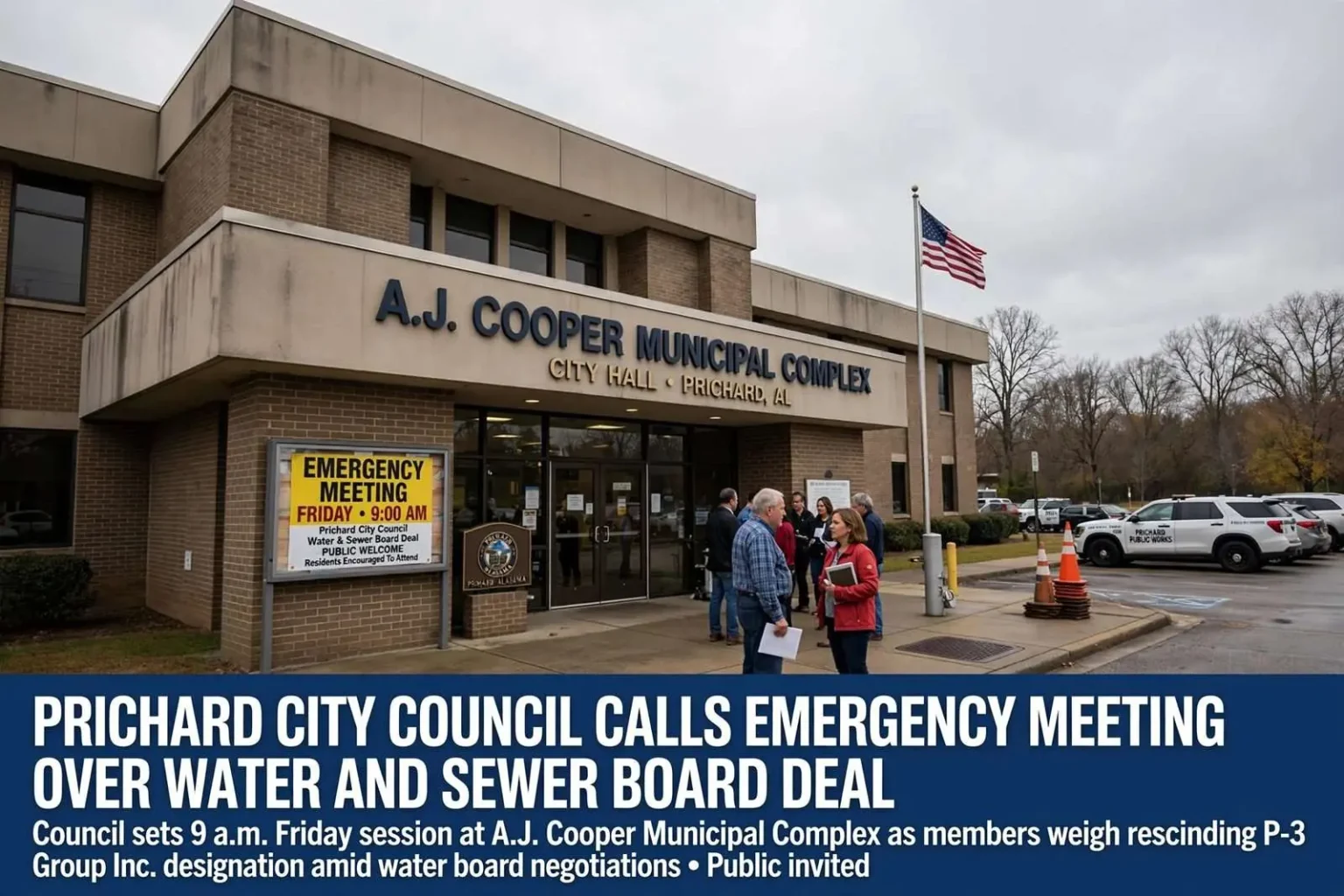
The Prichard City Council has called an emergency meeting to take up urgent business involving the city’s water and sewer board, giving residents a rare same-week opportunity to weigh in on the fast-moving issue. The session puts one of the city’s most consequential civic relationships, the one between the council and the utility that supplies its water, back at the center of public attention.
The meeting is set for 9 a.m. at the A.J. Cooper Municipal Complex and is open to the public. City officials are encouraging Prichard residents to attend, a notable invitation for a specially called session and a sign that the council expects, and perhaps wants, a visible audience when the water and sewer board matter comes to the floor.
At the center of the special session is a proposal to rescind a previous council resolution that had approved, ratified and authorized P-3 Group Inc. to serve as the city’s designated representative for negotiating a comprehensive solution involving the Prichard Water Works and Sewer Board. Rescinding such a resolution would strip the firm of the formal designation the council earlier granted, leaving the city’s representation in the negotiations to be redefined.
That earlier resolution specified that P-3 Group’s role was limited and remained subject to the council’s ultimate and binding authority over any final agreement. In other words, the firm was never empowered to close a deal on the city’s behalf; it was authorized to represent the city’s interests in discussions while the council retained final say over whatever terms emerged. The rescission proposal targets that authorization outright.
Calling an emergency meeting allows the council to bypass the standard notice period typically required for regular sessions, a step reserved for matters city leaders consider too pressing to wait for the next scheduled meeting. Alabama’s open meetings law permits such short-notice sessions only for urgent business, and the council’s decision to use that mechanism signals how quickly members want to revisit the water and sewer board arrangement rather than let the existing resolution stand until a later date.
Why the Water Board Matters in Prichard
Prichard’s water and sewer system has been the subject of ongoing scrutiny in recent years, with city and utility officials working through questions about financing, management and long-term infrastructure needs. The city of roughly 20,000 residents in Mobile County has faced well-documented fiscal struggles over the past two decades, including pension obligations that strained its budget for years, and the utility’s operations have drawn their own share of attention from ratepayers, officials and investigators.
The Prichard Water Works and Sewer Board operates as a separate entity from city hall, but its fortunes are inseparable from the city’s. The board sets rates, maintains lines and treatment capacity and carries debt of its own, and when the utility’s finances falter, the costs surface in customers’ bills and in the city’s broader economic standing. A comprehensive solution to the board’s situation would touch all of those levers at once, which is why the question of who represents the city in those negotiations matters so much.
The council’s decision to reconsider P-3 Group’s designated role suggests city leaders may be recalibrating how negotiations over the water and sewer board’s future are handled going forward. Whether the concern involves the firm’s approach, the terms of its authority, the direction of the talks or the council’s own role in them, the rescission proposal would reset the city’s representation before any final agreement takes shape.
Negotiations between municipalities and utility boards in Alabama can follow several paths: cooperative agreements, service transfers, management contracts, consolidation studies or, in extreme cases, receivership proceedings through the courts. Each path requires a designated negotiator on the city’s side, and each carries different implications for who controls rates, assets and debt in the long run. The council’s original authorization of P-3 Group was a choice among those possibilities; the rescission proposal reopens it.
Emergency sessions also compress the public’s window to react. A regular council agenda is published days in advance, giving residents time to read the resolutions and decide whether to speak. An emergency meeting called within the week gives them days, and for a matter as consequential as the water board’s future, the compressed timeline makes the council’s encouragement to attend all the more significant.
A City Watching Its Utility
Water issues strike close to home for Prichard residents in ways other municipal business does not. Every household in the service area receives a bill shaped by the board’s decisions, and years of rate adjustments, aging lines and questions about the utility’s management have made the water board a recurring topic at city council meetings and a source of persistent frustration for some customers.
The A.J. Cooper Municipal Complex, named for the former mayor who led the city through some of its most difficult years, houses the council chamber where these questions will be debated. Morning sessions are unusual for the council, whose regular meetings typically run in the evening, and the 9 a.m. start time requires working residents to take time off or send their concerns through other channels if they wish to be heard.
The relationship between Prichard’s council and its water board has shifted repeatedly over the years, with different councils taking different approaches to oversight, cooperation and conflict. Some administrations have sought deeper integration between the city and the utility; others have kept the board at arm’s length while pressing for reforms. The rescission proposal fits that long pattern of reassessment, and it arrives at a moment when a comprehensive solution, whatever form it takes, appears to be actively under negotiation.
No further details on the council’s reasoning were immediately available. Emergency meetings often move faster than the public record can capture, and the resolution’s full text and any discussion will become clear only when the council takes it up. What is known is the procedural posture: a previous resolution stands, a proposal to rescind it is on the agenda and the council chose the urgent-meeting route to address it.
Residents with questions about the water and sewer board or the proposed resolution change are encouraged to attend Friday morning’s meeting in person. Public comment rules vary by session, but attendance itself sends a message, and city officials’ unusual encouragement to attend suggests they expect, and may welcome, a full chamber when the vote comes.
What Comes Next
If the council votes to rescind the P-3 Group authorization, the immediate effect would be procedural, ending the firm’s designated role and returning responsibility for the city’s representation to the council or a new designee. The larger questions, the terms of a comprehensive solution, the future structure of the water board, the financial path for the utility’s infrastructure, would remain open and would fall to whatever negotiating arrangement the council approves next.
For a city that has spent two decades rebuilding its finances and its reputation, the handling of the water board question carries weight beyond the meeting room. How the council manages the negotiation, and how openly it manages this week’s emergency session, will shape ratepayers’ trust in both the city and the utility for years to come.
Understanding P-3 Group’s Role
P-3 Group Inc. entered the picture as the council’s chosen representative in negotiations that could reshape the utility’s future. Designated-representative arrangements like the one the council approved are common when a city needs professional negotiation support, outside perspective or capacity that its own staff cannot provide. The earlier resolution’s language mattered: by ratifying the firm’s role while reserving ultimate and binding authority to the council, members kept the final word on any agreement while allowing the firm to speak for the city in working sessions.
Rescinding such an authorization is not merely symbolic. It changes who may sit across the table on Prichard’s behalf and can pause or redirect negotiations that are already underway. Counterparties, whether the water board itself, outside agencies or potential partners in a comprehensive solution, take their cues from a city’s formal designations, and an invalidated authorization forces those parties to wait until the council clarifies its representation again.
The speed of the council’s move is itself informative. Councils typically let designations stand while negotiations proceed and revisit them only when something has changed: the direction of the talks, the performance of the representative, the council’s own composition or the terms on the table. Choosing an emergency session rather than the next regular meeting indicates that members saw a need to act before the negotiations advanced further under the existing arrangement.
Prichard’s history gives the deliberations their backdrop. The city, wedged between Mobile and Chickasaw in Mobile County, has worked to stabilize its finances since the pension crisis that made national headlines more than a decade ago, when the city could not meet its obligations to retired employees. Water and sewer infrastructure, much of it aging and expensive to maintain, has remained one of the persistent pressures on the city’s recovery, and the water board’s finances have periodically threatened to complicate the city’s own.
A comprehensive solution to the utility’s situation, the phrase used in the original authorization, could take many forms. Consolidation of services with a neighboring system, a management contract with a larger operator, a refinancing plan, a rate restructuring or a governance overhaul each has precedent in Alabama, and each demands a designated negotiator with clear authority. The council’s task this week is to decide who carries that authority forward and on what terms.
For residents, the practical stakes come down to reliability and cost. Water service failures, line breaks and rate increases all trace back to the decisions now being negotiated, and the council’s handling of its representation in those talks determines whose voice shapes them. Friday morning’s session offers the public its closest look yet at that process, and the council’s invitation suggests members understand that a water board deal made without public scrutiny is a deal likely to be questioned long after it is signed.