Satsuma First Responder Tests Positive for COVID-19 Antibodies, Negative on Follow-Up Swab
A member of Satsuma's roughly 30-person first responder team tested positive for coronavirus antibodies but negative on a subsequent COVID-19 nasal swab test, Mayor Tom Williams said.
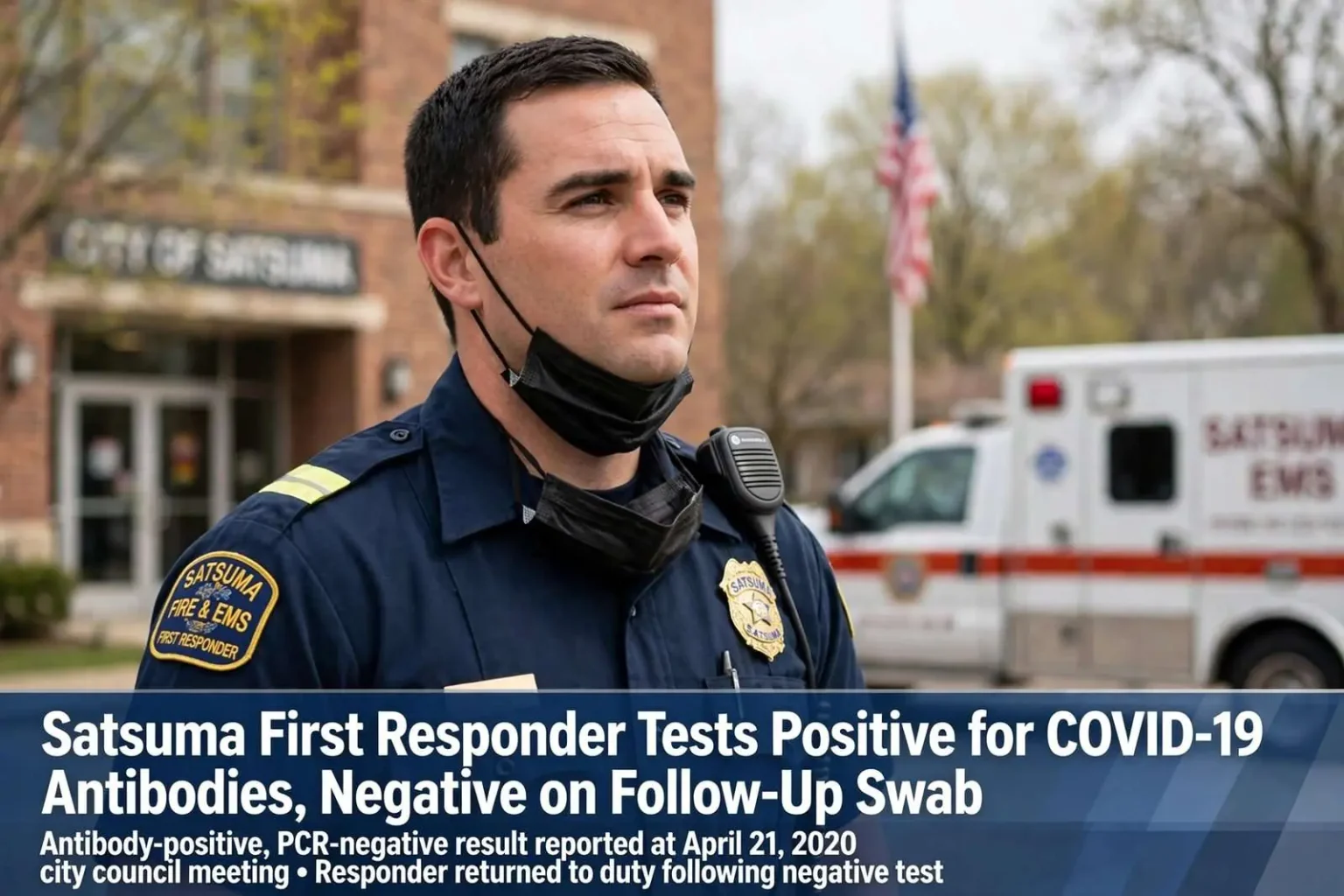
A Satsuma first responder tested positive for coronavirus antibodies but negative for active COVID-19 infection, according to results discussed at the City of Satsuma’s April 21, 2020, city council meeting — a result that city leaders treated as both a relief and a lesson in what the science could and could not tell them during the pandemic’s uncertain first spring.
The positive antibody result surfaced during the city’s examination of its roughly 30-member first responder team, the combined police, fire and emergency medical workforce that keeps the small northern Mobile County city covered around the clock. As COVID-19 spread through the Gulf Coast that April, Satsuma’s leaders joined municipalities across the region in trying to answer the question every department was asking: which of their people had already been exposed to the virus, and which ones were carrying it?
Satsuma Mayor Tom Williams told the council that after the responder’s positive antibody test, the individual was given a COVID-19 nasal swab test to check for active infection. That follow-up test came back negative, and the employee has since returned to work as a first responder, clearing the way for the city to keep its coverage intact without a quarantine period.
What the two tests actually measure
The distinction between the two tests was central to how the city handled the case, and it was a distinction most Americans were learning on the fly that spring. An antibody test — a blood test, in most cases — looks for the immune system’s response to the virus: the proteins the body produces after an infection, whether or not the person ever felt sick. A nasal swab test, typically a PCR-based diagnostic, looks for the virus itself, detecting an infection that is active at the time the swab is taken.
An antibody-positive, swab-negative result like the one reported in Satsuma suggested possible past exposure to the virus without an active infection at the time of testing. In practical terms, it meant the responder was not considered infectious and could return to duty — the outcome the city wanted. But it also came with a caution that health officials were repeating nationwide: antibody tests available in the pandemic’s early months were still considered less reliable than PCR-based diagnostic tests for confirming active cases, and the science on whether antibodies conferred immunity, and for how long, was still being worked out.
False positives were a particular concern with early antibody tests, some of which had been rushed to market under emergency authorizations without the validation that standard diagnostics undergo. A positive antibody result could mean prior infection — or it could mean the test had reacted to antibodies from other coronaviruses, the family of viruses that includes the common cold. That uncertainty is why the follow-up swab mattered: it confirmed the responder was not actively infected regardless of what the antibody result meant for the past.
How the city learned of the result also said something about how the pandemic was managed locally. Rather than a personnel matter handled behind closed doors, the case was discussed in an open council meeting, with the mayor walking the council and the public through the sequence — antibody test, confirmatory swab, negative result, return to duty. In communities the size of Satsuma, transparency carried practical weight: residents who knew the department was testing its people, and that procedures were being followed, had reason to keep calling 911 without hesitation and to trust the responders who arrived.
Screening the first responder ranks
The testing effort reflected a broader push among South Alabama municipalities in the spring of 2020 to screen police officers, firefighters and other emergency personnel for coronavirus exposure, given the close contact those workers often have with the public. Police officers answered calls in living rooms and pulled drivers over within arm’s reach; firefighters and medics treated patients whose infection status nobody knew. An outbreak inside a small department could take an entire shift off the street at once, and in a town the size of Satsuma there was no neighboring department with spare bodies to cover.
Mobile County’s smaller municipalities faced the dilemma in its sharpest form. Cities such as Satsuma, Creola and Chickasaw maintained forces measured in dozens rather than hundreds, and each of them sat within the metro area’s web of daily travel — responders who commuted in from Mobile or Saraland, shopped in the same stores and served the same crowded highways. A department could do everything right inside its own walls and still absorb a case from the community through a single responder’s weekend. Screening programs, symptom checks and eventually the antibody tests discussed at the Satsuma council meeting were all attempts to see that risk coming before it emptied a shift.
The costs of the pandemic reached these departments in other ways too. Dispatch volumes shifted as residents put off minor calls and waited on others, medical calls tied to the virus added new protocols to every run, and departments that funded themselves partly through service fees saw the pandemic disrupt the finances alongside the schedule. City councils across the county spent those spring meetings, like Satsuma’s April 21 session, working through operational questions that no governing body had ever planned for.
A small city’s coverage problem
Satsuma, a small city in northern Mobile County, relies on a compact first responder team to cover police, fire and emergency medical needs for the community, making the health and availability of that workforce a particular focus for city leaders as COVID-19 spread through the region in the spring of 2020. The city’s roughly 30 first responders were not an abstract statistic to residents — they were the officers who answered the door on a domestic call, the firefighters who arrived at a house fire, the medics who ran the ambulance on the response that mattered most.
The math of a small department made each case consequential. Lose a handful of responders to quarantine and a city the size of Satsuma faces the prospect of mutual aid from neighboring departments adding minutes to emergency response times, minutes that matter in cardiac arrests and structure fires. That risk is why municipal leaders across Mobile County spent the spring of 2020 doing arithmetic that big-city departments rarely had to consider: how many people could be out sick before coverage broke?
The pandemic also changed how the work itself was done. Departments adopted screening at shift changes, masking on calls where possible, disinfecting of patrol cars and ambulances between patients, and protocols for handling callers who reported symptoms consistent with COVID-19. Personal protective equipment was scarce nationwide in those months, and smaller departments often waited longest for shipments, which made keeping responders healthy through prevention — including testing — all the more urgent.
Where antibody testing fit in
In April 2020, antibody testing carried a double appeal for municipalities: it could identify workers who might have some protection, and it offered a rough map of how far the virus had already spread through a community. Some departments hoped antibody results could guide duty assignments, putting potentially immune responders on the front lines of COVID calls. Public health officials tempered those hopes, noting that the immunity question was unresolved and that the tests’ accuracy varied widely by manufacturer.
The Food and Drug Administration tightened its oversight of antibody tests that spring, and the Centers for Disease Control and Prevention cautioned that results should not be used to make decisions about returning people to work in groups or changing protective practices. Satsuma’s approach — treating the antibody result as a signal to be confirmed with a diagnostic swab rather than a basis for relaxing precautions — aligned with that guidance, even if the city’s practical outcome, a responder back on duty, was the one every department wanted.
What the meeting captured
The April 21, 2020, council discussion captured a moment when municipal government was improvising public health policy with incomplete tools. Mayors and councils across Alabama that month were balancing closed city halls, suspended services and shrinking sales tax revenue against an emergency that changed weekly. For Satsuma, the first responder’s results were a small, contained episode — one employee tested twice, cleared and returned to work — but the episode illustrated the framework the city would rely on for the rest of the pandemic: test, confirm, isolate when necessary, and keep the emergency coverage whole.
In the months that followed, testing capacity expanded, turnaround times shrank and vaccines eventually arrived to replace much of the uncertainty that spring. But in April 2020, the best a small city could do was exactly what Satsuma did: screen its front-line workers, follow up on ambiguous results, and lean on the reliability of its people to keep answering the calls while the science caught up with the crisis.