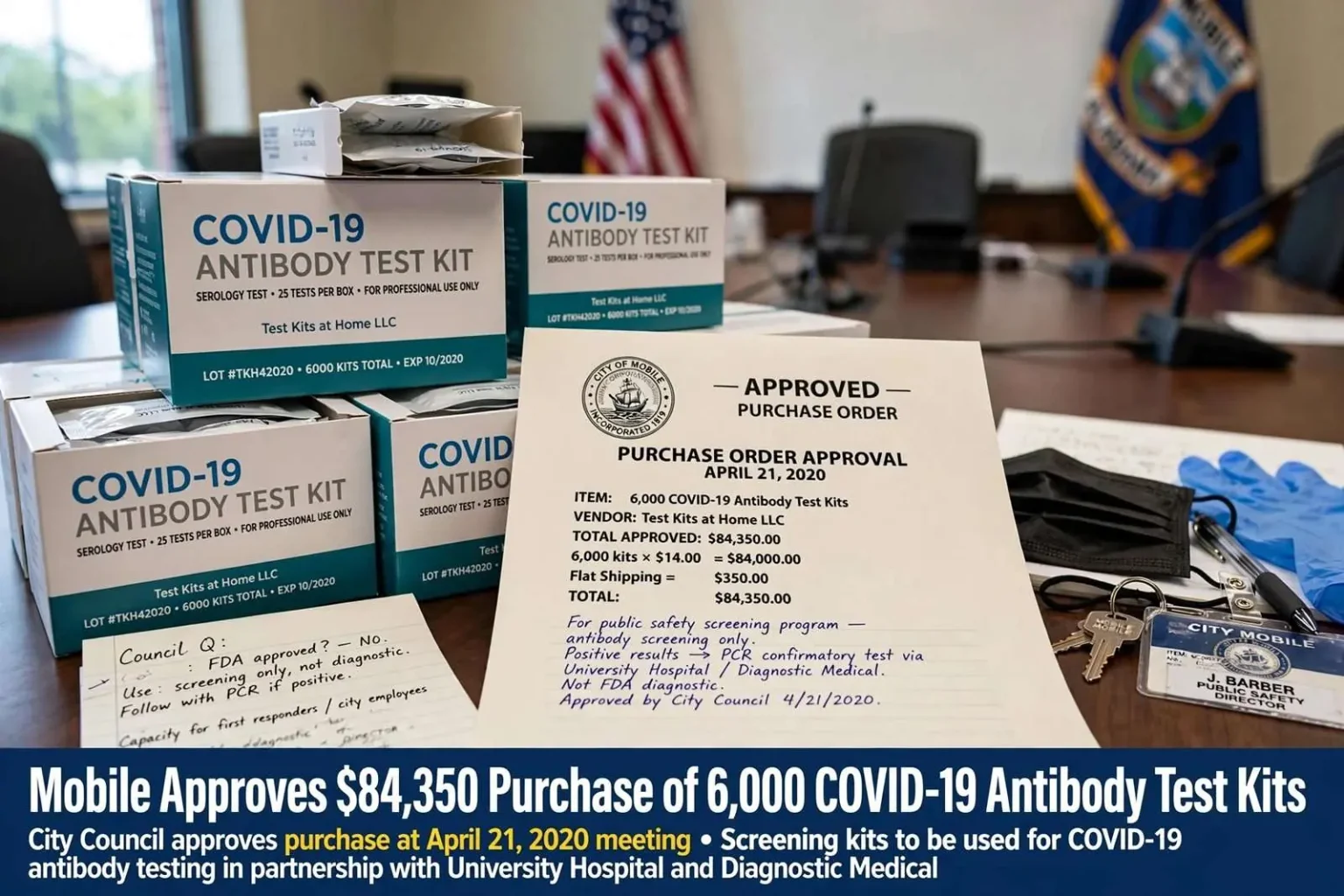
The Mobile City Council approved a purchase order for 6,000 COVID-19 test kits at its Tuesday meeting on April 21, 2020, agreeing to pay Test Kits at Home LLC $84,350 for the order. Under the terms of the purchase, the city will pay $14 per test kit plus a flat $350 shipping charge.
The purchase was one of five COVID-19-related items council members took up for immediate consideration during the meeting, part of a scramble by cities across the Gulf Coast that spring to secure whatever testing capacity could be found on a market where supply chains had not yet caught up with demand. Councilwoman Bess Rich asked whether the kits were approved by the U.S. Food and Drug Administration. Mobile Mayor Sandy Stimpson said they were not.
Rich followed up by asking how the kits would be used in the community, noting that PCR testing remained the standard diagnostic test for the virus. Stimpson clarified that the kits were intended as screening tools rather than diagnostic tests, distinguishing them from PCR tests — an exchange that captured the confusion, shared by city councils and the public alike, over what the new wave of antibody tests could and could not do in the pandemic’s first months.
The city’s explanation of the screening plan
Public Safety Director James Barber told council members there had been some confusion about the difference between antibody tests and PCR tests and how each would be used. He said the city had partnered with Diagnostic Medical and University Hospital to provide trained medical personnel to administer the antibody screenings.
“We have partnered up with Diagnostic Medical and University Hospital to provide those personnel who are administering the antibody screening, so if you do come back with a positive reading that’s when we go to the PCR; so we’re not using it as a diagnostic tool, because it is not approved as an FDA diagnostic tool,” Barber said. “The only approved diagnostic tool is the PCR test and so if you do show antibodies we’ll use the PCR test to see if you are asymptomatic or a carrier of the COVID-19 virus. That’s the only way we can determine it. But I think you’re going to see antibody testing get qualitative and quantitatively better because we have more machinery coming in.”
The arrangement put the medical interpretation of the results in the hands of trained personnel rather than city staff, and built the PCR follow-up into the workflow from the start: a positive antibody reading would trigger a confirmatory diagnostic test, not a diagnosis in itself. Barber’s remarks to the council laid out that two-step sequence in detail, pre-empting the concern that screening results might be mistaken for proof of immunity or infection.
What antibody tests do — and don’t — show
Antibody tests, known medically as serology tests, look for the immune system’s response to the virus rather than the virus itself. A blood sample is examined for the proteins the body produces after an infection, which means a positive result generally indicates a person was exposed at some point — not that the virus is currently present. PCR tests, by contrast, detect the virus’s genetic material in an active infection and were, at the time, the only method approved to diagnose COVID-19.
In April 2020 the distinction mattered enormously. The pandemic was in its first wave, testing capacity nationwide was severely constrained, and public health officials were desperate for any tool that could estimate how widely the virus had already spread through a community. Serology tests promised exactly that — a way to find people who had been infected without ever knowing it — but many early products had reached the market without full FDA review, and their accuracy varied widely.
That was the landscape behind Rich’s question. A city spending $84,350 on a test the FDA had not approved as a diagnostic was, in effect, buying a public health screening instrument, and the council’s debate turned on whether the money would produce usable information. Stimpson and Barber’s answer was yes, provided the results were used the way the administration described: as a first filter that would route positives to PCR confirmation.
Why the number mattered
The math of the purchase — 6,000 kits at $14 each, plus $350 in shipping — reflected both the scarcity and the volume the city was aiming for. Six thousand screenings could cover a meaningful slice of the city’s workforce, first responders and high-contact residents, and the per-kit price was comparable to the spot rates cities were paying nationwide as laboratories, states and the federal government all competed for the same manufacturing capacity.
Mobile, like cities across Alabama, had spent the previous weeks closing public facilities, canceling events and shifting employees to remote work under state health orders. Testing capacity was the missing piece in every plan: without knowing who carried the virus, officials were making closure decisions blind. The council’s willingness to move quickly — taking up five COVID-related items for immediate consideration in a single meeting — reflected that urgency.
The purchase also positioned the city for what Barber predicted would be a rapidly improving market. Antibody testing technology was evolving week to week in spring 2020, with better machinery arriving at laboratories across the country, and cities that had staff trained to administer screenings would be ready as the products improved.
Screening the people who keep the city running
Administering 6,000 screenings required the partnership Barber described because the kits were not self-contained at-home diagnostics in any medically meaningful sense. Blood samples had to be drawn and read by trained personnel, results had to be explained, and positive readings had to be routed into confirmatory PCR testing. University Hospital, as the region’s major public hospital, and Diagnostic Medical provided that clinical layer, sparing the city from assembling its own medical operation from scratch.
First responders were an obvious priority population. Police officers, firefighters and paramedics had continued working face-to-face with the public through the stay-at-home period, and an exposure that sidelined a shift’s worth of personnel was among the scenarios city planners feared most. Screening that population was both a safety measure for the workers and a continuity measure for the services they provided.
The spring 2020 testing push reflected a broader push by Mobile officials to expand the city’s COVID-19 testing capacity even as national supplies of testing materials remained strained and guidance from Washington shifted week to week. Cities that moved early on purchases often faced criticism when products fell short of expectations; Mobile’s answer, as laid out to the council, was to buy the screening capacity while insisting on the confirmatory PCR step that made the results actionable.
The April 21 approval captured the moment in miniature: a city council, unable to wait for the federal supply chain, spending local money on an imperfect tool, with its administration explaining on the record exactly what the tool could not do. The 6,000 kits were one purchase among five taken up that evening — one more piece of the improvisation with which American cities fought the pandemic’s first spring.
The meeting itself was a product of the era. Council sessions in spring 2020 were conducted with social distancing and streamlined agendas, and the five COVID-19 items taken up for immediate consideration bypassed the usual committee process — a procedural accommodation cities across the country adopted so purchases could be made at pandemic speed. Items that might once have drawn weeks of review were approved in a single afternoon, with questions like Rich’s serving as the standing check on the administration’s judgment.
Rich, the council’s longtime voice on fiscal detail, was known for probing the specifics of city contracts, and her line of questioning — approval status, then intended use — traced exactly the concerns the FDA itself was raising about unapproved serology products at the time. The exchange gave the public record a clear statement that the city understood the tests’ limits before spending the money.
Test Kits at Home LLC, the vendor, was one of many companies that appeared almost overnight in 2020 to broker testing supplies, and cities evaluating such vendors had to weigh price, availability and reliability with little history to guide them. The $14 per-kit price and $350 flat shipping made the Mobile order small by national standards but real for a municipal budget operating under emergency conditions.
What happened after the purchase was the story of the pandemic itself: screening programs evolved, PCR capacity grew, and the antibody tests of April 2020 — like the emergency meeting that approved them — became an artifact of the crisis’s first act. The council minutes from that Tuesday record the vote, the price and the caveats; the wider record, built over the months that followed, showed a city adapting in public, one purchase order at a time.