A Dozen Spanish Oak Inn Tenants Sign With an Attorney as a Tax Lien Adds to the Uncertainty
After residents described days without running water, an attorney says at least a dozen tenants have signed agreements while he reviews potential claims. A separate tax lien on the property has raised questions — though officials say it does not put residents at immediate risk.
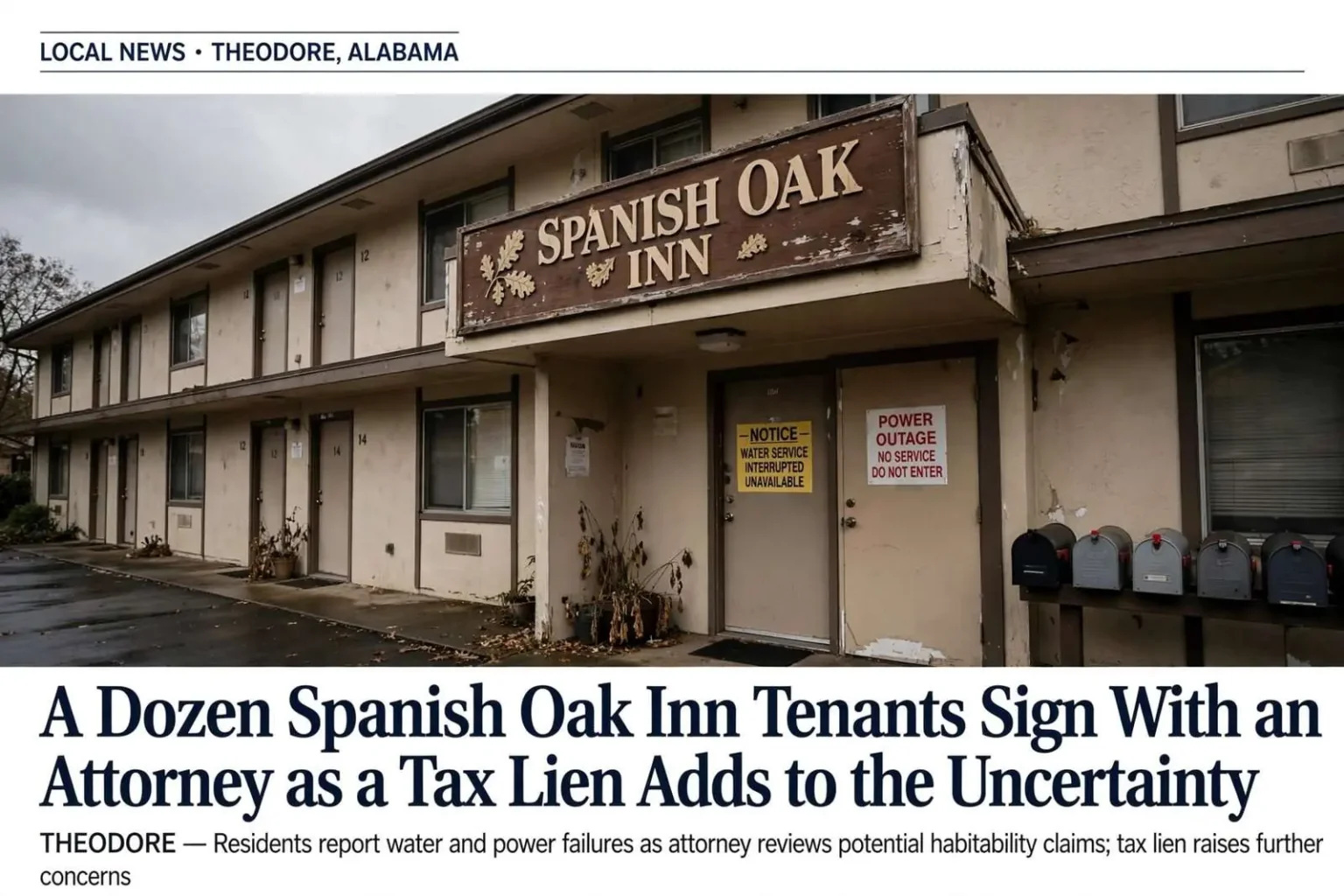
THEODORE — After residents at Spanish Oak Inn spoke publicly about water and power failures at the complex, an attorney says at least a dozen tenants have signed agreements with him as he reviews potential legal claims against the property.
More than six residents came forward last week describing days without running water. Some also described ongoing power problems, water that ran cold or looked dirty once service returned, and fears that they could be forced from their homes. All residents interviewed asked to remain anonymous.
What the Potential Claims Involve
Attorney Cody Poe said the claims under review center on habitability, essential utilities and alleged wrongful evictions.
“Particularly what we’re focusing in on is habitability — making sure that reasonable utilities are installed and in place,” he said. “A lot of our claims [are] built around that wrongful eviction, invasion of their rights as tenants to quiet enjoyment of the property, breaches of contract, things like that.”
Poe emphasized that the claims are still being investigated and have not been proven in court. No lawsuit has been filed.
What Alabama Law Requires
Under Alabama’s landlord-tenant law, landlords are generally required to maintain electrical and plumbing systems and to provide running water and reasonable amounts of hot water, with limited exceptions. Those obligations appear in Alabama Code § 35-9A-204.
The statute is the legal foundation beneath the word “habitability.” It establishes that certain services are not amenities a landlord may elect to provide but duties attached to the tenancy itself. When a complex goes days without running water, the question a court would examine is whether that duty was met.
The second concept Poe raised — quiet enjoyment — is a related but distinct tenant right. It refers to a tenant’s entitlement to possess and use the rented property without unreasonable interference from the landlord.
The Rule Against Self-Help Evictions
Residents have said they fear management could remove them from their apartments. Poe said some of his clients had already been put out before they hired him.
Alabama law does not permit a landlord to remove tenants through what is known as a “self-help” eviction — ordering them out or changing the locks without going through the court process.
“Alabama is pretty clear that no self-help evictions are allowed,” Poe said. “You have to have an order from a judge, and only the sheriff is the one who can come out and remove somebody from a property through our legal process.”
The rule exists because eviction transfers possession of a home, and the law reserves that power to a court rather than to one party in a private dispute. A landlord who believes a tenant should be removed must file, obtain a judgment and have a sheriff execute it.
Why Getting Back In Is Difficult
Poe said families who have already been removed face an immediate and practical problem: returning to their homes is not simple, even when they later pursue legal action.
“You’re kind of limited in what you can do immediately,” he said. “I think that lawsuit, frankly, is the only legal remedy that you have. To go back and get you back into the place, there’s not a ton that can be done outside of filing a lawsuit.”
That gap between a right and a remedy is a recurring feature of housing disputes. A tenant removed improperly may have a valid claim, but the claim moves at the pace of litigation while the housing need is immediate.
“They need and deserve a place where they can lay their head down at night knowing that it’s not going to be ripped out from under them,” Poe said. “Justice looks like what we all want — to be at peace in our homes.”
The Tax Lien, and What It Does Not Mean
A tax lien associated with Spanish Oak Inn also surfaced. Tyler Pritchett, an attorney for the Mobile County Revenue Commission, said the lien resulted after the property owner did not pay last year’s property taxes.
The lien went to a tax-lien auction in May 2026, Pritchett said, and an investor purchased it.
“All that means is that the property owner didn’t pay his taxes last year,” Pritchett said. “They went into the tax lien auction, which happened in May of this year. There was an investor that purchased the lien on it.”
Pritchett was direct that the lien does not create an immediate eviction process for residents. The owner can still pay the delinquent taxes. An investor could not move into circuit court to begin foreclosure proceedings until four years after the May 2026 auction.
“From the Revenue Commission and a taxation [standpoint], they have nothing to worry about,” Pritchett said of residents. “The management needs to pay — or the owner needs to pay — the property taxes and get them current.”
The distinction matters for tenants trying to assess their risk. A tax lien is a claim against the property for unpaid taxes, purchased at auction by an investor who is effectively buying the right to collect. It runs on a statutory timeline measured in years, and it operates separately from any landlord-tenant dispute. The four-year window Pritchett described means the lien is not the pressing question facing residents today.
Where Things Stand
Spanish Oak Inn management has been repeatedly asked for comment and has not responded.
For now, the tenants’ claims remain under investigation, no suit has been filed, and the property’s tax delinquency remains curable by the owner. What residents described — extended outages of water and power in occupied housing — is the fact pattern that any eventual filing would be built around.