
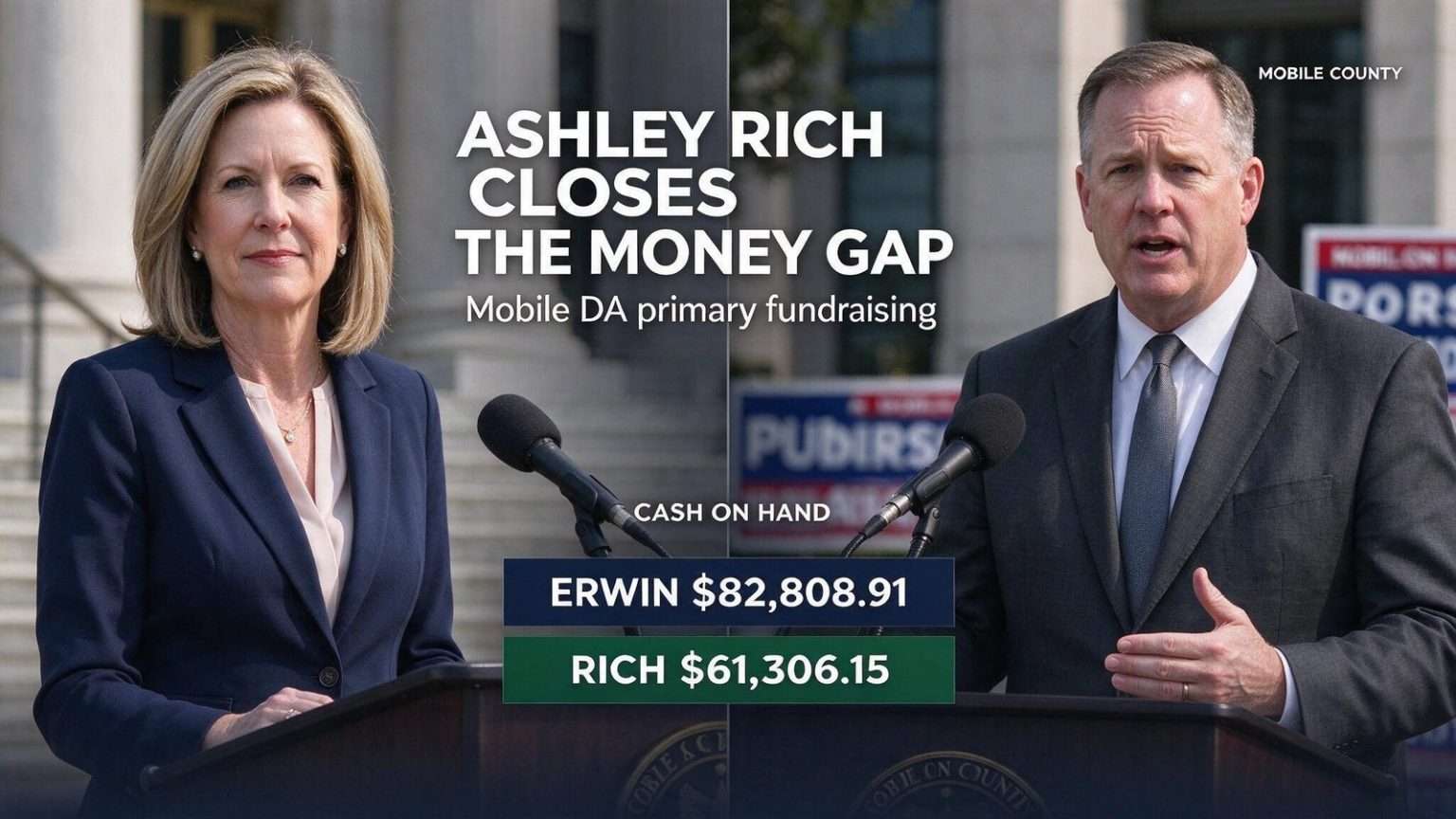
Assistant District Attorney Ashley Rich has narrowed the money gap smartly in her contest with Mark Erwin for the Republican nomination for Mobile County district attorney, according to campaign financial disclosures filed ahead of the June 1 primary. The ledger shows Rich reported contributions totaling $90,895 for the period. Erwin raised $70,290 over the same stretch — but Erwin, who entered the race well ahead of the assistant district attorney, began the period with a balance of almost $35,000 already banked from his earlier start.
The result is that with less than six weeks to go before the June 1 primary, Erwin still holds the advantage in the bank: an ending balance of $82,808.91 against Rich’s $61,306.15. Both candidates have enough to contest the stretch run energetically. Neither has enough to coast. In a countywide race that will be decided in a low-turnout primary, where a few thousand votes can separate the winner from the loser, the final weeks of television, radio and direct-mail spending are expected to matter, and both camps now have the resources to make themselves heard.
The primary is the decisive contest this year. Mobile County remains a Republican-leaning county in statewide and local races, and the winner of the Rich-Erwin matchup will carry the party’s banner into the November general election against a Democrat. That arithmetic has made the GOP primary the race that donors from both parties’ orbit are watching, and the disclosures capture a contest that has become genuinely competitive in both money and message.
Why Erwin got a head start
Erwin, a former chairman of the Mobile County Republican Party and a municipal judge in Saraland, announced his campaign last fall. That early entry gave him months to accumulate contributions and build a network of party loyalists before a serious opponent appeared, and it explains why he began the most recent reporting period with a five-figure cushion despite raising less money than Rich over the same stretch of the calendar.
Rich, who is also a member of the Mobile County Republican Executive Committee, waited — because her boss had not yet decided what he would do. Longtime District Attorney John Tyson Jr., a veteran Democrat who has held the office since 1994 and who hired Rich in 1996, ultimately backed away from a re-election bid and accepted an appointment from Republican Gov. Bob Riley to head the governor’s task force on illegal bingo. Rich, who now heads the office’s murder team, entered the race after that decision was made.
The delay cost Rich months of fundraising time but gave her campaign a different kind of asset: the endorsement, tacit and financial, of the incumbent she served. Tyson’s decision to step aside rather than seek another term reshaped the race overnight, converting what had shaped up as a potential general-election rematch into an open-seat contest decided inside the Republican primary.
Over the years, a series of controversial investigations and prosecutions with political implications appeared to sap Tyson’s political strength, both among his Democratic base and among the independents who had made him the only Mobile County Democrat holding a non-judicial countywide elective office. Three local circuit judges still hold their seats as Democrats, but the DA’s chair was the last countywide executive office in Democratic hands, and Tyson’s exit effectively handed control of it to whichever Republican emerges from the primary.
The November matchup
Former U.S. Attorney Don Foster has qualified to run as a Democrat and will meet the Republican nominee in November. Foster served six years as the region’s top federal prosecutor during the administration of President Bill Clinton, overseeing federal criminal casework across southwest Alabama, and he gives down-ticket Democrats a credible name at the top of what is otherwise a difficult map for the party in Mobile County.
Whoever wins the primary inherits a formidable general-election opponent and a demanding job. The district attorney’s office prosecutes every felony case in Mobile County, from capital murder to economic crime, and supervises a staff of prosecutors and investigators spread across the county courthouse. The office’s murder team, which Rich has led, handles the county’s most serious homicide prosecutions, and its caseload is among the largest in the state.
For voters, the primary campaign has effectively been a debate about succession: whether to elevate the sitting administration’s second-in-command or to install a Republican Party figure with no ties to the current office. The fundraising patterns tracked that split, with each candidate drawing support from overlapping but distinct corners of the city’s professional and political establishment.
A boss who writes checks
Tyson, who remained a Democrat as of Wednesday, April 21, was among the larger contributors to his own assistant’s campaign. He and his wife, Beth, gave Rich $2,000. For a Democratic incumbent to finance a Republican successor’s primary bid is unusual on its face, but it underscored how completely the succession question had been settled inside the office before the qualifying deadline.
Other contributions carried unusual wrinkles. Former City Councilwoman Bess Rich — no relation — and businessman Elliot Maisel gave to both campaigns. Former Mayor Mike Dow backed Erwin with $1,000, while Dow’s partner and brother-in-law Jim Busby gave Rich $500. The plaintiff’s firm Cunningham Bounds gave Erwin $2,500, an amount neatly offset by associate Greg Breedlove’s $2,500 donation to Rich.
In other words, a good deal of the Mobile establishment declined to choose. Hedged giving is a familiar feature of local races, where attorneys, developers and business owners anticipate needing to work with the district attorney’s office regardless of who occupies it. The disclosures suggest that many donors expected the race to be close and wanted a foothold with both candidates.
Who gave what
Rich’s contributor list runs deep into the professional and civic classes: physicians, lawyers, seafood companies, boat builders, real estate interests and a long tail of $100 and $250 donors. Her single largest source was DA-PAC, which passed along $18,000 — nearly all of its receipts. The PAC’s own funders included the firm Eiland and Ritchie ($5,000), the SSI Group ($5,000), General Insulation, Graham Shrimp Co., Dobson Sheet Metal and Roofing, and several individual donors.
DA-PAC’s role highlights a peculiarity of Alabama campaign finance: political action committees formed around a candidate’s profession can concentrate giving from dozens of individual contributors into a single, legally distinct transfer. In practice, the $18,000 from DA-PAC represented bundled support from members of the local prosecutorial and legal community, giving Rich a fundraising channel her rival could not easily duplicate.
Erwin’s list is heavier on firms and PACs: Cunningham Bounds, Bancorpsouth Bank PAC, RSVPAC, Volkert & Associates, Sonny Callahan and Associates, Delaney Development, Pollman’s Bake Shop, and a run of $500 and $1,000 contributions from Mobile businesses and attorneys. The mix reflects his dual identity as a party insider and a sitting municipal judge in Saraland, with access both to organized Republican money and to the business community of north Mobile County.
Erwin’s ties to the county party organization he once chaired give him a turnout operation that money alone cannot buy. In a primary decided by a small share of registered voters, identification of reliable Republican voters and the ground game to reach them can matter as much as the size of a campaign account, and Erwin’s years atop the local party built precisely that kind of network.
The stretch run
The final six weeks will test both theories of the race. Rich has the fundraising momentum, the prosecutorial résumé and the incumbent’s quiet blessing. Erwin has the party infrastructure, an earlier start and more money in the bank. Both will spend most of it before June 1, with direct mail and broadcast advertising likely to consume the bulk of the balances they now hold.
What the numbers make clear is that neither campaign can afford to cede the airwaves. With ending balances within about $21,500 of each other and more than $60,000 apiece available, the primary should reach voters through multiple channels in the campaign’s closing days — a level of saturation unusual even for an open countywide seat in Mobile County.
The money chase also reflects how expensive countywide communication has become. A modest broadcast flight in the Mobile market, paired with targeted digital advertising, can consume tens of thousands of dollars in weeks, and both campaigns began the stretch run knowing their April totals would need to carry them through May with little expectation of late money arriving in volume.
For Mobile County voters, the stakes extend beyond personality. The next district attorney will set charging priorities, manage relationships with municipal police departments across the county, and steer an office that has been led by one Democrat for a generation. The June 1 primary will, in practical terms, decide who takes that office in January — and the money already raised shows both candidates intend to make the argument all the way to Election Day.


