Economist Says Delays on New Mobile River Bridge Are Costing Commuters Hundreds of Millions a Year
A local economist's analysis finds that unresolved delays in building a new I-10 Mobile River Bridge are costing area commuters tens of millions of hours and hundreds of millions of dollars a year in lost time, fuel and income.
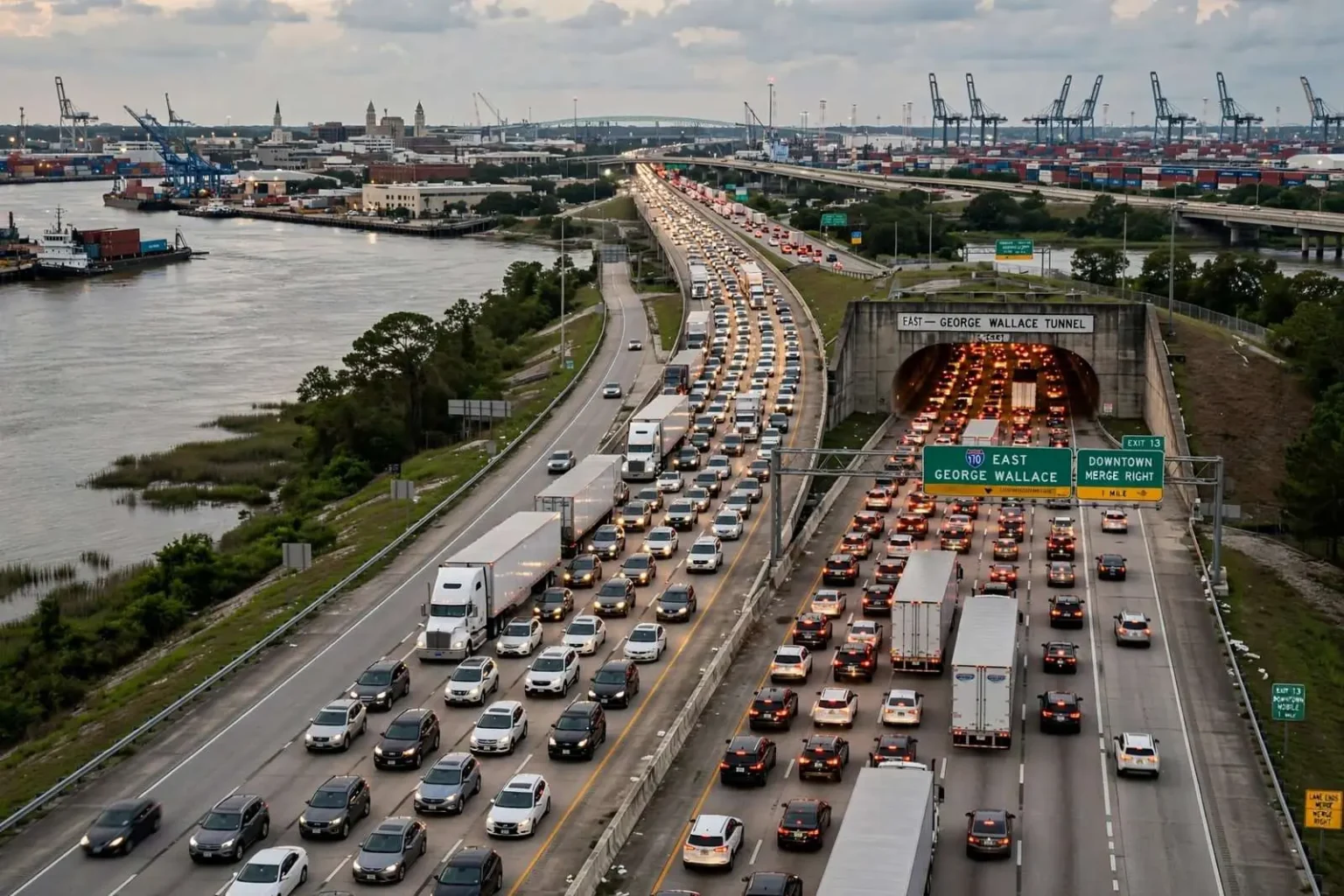
Every day that a long-discussed new Interstate 10 bridge across the Mobile River goes unbuilt, drivers in the Mobile area are paying a steep and growing price in wasted time, wasted fuel and lost income, according to a local economist who has spent years tracking the financial toll of the region’s traffic bottleneck.
Congestion around the existing I-10 tunnels beneath the Mobile River has long been one of the most persistent complaints among residents and visitors traveling between Mobile and Baldwin County. Commuters heading to work, families driving to the beach and truckers moving freight through the port city all funnel through the same aging river crossing, and delays there ripple out across the regional economy in ways that are not always obvious to the drivers stuck in them.
The bottleneck is a quirk of geography and history. Interstate 10, the southernmost coast-to-coast highway in the country, must cross the Mobile River at the city’s downtown riverfront, and it does so through a pair of tunnel tubes — the older Bankhead Tunnel and the four-lane George Wallace Tunnel, which opened in the early 1970s. The tubes work, but they were sized for a metropolitan area and a freight volume that have long since outgrown them. Lane drops at each portal squeeze traffic, grades slow heavy trucks, and a single wreck in a tunnel can close the entire crossing for an hour or more.
The price of the wait
Using national transportation research, the analysis estimates that Mobile-area drivers lose a combined 10.396 million hours a year sitting in traffic tied to the congestion, which works out to roughly 30 hours annually for the average auto commuter. That is less than the 42-hour national average for commuters in similarly sized metro areas, but the gap is closing as the region’s population and traffic volumes grow.
Thirty hours a year sounds manageable when it is described as an average — roughly three working days. But averages disguise the reality at the river crossing, where a driver’s delay is not spread evenly through the year. It arrives in bursts: the summer Saturday when the beach traffic backs up from the tunnel to midtown, the weekday afternoon when an incident turns a twenty-minute crossing into ninety, the pre-dawn hours when freight traffic stacks up behind the slowest truck in the tube. For regular users of the corridor, the annual total can run far beyond the average.
The same research estimates that the typical U.S. commuter burns through 19 gallons of fuel a year idling in congestion, a figure that translates directly into money spent going nowhere. Idle time is the most expensive kind of driving an engine can do — the vehicle burns fuel, accrues wear, and covers no distance — and stop-and-go operation around the tunnels is precisely the pattern that produces it.
The dollar figures are larger. The analysis puts Mobile’s annual congestion cost at $236 million in lost income, or about $670 per auto commuter, compared with a national average of $960 per commuter. Extrapolated further, the lost economic activity tied to that congestion is estimated to be the equivalent of roughly 2,299 jobs that could otherwise exist in the local economy each year.
The jobs framing is the point economists keep returning to when the bridge debate stalls. Time lost in traffic is not simply an inconvenience absorbed by individuals; it is productive capacity that never gets used. An economy that loses the equivalent of more than two thousand jobs’ worth of output every year is smaller than it would otherwise be — fewer shipments delivered on schedule, fewer customers served, fewer hours billed — and the loss compounds as the region grows into the bottleneck rather than out of it.
Those figures cover only passenger vehicle traffic. They do not account for the added cost of truck traffic delays, which can compound the economic drag on a region like Mobile that relies heavily on port, manufacturing and distribution activity moving through the same corridor.
That omission matters for Mobile specifically. The city’s riverfront has become one of the fastest-growing container ports on the Gulf of Mexico, and every container that lands there must move by truck or rail through the same tight downtown network the tunnels serve. Paper mills, chemical plants, aerospace suppliers and distribution warehouses across the region all depend on predictable freight travel times. A port and manufacturing economy can absorb a bad commute; it cannot indefinitely absorb unreliable ones, and reliability is exactly what the tunnel crossing cannot guarantee.
The health toll of stop-and-go
Beyond the dollars and hours, there are health considerations tied to stop-and-go traffic. Gridlock concentrates vehicle emissions in a smaller area for longer stretches of time, and public health researchers have linked heavier, slower-moving traffic to higher levels of airborne pollutants near major roadways.
The tunnels themselves compound the concern, because their enclosed ventilation systems concentrate whatever the vehicles passing through them emit. The neighborhoods around the downtown approaches — including the historic Africatown community just north of the river crossing — sit near some of the region’s heaviest traffic corridors, where congestion-driven emissions meet industrial traffic. For residents who live and work along those roads, the cost of the bottleneck is measured not only in minutes but in the air they breathe.
Public health literature on traffic-related air pollution has tied proximity to heavy roadway congestion to elevated rates of respiratory illness, and children, the elderly and people with existing conditions are understood to be the most exposed. None of that appears on any transportation budget line, which is part of why economists argue the true cost of delay is consistently understated.
The detour that exists now
In the meantime, transportation planners and local drivers have pointed to the Cochrane-Africatown Bridge as an alternate route that can relieve some pressure on the I-10 tunnels, offering both a short-term detour and a longer-term traffic management option. The bridge, which carries the US 90 truck route across the Mobile River north of downtown, offers a high-level crossing with no tunnel grades or lane drops — a route trucks already favor and that passenger vehicles can use when the tunnels back up.
Directing more drivers toward that route could mean pairing infrastructure fixes with simpler, low-cost steps: navigation apps and mapping services could be encouraged to route more travelers over the bridge, and additional highway signage on I-10 and I-65 could help guide drivers who are not using GPS navigation toward the alternate crossing.
Rerouting is not a substitute for capacity, planners caution. The Cochrane-Africatown crossing adds miles for many trips, and its own approaches have limits. But as a pressure-relief valve — particularly for through freight and for drivers already using GPS — it represents the only meaningful addition to the region’s river-crossing capacity in decades, and its unused headroom is the cheapest capacity available until a new I-10 crossing is built.
How the permanent fix stalled
The bigger question hanging over the region is what it will take to move a permanent fix forward. Plans for a new Mobile River bridge and the accompanying Bayway have been studied, debated and revised for years, with funding, tolling and design questions repeatedly stalling final agreement among the state, federal and local stakeholders involved.
The proposed fix is enormous by any standard: a new high-level bridge across the Mobile River to carry I-10 traffic over the port instead of under it, plus a rebuilt elevated roadway — the Bayway — across Mobile Bay toward the Eastern Shore. The project’s price tag and its footprint have made it the largest transportation undertaking ever proposed in south Alabama, and its scale is precisely why agreement has been so elusive. Federal money covers part; the state covers part; and the remainder has repeatedly been proposed to come from tolls, which became the project’s most divisive question.
Tolling split the region in a way that few infrastructure questions do. Baldwin County commuters who would cross daily argued they were being asked to pay for a road that every other interstate user takes for granted; supporters countered that without tolls the project does not get built, and that those who pay are those who benefit from the fastest route. Local governments weighed in on both sides, federal approvals and design revisions added years, and each round of delay pushed the estimated cost upward.
Every year that passes without a resolution adds to the cumulative cost calculated in the congestion estimates, even as the underlying traffic volumes continue to climb. The region’s population growth — led by the fast-growing communities across the bay — guarantees that the traffic demanding passage between Mobile and Baldwin County will be larger next year than this one, whether or not a crossing is built to hold it.
For now, commuters and coastal-bound travelers are left absorbing the cost in idling engines, missed appointments and long backups at the river crossing, while the debate over how and when to finally build a new bridge continues. The estimates place a number on what the waiting costs — millions of hours, hundreds of millions of dollars, thousands of jobs’ worth of growth — and that number, economists note, resets to zero every year only in the sense that it starts accumulating all over again.