ALEA: Cement Truck Driver Was Distracted Looking for Wallet Before Fatal Kushla McLeod Road Crash
Attorney David Greene says he represents the family of 21-year-old Jeriah Roberts, killed Sept. 2 on Kushla McLeod Road. Greene says Roberts' father was driving just ahead of him, swerved to avoid a cement truck, and turned back to find his son's car engulfed in flames.
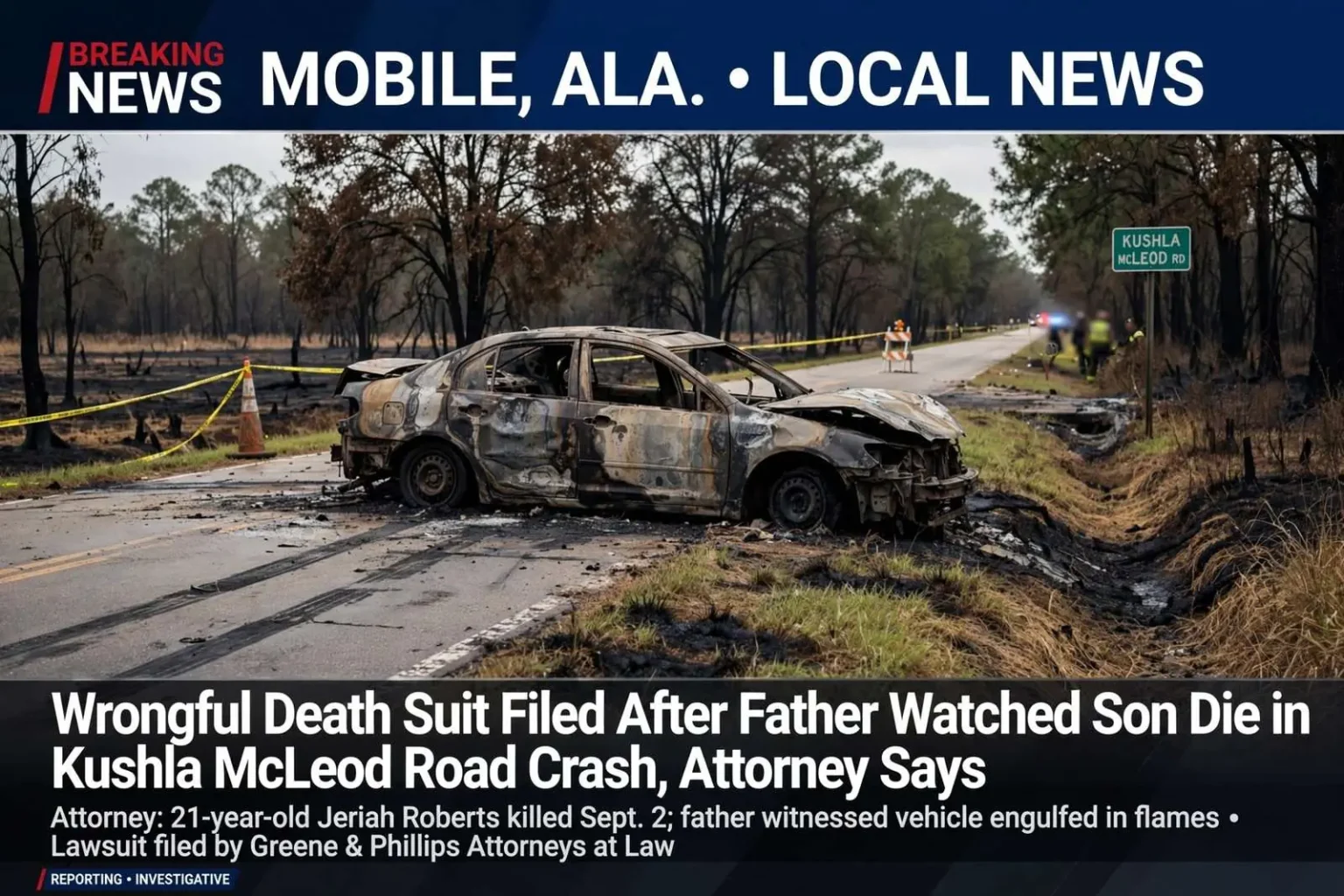
MOBILE, Ala. — A Mobile County crash that killed a 21-year-old man last week has become a wrongful death case, and the attorney handling it says the details are among the worst he has encountered in three decades of practice.
Update, Oct. 7, 2026: An Alabama Law Enforcement Agency crash report says the driver of the cement truck involved in the fatal Sept. 2 Kushla McLeod Road crash told investigators he became distracted looking for a wallet that had fallen to the floorboard and looked up to find his truck had crossed the center line. The truck then overturned onto Jeriah Roberts’ car, the report says.
Latest developments: What the ALEA crash report says
The Alabama Law Enforcement Agency’s crash report gives the first official account of how the crash that killed 21-year-old Jeriah Roberts unfolded. Agencies responded shortly before noon on Sept. 2, and ALEA said Roberts was pronounced dead at the scene.
Distracted while looking for a wallet
According to the report, the cement truck was owned by Bay Concrete and was traveling west on Kushla McLeod Road. The driver “advised he became distracted while looking for his wallet, which had fallen on the floorboard inside the vehicle…when he looked up, he observed that his vehicle had crossed the center line.”
Truck overturned onto Roberts’ car
The report says that when the cement truck swerved, Roberts also swerved to the right and ran off the road. The truck then overturned on top of Roberts’ car before coming to rest in the ditch. Roberts’ car caught fire while he was still inside.
That sequence adds important detail to the account given earlier by David Greene, the attorney for the Roberts family. Greene had said Roberts’ father, driving ahead in a separate vehicle, saw the truck coming into his lane, swerved into the ditch and then ran back to find his son’s car engulfed in flames.
Company declines comment
Bay Concrete was contacted multiple times about the crash and said it had no comment.
What the report means for the case
A crash report records the investigating agency’s findings and statements gathered after a collision, including what drivers tell troopers. It is not a court ruling on fault or liability. In a civil wrongful death case, a report like this one is typically one of many pieces of evidence, alongside witness testimony, vehicle data and expert reconstruction, that a court or jury may weigh. As noted earlier, no findings of fault have been made in court, and anyone named as a defendant is entitled to contest the claims.
Roberts, a Saraland High School graduate, had recently started a new job, Greene has said.
David Greene, founding partner of Greene and Phillips Attorneys at Law, said he is representing the family of Jeriah Roberts in a wrongful death lawsuit. Roberts was killed in a crash on Kushla McLeod Road on Sept. 2, just before noon.
Greene said Roberts and his father were nearly home from work when it happened. They were traveling in separate vehicles, the father ahead.
“His father, Mr. Roberts, notices a large cement truck that’s coming into his lane, and so all he could do is swerve off the roadway, go into the ditch, crashed his vehicle, destroyed his vehicle,” Greene said. “Of course, that wasn’t the worst of what was about to happen. As soon as he was able to get out of his vehicle, he ran back to the car behind him where he knew Jeriah was, only to see it fully engulfed in flames.”
The Scene
Smoke could be seen rising from a burned car when first responders and an ambulance were on scene the afternoon of Sept. 2. Trees and grass near the crash site remain scorched. Tire marks lead off the pavement and into the ditch.
Greene said he has spoken with multiple witnesses. One told him they had tried to put out the fire with a portable extinguisher and could not.
“We’ve seen a lot of horrific crashes and cases, but to see a father have to see his son burning in a car, I can’t imagine it,” Greene said. “There will be initial defendants and perhaps even more defendants later down the road as we investigate this through discovery. What a tragedy this family is living through. It’s a parent’s worst nightmare.”
Roberts was a Saraland High School graduate. Greene said he had recently started a new job.
How a Wrongful Death Case Works in Alabama
Alabama’s wrongful death statute is unusual, and it shapes everything about a case like this one.
In nearly every other state, a wrongful death claim compensates the family for what they lost — income the deceased would have earned, the value of their companionship, the family’s own grief. Alabama does not do that. Under Alabama law, the only damages available in a wrongful death action are punitive: money intended to punish the defendant’s conduct and deter others, not to compensate the survivors for their loss.
That has several practical consequences. A jury is instructed to consider the wrongfulness of the defendant’s conduct rather than the value of the life lost, which means the same death can produce very different verdicts depending on how culpable the conduct was. It also means the claim is brought by the personal representative of the estate rather than by individual family members, and any recovery passes through the estate to the heirs under Alabama’s intestacy rules rather than being awarded to particular relatives.
Alabama gives families two years from the date of death to file. That is a hard deadline, and missing it ends the claim regardless of its merits.
Why ‘Initial Defendants’ and ‘More Defendants Later’
Greene’s phrasing — that there will be initial defendants and possibly more as discovery proceeds — describes standard practice in commercial vehicle litigation, and it reflects how many parties can sit behind a single truck.
A crash involving a commercial vehicle can implicate:
- The driver, for the operation of the vehicle itself.
- The motor carrier, both for the driver’s conduct within the scope of employment and independently for hiring, training, supervision and retention decisions.
- The vehicle’s owner, where that is a different entity from the carrier, which is common in leased-equipment arrangements.
- A maintenance contractor, if a mechanical failure contributed.
- A shipper or broker, in circumstances involving load securement or scheduling pressure.
- Component or vehicle manufacturers, if a design or manufacturing defect is implicated — which, in a case where the central fact is a post-crash fire, is a line of inquiry a plaintiffs’ firm would be expected to pursue.
Discovery is the process that sorts this out. It is also why lawyers rarely name every defendant at filing: the corporate relationships behind a commercial vehicle are frequently not visible from the roadside.
Post-Crash Fire as a Legal Question
In most fatal crashes, the question is what caused the collision. Where a fire follows, a second question opens: what caused the fire, and did it — rather than the impact — cause the death.
Those are separable issues, and they can point at different defendants. Fuel system integrity in a collision is governed by federal motor vehicle safety standards, and post-crash fire litigation historically has focused on fuel tank placement and shielding, fuel line routing, and the behavior of electrical systems after an impact. Modern vehicles also carry high-capacity batteries and, increasingly, lithium-ion packs, each with its own fire profile.
Establishing which of these applies requires the vehicle itself. Preserving the wreckage — and preventing an insurer or salvage yard from crushing it — is typically one of the first things a plaintiffs’ firm does, often through a written spoliation letter within days of being retained. The remains of the vehicle are the single most important piece of evidence in a fire case, and once they are gone the case is effectively unprovable.
The witness account Greene described, of someone attempting to extinguish the fire with a portable unit, is consistent with what fire investigators generally expect: a hand-held extinguisher is sized for an incipient fire and is not adequate for a fully involved vehicle. Vehicle fires reach flashover quickly and require the water volume of an engine company to control.
The Investigation Runs on Two Tracks
It is worth noting that two separate processes are now underway, and they do not necessarily reach the same conclusions on the same schedule.
Law enforcement conducts a criminal and traffic investigation, which asks whether any statute was violated and whether charges are warranted. That inquiry is governed by the criminal standard of proof.
The civil case asks a different question — whether someone was negligent or worse, measured by a preponderance of the evidence — and it has investigative tools the criminal process may not use in a case like this, including subpoenas for a carrier’s maintenance records, driver qualification file, hours-of-service logs, telematics and electronic control module data.
A driver can face no charges and still be found liable. The reverse is also possible. Neither outcome dictates the other.
A Call for Witnesses
Greene said he is urging anyone who saw the crash, or who has video of it, to come forward. Dash camera footage from vehicles traveling Kushla McLeod Road around midday on Sept. 2 would be particularly valuable, as would any video from nearby properties.
Witness memory degrades quickly and dash camera systems overwrite themselves on a loop, sometimes within days. In practical terms, footage that has not been pulled off a device by now may already be gone.
What Comes Next
Cases of this kind move slowly. Filing is followed by service on defendants, responsive pleadings, written discovery, document production from the corporate parties, depositions of the driver and company representatives, and expert work in accident reconstruction and fire origin and cause. Trial, if the case reaches one, is typically years out.
For the family, none of that timeline addresses the part Greene kept returning to.
“What a tragedy this family is living through,” he said. “It’s a parent’s worst nightmare.”
What the Family Faces Procedurally
Before any of the litigation described above begins, a family in this position has to complete a set of steps that few people know about until they are in the middle of them.
Because Alabama’s wrongful death claim belongs to the estate rather than to individual relatives, someone has to be appointed personal representative of the estate through the probate court in the county of residence. That appointment is what gives a person legal standing to bring the claim, and it has to happen before a complaint can be properly filed. Where there is no will, the probate court appoints an administrator under statutory priority rules.
That step is routine but not instantaneous, and it frequently surprises families who assume a parent automatically has the right to sue over the death of an adult child. Under Alabama’s scheme, the parent may well end up as the personal representative — but the authority flows from the appointment, not the relationship.
Preserving the Evidence
The single most time-sensitive action in a case built around a post-crash fire is preservation of the vehicles.
After a crash, a damaged vehicle typically moves from the scene to a tow yard, then to a salvage facility, and then — often within weeks — to a crusher or a parts auction. Insurers move quickly to dispose of total losses because storage costs money. Once the vehicle is gone, so is the ability to examine the fuel system, the electrical system, the battery, and the burn patterns that a fire origin-and-cause expert would rely on.
The standard countermeasure is a spoliation letter: written notice to every party that may control relevant evidence, demanding preservation and warning that destruction may carry legal consequences. In a commercial vehicle case, that notice generally extends beyond the vehicles to the carrier’s electronic records, which many systems overwrite automatically on a rolling basis measured in weeks.
Federal Regulations in a Commercial Vehicle Case
Commercial motor vehicles operate under a body of federal regulation that has no counterpart for passenger cars, and it generates a documentary record that becomes central in litigation.
Motor carriers are required to maintain driver qualification files, records of duty status governing how many hours a driver may operate, systematic inspection and maintenance records for each vehicle, and drug and alcohol testing records including post-accident testing under defined circumstances. Many vehicles carry telematics that log speed, location, braking and engine parameters continuously.
Each of those categories is discoverable, and each can either support or undercut a carrier’s position. A maintenance file showing a deferred repair, or duty records showing a driver near an hours limit, changes a case substantially. So does a clean file.
Whether any of that is relevant here is unknown. What is known is that discovery in a case of this type is document-intensive, and that is a large part of why Greene described defendants potentially being added as the investigation proceeds.
A Note on Public Discussion
Cases like this generate immediate speculation online, frequently naming companies or individuals before any facts are established. It is worth stating plainly that no findings of fault have been made, that filing a lawsuit is an allegation rather than a determination, and that anyone eventually named as a defendant is entitled to contest the claims.
The family’s attorney has asked witnesses to come forward. That request, rather than online speculation, is the useful contribution a member of the public can make.