Mobile County Commission Approves $31.5 Million Bond for Jail, Road and Emergency Center Upgrades
The Mobile County Commission approved a $31.5 million bond for jail upgrades, road projects and a new Emergency Operations Center.
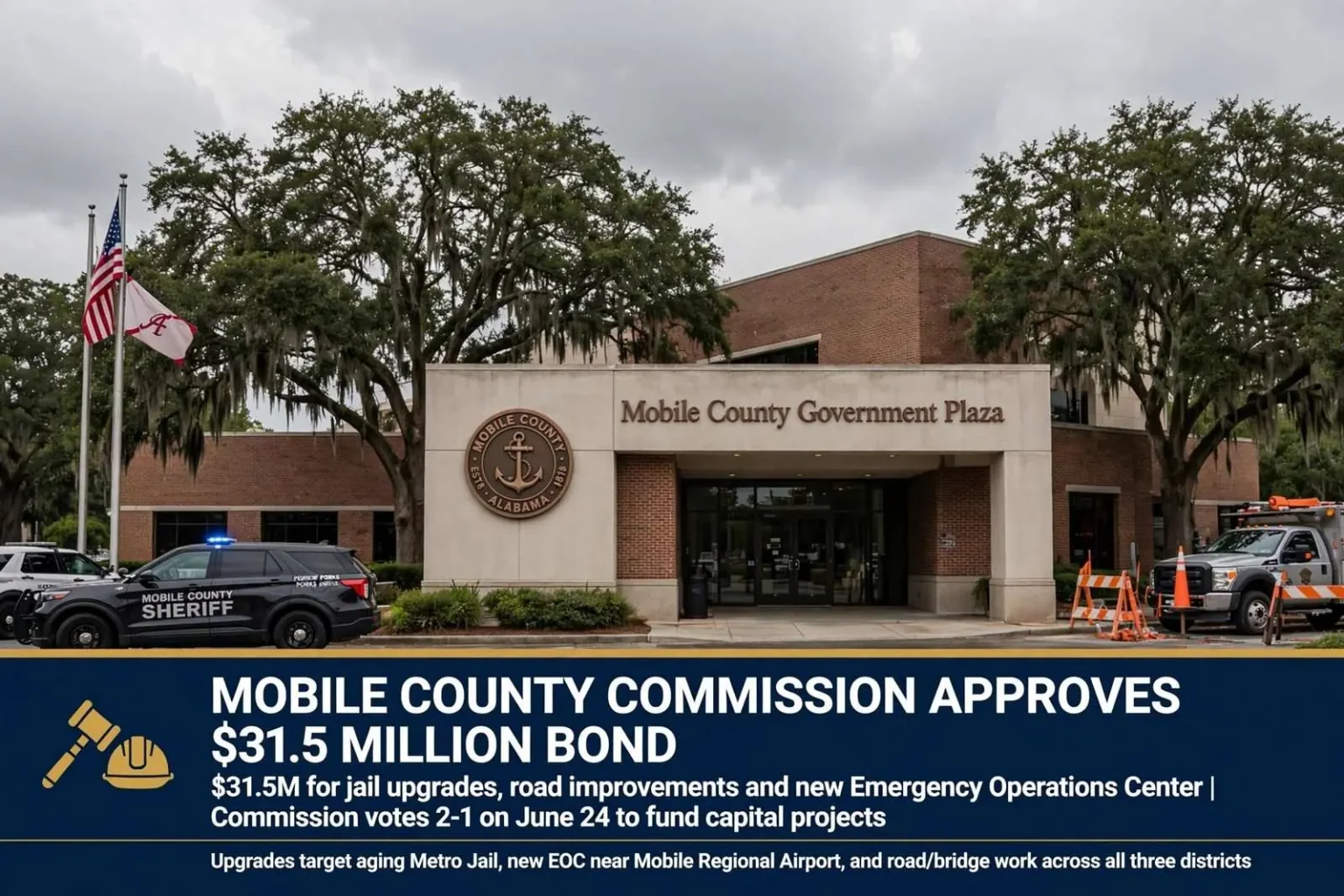
The Mobile County Commission has approved a $31.5 million loan to fund a slate of capital improvement projects, including jail upgrades, road work and additional funding for a new Emergency Operations Center. The commission voted 2-1 on June 24 to approve the bond issue. Despite being in the works for some time, the bond issue wasn’t discussed during the commission’s conference meeting the week prior. Nancy Johnson, Mobile County’s public affairs and community services director, said at the time the county was still waiting on confirmation before placing the warrants on the agenda. “The bond counsel had asked us to get this proposal validated, which is a court process that also takes place before we can actually issue the bonds,” Johnson explained. “Meanwhile payments come due — such as the incentives ($4 million) already approved for Airbus — so there was motivation for us to move expeditiously.”
In total, the county issued $31.5 million in general obligation warrants, which are backed by the county’s credit and taxing power rather than revenue from any specific project. The move is part of what the county calls its “dynamic structured debt service” approach, designed to keep annual debt payments consistent from year to year. During last year’s budget hearings, Mobile County Finance Director Michelle Herman said the county has maintained roughly $10 million in annual debt service in recent years, though that figure saw a slight decrease in 2015. Under the agreement with Regions Bank, the bonds approved are set to be repaid by 2026. “The process is that every two years bonds roll off and comparable borrowing is made to continue funding the capital budget, all the time with a level debt service,” Johnson said, noting that Standard & Poor’s has previously characterized the county’s debt load as a “low overall debt burden.”
Upgrades Planned for Emergency Operations Facility
The projects funded through the recent warrants were originally approved in 2012 as part of the county’s capital improvement plan. The largest single allocation, approximately $12 million, is directed toward upgrades at the Mobile County Metro Jail, where aging infrastructure has created ongoing maintenance and safety concerns. The jail, which houses both pre-trial detainees and sentenced inmates, has faced scrutiny over conditions including plumbing failures, ventilation issues, and security system obsolescence. The planned improvements include replacement of cell door locking mechanisms, upgrades to the fire suppression system, renovation of medical and mental health treatment areas, and modernization of the facility’s camera and communications infrastructure.
The new Emergency Operations Center, slated for construction on county-owned land near the Mobile Regional Airport, will receive approximately $8 million from the bond proceeds. The current emergency operations facility, located in a converted warehouse, has been deemed inadequate for coordinating multi-agency response to hurricanes, industrial accidents, and other large-scale emergencies. The new center will feature hardened construction rated for Category 5 hurricane winds, redundant power and communications systems, a dedicated situation room with GIS mapping capabilities, and space for state and federal liaison officers during declared emergencies. The project reflects lessons learned from Hurricane Katrina in 2005 and Hurricane Sally in 2020, both of which exposed gaps in the county’s emergency coordination capacity.
Road Improvements and Infrastructure Investment
Approximately $11.5 million is allocated for road and bridge projects across the county’s three commission districts. Mobile County maintains over 1,200 miles of paved roads and 200 miles of dirt roads, a network that has deteriorated under the combined pressure of heavy truck traffic, coastal weather, and deferred maintenance. The bond-funded work will prioritize resurfacing of collector roads that connect residential areas to major arteries, replacement of structurally deficient bridges on county-maintained roads, and drainage improvements in flood-prone areas identified through the county’s watershed management plans. Commission President Randall Dueitt emphasized that road funding has been the most consistent request from constituents across all districts, and the bond issue allows the county to address a backlog of projects that would otherwise compete for limited annual maintenance budgets.
The county’s road department has developed a pavement condition index that ranks road segments by structural integrity, ride quality, and safety metrics. Roads scoring below a threshold of 60 on a 100-point scale are candidates for full-depth reclamation or reconstruction rather than surface treatment alone. The bond funds will enable the department to move beyond the “worst-first” approach that has dominated recent years and implement a more strategic asset management program. Several of the targeted roads serve as evacuation routes for coastal communities, adding a public safety dimension to the infrastructure investment.
Debt Management and Fiscal Strategy
Mobile County’s “dynamic structured debt service” model reflects a sophisticated approach to municipal finance that has allowed the county to maintain capital investment capacity without increasing the millage rate. The strategy relies on the predictable retirement of existing debt to create capacity for new borrowing, keeping total annual debt service within a narrow band. This approach has earned the county favorable credit ratings from both Standard & Poor’s and Moody’s, which cite strong financial management, a diverse economic base anchored by the Port of Mobile, Airbus, and the healthcare sector, and a moderate debt burden relative to peer counties in the Southeast.
The Airbus incentives referenced by Johnson stem from a 2012 agreement that brought the European aerospace manufacturer’s A320 final assembly line to the Mobile Aeroplex at Brookley. The $4 million annual incentive payment is tied to employment and production targets that Airbus has consistently met, and the facility now employs over 1,500 workers with a multiplier effect that supports thousands more jobs in the regional supply chain. The county’s ability to meet these obligations while simultaneously funding capital improvements demonstrates the fiscal discipline that underpins its creditworthiness. The bond validation process, a court-supervised proceeding required by Alabama law for general obligation warrants, provides an additional layer of transparency and legal certainty for bondholders.
Jail Conditions and Criminal Justice Context
The Metro Jail upgrades address longstanding concerns raised by federal courts, advocacy organizations, and the county’s own inspection reports. In 2019, a U.S. District Court order in a long-running class action lawsuit mandated specific improvements to medical and mental health care delivery at the facility, including increased staffing, renovated treatment spaces, and enhanced suicide prevention protocols. The bond-funded renovations will help the county achieve compliance with these court-ordered requirements while also addressing infrastructure deficiencies that predate the litigation. The jail’s average daily population has fluctuated between 1,200 and 1,500 inmates in recent years, placing it among the larger county detention facilities in Alabama.
Mobile County has participated in the Safety and Justice Challenge, a national initiative supported by the MacArthur Foundation that seeks to reduce jail populations through pretrial reform, diversion programs, and case processing efficiencies. The county has implemented a risk assessment tool for pretrial release decisions, expanded its pretrial services division, and established a mental health diversion docket in partnership with AltaPointe Health Systems, the region’s largest behavioral health provider. These efforts have contributed to a modest reduction in average daily population since 2018.
Economic Development and Regional Competitiveness
The capital improvement program funded by the bond issue supports Mobile County’s broader economic development strategy, which positions infrastructure reliability as a competitive advantage in attracting and retaining industry. The Mobile Area Chamber of Commerce’s 2021 Competitiveness Report identified transportation infrastructure, workforce quality, and regulatory predictability as the region’s primary strengths, while noting that aging public facilities and flood vulnerability represent ongoing challenges. The Emergency Operations Center sends a signal to existing and prospective employers that the county takes business continuity and disaster resilience seriously.
The Port of Mobile, which ranks among the top 15 U.S. ports by tonnage, depends on the county’s road network for efficient cargo movement between docks and interstate highways. Several of the road projects funded by the bond directly serve port-related truck traffic, reducing wear on municipal streets and improving transit times for time-sensitive cargo. The county’s coordination with the Alabama State Port Authority on infrastructure priorities reflects an institutional partnership that has deepened as the port has expanded its container terminal capacity and pursued new trade lanes.
Commission Dynamics and Public Process
The 2-1 commission vote reflected partisan and philosophical divisions that have characterized Mobile County government in recent years. The two commissioners voting in favor argued that the bond issue represented a responsible use of the county’s borrowing capacity to address deferred maintenance that would only become more expensive with delay. The dissenting commissioner expressed concern about committing future revenue streams without a more robust public engagement process, noting that the bond issue had not appeared on the conference meeting agenda where citizens typically have opportunity for comment.
Public reaction was mixed, with business groups and public safety advocates generally supportive while some taxpayer organizations questioned the timing given economic uncertainty. The county held a public hearing prior to the validation proceeding, as required by law. The bonds were ultimately validated by the Mobile County Circuit Court, clearing the way for issuance through Regions Bank, which has served as the county’s primary financial advisor and underwriter for multiple bond series over the past decade. The county’s financial advisors project that the debt service on the new warrants will be absorbed within the existing debt service budget through the structured rollover mechanism, avoiding any need for a tax increase.