Historical report, published from archived local news coverage.
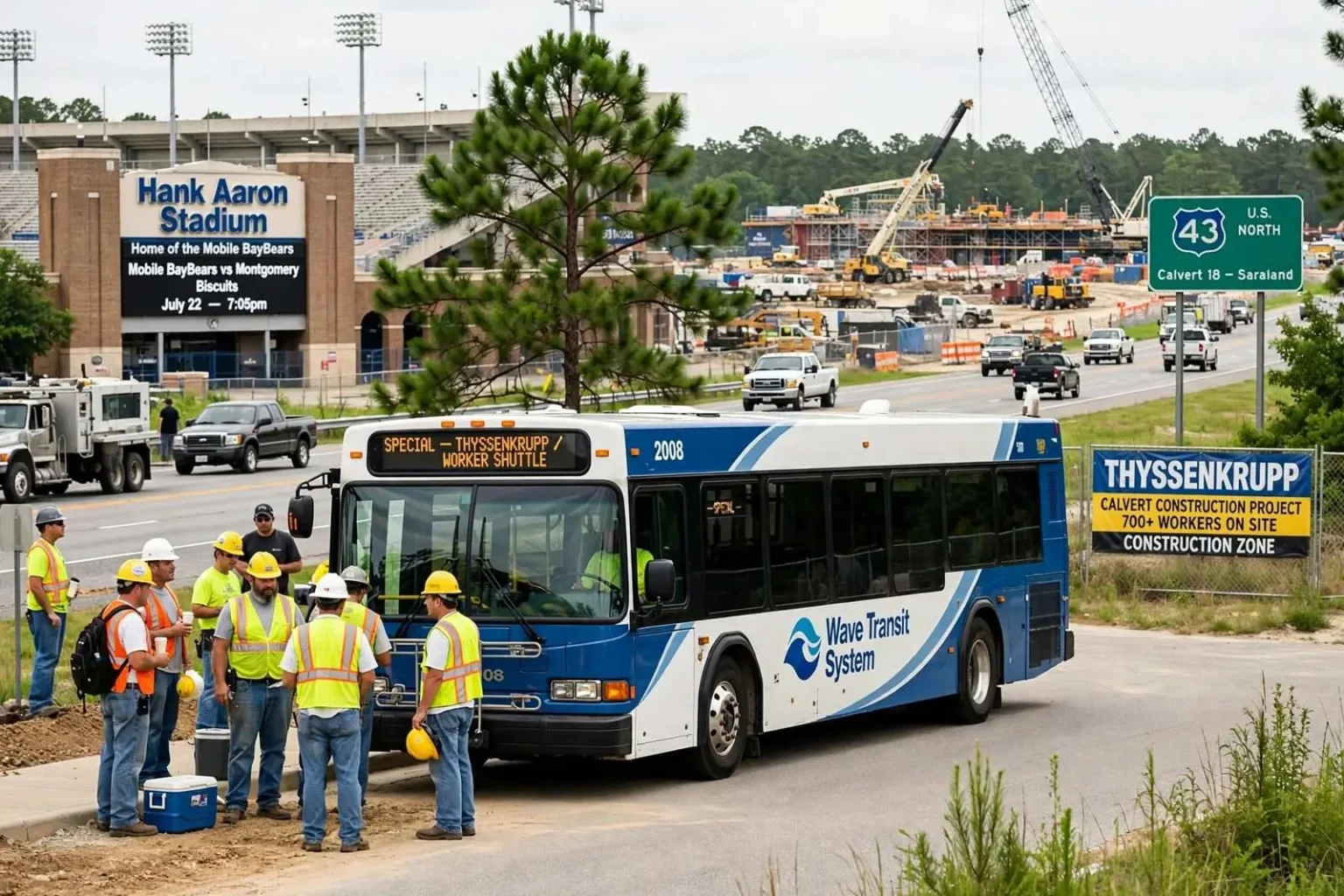
MOBILE COUNTY, Ala. — In July 2008, a Mobile County commissioner said a mass-transit system might help ease the growing traffic congestion along U.S. Highway 43 in the northern part of the county, according to an archived local news report. The suggestion came as construction of the ThyssenKrupp steel mill at Calvert was sending thousands of workers up and down the Highway 43 corridor every day, straining a two-lane road that had never been asked to carry that kind of volume.
Commissioner Merceria Ludgood, whose district included parts of northern Mobile County, cited the traffic increases linked to the ThyssenKrupp construction project. At the time, the German steelmaker had about 700 construction workers on site at Calvert, where the company was building one of the largest industrial facilities undertaken in Alabama in a generation. The company said construction could eventually involve as many as 7,000 workers a day at the peak of the build-out, a number that dwarfed the population of the small communities along the route between north Mobile County and the site.
The Highway 43 Corridor Under Pressure
U.S. Highway 43 runs north from Mobile through Prichard, Saraland, Creola, and Axis before crossing into Washington County toward the ThyssenKrupp site at Calvert, which sits near the Mobile-Washington county line. In 2008 the corridor was lined with small towns, churches, and roadside businesses that had grown up around a road designed for local traffic, not for a daily industrial commute. Residents and workers interviewed by a local station described bumper-to-bumper morning traffic as construction crews converged on the site, a sight few people in the area had ever witnessed on that stretch of road.
The congestion was not just an inconvenience. North Mobile County communities worried about safety on a highway where residents pulled out of driveways and side roads into a stream of commuter traffic, about wear on local roads that construction trucks used as shortcuts, and about the strain placed on businesses and intersections in Creola and Axis. For county government, the ThyssenKrupp build-out forced a question that rural counties rarely face: whether the region needed a genuine transit option to move thousands of workers at once.
A Transit Proposal and Its Appeal
Ludgood’s suggestion that mass transit might help was an early response to that question. One suggestion discussed at the time included a pickup location near Hank Aaron Stadium, the ballpark in Mobile that would have given commuters from the city a centralized, park-and-ride style point to board buses or vans heading north to Calvert. The idea reflected how transit planners typically approach commuter demand from a scattered workforce: rather than route buses down every street, concentrate boardings at a landmark with parking and highway access.
Workers and nearby residents interviewed about the idea expressed mixed support. Some who sat in the morning backup every day welcomed any option that would take cars off Highway 43; others were skeptical that a transit system could match the flexibility of driving, particularly for construction workers who arrive at staggered times or carry tools and equipment that a bus commute does not accommodate. That mix of interest and doubt was a familiar response in a region where public transit beyond the city of Mobile was, and remains, limited.
ThyssenKrupp at Calvert: The Project Behind the Traffic
The ThyssenKrupp steel mill announced for Calvert in 2007 was among the largest single industrial investments ever made in Alabama. The German conglomerate selected the site near the Mobile-Washington county line for its combination of rail access, proximity to the Tombigbee River, and distance from the Gulf’s hurricane zone, with plans for a carbon steel and stainless steel processing complex that would employ roughly 2,700 people in permanent operations once completed. The state and local governments had committed incentives worth hundreds of millions of dollars, and expectations across southwest Alabama ran high.
Construction employment, however, was the immediate story of 2008. Building a steel mill of that scale required years of work by thousands of craft workers — ironworkers, electricians, pipefitters, welders, and equipment operators — many of whom commuted daily from Mobile, Saraland, and the surrounding counties. The company’s projection that construction could eventually involve as many as 7,000 workers a day meant the Highway 43 corridor faced a sustained commuter load for years, not months, and that the peak was still ahead when Commissioner Ludgood raised the transit idea in July 2008.
Who Merceria Ludgood Was and Why Her Voice Mattered
Merceria Ludgood served on the Mobile County Commission, the three-member governing body of Alabama’s second-most-populous county. As a commissioner representing districts that included northern Mobile County, she was among the officials most directly answerable for conditions on Highway 43 and the roads feeding it. County commissions in Alabama hold responsibility for county roads and work with the Alabama Department of Transportation on state highways, which gave the commission a role in pressing for improvements even though the federal-and-state highway program, not the county, controls U.S. 43 itself.
Commissioners in that period juggled competing demands from the project: welcome the jobs, coordinate with the company, and absorb the infrastructure impacts on the communities between Mobile and Calvert. A mass-transit option was one of the few tools that could relieve congestion without waiting for highway construction, since buses and vans can be mobilized far faster than a road can be widened. The counterargument, familiar in rural Alabama, was cost and ridership — commuter transit needs sustained funding and predictable demand to operate.
Transit Reality on the Gulf Coast in 2008
The backdrop to the discussion was the thin state of public transit in southwest Alabama at the time. The Wave, Mobile’s public transit system, operated fixed routes largely within the city limits, and no commuter service linked Mobile’s suburbs to the northern county, much less to Washington County. Commuter bus service in the region had never taken root outside the city core, and funding through Alabama’s transit framework was modest, leaving most proposals dependent on federal grants and local match dollars.
That context helps explain why the Highway 43 proposal remained a suggestion rather than a system. A pickup location near Hank Aaron Stadium and routes up the corridor would have required buses, drivers, a maintenance base, and an operating subsidy — a commitment no local government in the region had made before for commuter service. The idea nonetheless captured a real moment: for the first time in decades, the Mobile area had a commute problem of industrial scale, and its elected officials were openly discussing transit as part of the answer.
What Commuters and Residents Said
The interviews conducted along the corridor in July 2008 gave the story its texture. Workers described leaving home earlier and earlier to beat the backup, with the morning crawl stretching travel times that had once been measured in minutes. Nearby residents described pulling onto Highway 43 from side roads as a daily gamble, waiting for gaps in a line of vehicles that had not existed before the mill construction began. Both groups, according to the archived coverage, expressed mixed support for a possible transit option — sympathetic to the need, uncertain about whether a bus or van service would fit the way construction work actually runs.
Construction schedules complicate commuter transit by design. Shift times change as project phases advance, craft workers report to staggered start times, and many carry heavy tool bags and equipment that make a seat on a shuttle impractical. These are the reasons industrial projects typically generate vanpools and informal carpools rather than fixed-route bus service, and the Highway 43 corridor in 2008 was no exception — even as the sheer volume of traffic kept the larger transit idea alive in county discussions.
The Corridor After 2008
The traffic pressures Ludgood described did not remain theoretical. As the ThyssenKrupp construction workforce grew toward its projected peak, state and local officials pursued improvements along the Highway 43 corridor, and the Alabama Department of Transportation worked on upgrades serving the Calvert site and the communities around it. The mill itself moved toward completion at the start of the following decade, hiring for the permanent operations positions that had been promised from the beginning — though the plant’s ownership later passed to ArcelorMittal and Nippon Steel in a joint venture, and its story continued to shape employment and traffic in northern Mobile County for years.
For the small towns along the way — Creola, Axis, Mount Vernon, and the Washington County communities on the far side of the line — the 2008 episode became part of local memory: the years when Highway 43 filled with morning traffic, when the subject of buses and park-and-ride lots briefly entered county conversation, and when the pace of change in rural southwest Alabama was set by a steel mill rising near the river. The proposal discussed that summer never matured into a permanent commuter system, but it recorded a moment when county leadership looked at a crowded two-lane highway and asked whether the region had outgrown the automobile-only assumption it had always made.
This article is a historical report on a proposal and conditions at that time, not a current traffic or transit notice. Road conditions, construction activity, and transit services in Mobile County have all changed since July 2008, and the figures cited — 700 workers on site, a possible 7,000 at peak — reflect the company’s projections during the construction era, not the mill’s permanent employment or the corridor’s present-day traffic.