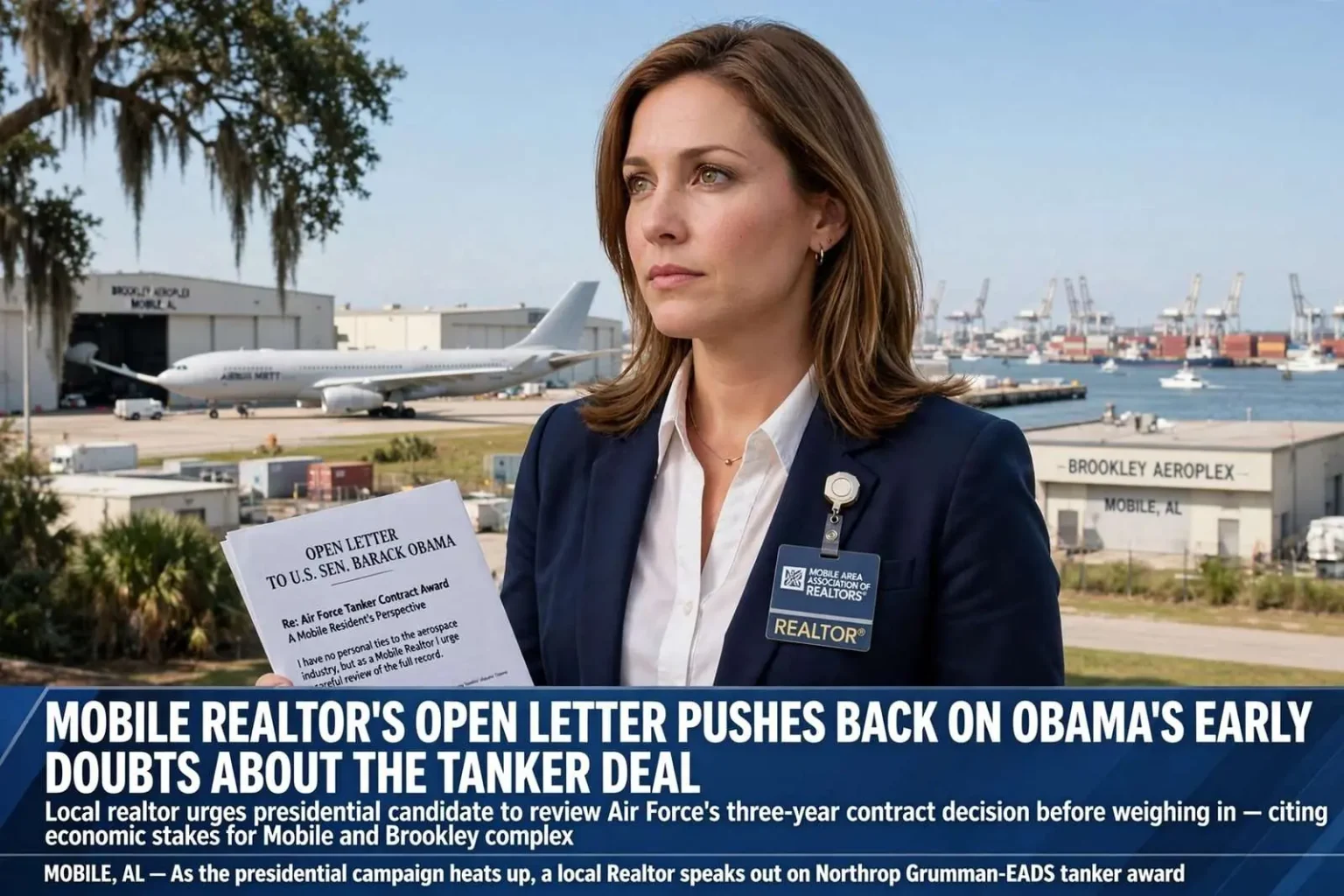
A Mobile-area Realtor has written an open letter to U.S. Sen. Barack Obama, pushing back on the presidential candidate’s early skepticism about the Air Force’s decision to award a massive aerial refueling tanker contract to Northrop Grumman and its European partner, EADS Airbus, over Boeing.
Obama had voiced concerns about the award publicly, though he acknowledged he had not yet reviewed the decision in detail. The letter’s author, who says she has no personal or family ties to the aerospace industry but works locally as a Realtor, argued the senator should hold off on final judgment until he had studied the full record.
“My understanding is the Air Force considered this contract award over three years before making a decision,” the letter states, asking why the public shouldn’t trust the Air Force’s own judgment about a deal it evaluated for so long and explained in detail once Northrop Grumman and EADS were selected.
The stakes behind the letter could hardly be higher for Mobile. The tanker award carried with it the promise that the winning aircraft would be assembled at the Brookley complex in Mobile, a former Air Force field on the bay that the city has long worked to fill with aerospace and industrial employers. For a metropolitan area whose economy has historically leaned on shipbuilding, the port and healthcare, an aircraft assembly line of this scale represented the kind of transformational investment that arrives once in a generation — and residents understood that political second-guessing of the award could put it at risk even after the contracts were signed.
The political moment mattered as much as the contract. With the presidential campaign underway, the tanker award had migrated from defense-budget news into campaign-trail rhetoric, where Boeing’s loss was cast as a loss of American jobs and the Air Force’s process as suspect. For Mobile, the frustration was that the debate unfolded at a distance from the community the decision would most directly affect — a community that had spent years recruiting aerospace work to the Gulf Coast and now watched the prize it had won described in other states as a giveaway. The letter was a local answer to that framing, written not by a lobbyist or a company official but by someone with a stake in the city’s future and no stake in the industry itself.
The buy-American question
The letter acknowledges the emotional pull of “buying American” and keeping jobs at home, but argues the reality of the global economy is more complicated. It notes that companies routinely move operations and support jobs overseas to cut costs, and that France and Germany — both longtime U.S. allies — have strong reputations for quality manufacturing that American consumers already buy from in other industries.
The point cuts at an inconsistency critics of the award rarely confront: American companies manufacture abroad and European companies manufacture in the United States, and the flow of jobs across the Atlantic runs in both directions. An aircraft assembled in Mobile by workers drawing Mobile wages, letter-writers argue, is an American job creation story regardless of the nationality of the corporate parent — and the alternative is not necessarily more American manufacturing, but fewer manufacturing jobs of any nationality locating in the United States at all.
The author also points to Mobile’s own experience as evidence that international investment can be a net positive for a community: the city was separately chosen around the same time by Germany’s ThyssenKrupp to build a large steel plant, a deal local officials have touted as a sign of the region’s growing economic profile. The steel project — one of the largest industrial investments ever announced in the state — established the pattern the tanker contract would extend: European capital hiring American workers on Alabama soil.
The competitive record
On the competitive question, the letter argues Boeing is unlikely to be seriously harmed by losing this particular contract. It notes the Air Force ultimately plans to acquire roughly 500 new tankers in total, leaving Boeing other opportunities to bid in the future, and suggests Boeing may have underestimated fuel costs in its own proposal, a factor that could have worked against it in the evaluation.
That reading of the competition answers the loudest criticism from Boeing’s congressional allies — that the award reflected price-gouging by a subsidized rival rather than a legitimate assessment. If the letter’s premise holds, the Air Force simply chose the bid that better evaluated the cost of actually flying, maintaining and fueling a tanker fleet across decades of service, and rejected the one that failed to account for its own operating realities. Awarding a fleet this size on anything other than lifetime cost, the argument runs, would amount to the taxpayers overpaying by billions to accommodate a contractor’s miscalculation.
The warning about Washington’s signal
The letter also raises a broader worry: that public pressure from Washington to reverse or second-guess the award over job-loss concerns in Washington state and elsewhere could send an unwelcome signal to European companies considering future investment in the United States, potentially affecting deals well beyond the tanker program and beyond Alabama.
The concern is straightforwardly transactional. Companies deciding where to build billions of dollars of capacity — steel mills, aircraft lines, manufacturing campuses of any kind — weigh the risk that the rules will change after they have won. If a competitive process can be reopened whenever the losing side’s congressional delegation applies pressure, the value of winning any American competition declines, and the next ThyssenKrupp or EADS may simply choose a country where the award means what it says. For a region courting exactly that kind of international investment, the reputational stakes extend far past one contract.
The letter’s author, writing as a private citizen rather than an industry advocate, frames that risk as the real issue a presidential candidate should weigh. Whatever Obama’s judgment on the aircraft’s merits, she argues, the campaign’s rhetoric about the award carries consequences for communities like Mobile that have staked their economic futures on playing host to global companies — and on being able to assure the next suitor that a deal made here is a deal that holds.
The tanker fight also unfolded against the backdrop of a military equipment crisis that gave urgency to both sides. The Air Force’s existing refueling fleet, built around aircraft designed in the 1950s, had been flying far beyond its intended service life, and repeated attempts to replace it — including a earlier lease-and-buy arrangement that collapsed in scandal — had left the service without a successor program. Every year of protest and reopened competition meant more years flying tankers older than the crews aboard them. That operational reality was the strongest argument for letting the awarded contract stand: whatever its flaws, the fleet needs new aircraft, and the nation’s ability to project air power depends on them.
A citizen’s letter with civic weight
Open letters of this kind are a familiar form of civic advocacy in Gulf Coast economic development fights. Businesspeople without direct industry ties — realtors, bankers, merchants, retirees — have repeatedly weighed in during the region’s contests for major industrial projects, arguing from local experience rather than technical expertise. Their letters, published in local newspapers and circulated among civic groups, form part of the public record that elected officials in Washington read alongside the industry testimony and Pentagon briefings.
The author closes by wishing Obama luck in his bid for the Democratic nomination, while urging him to reconsider his position once he has had a chance to review the full record behind the Air Force’s decision. The gesture — courteous on the campaign, firm on the substance — reflects the letter’s underlying posture: this is not partisan opposition, but a local resident’s appeal to a candidate she may well support, asking that the facts of a competition three years in the making be given their weight before the politics take over.
Whether the letter changes any minds in the campaign, its circulation in Mobile captures the mood of a city that had just learned what it stood to gain from the tanker program and had begun to grasp how easily a decision of that magnitude could be reopened in Washington. For residents who watched the Air Force deliberate for three years and explain its choice at length, the frustration is not with debate itself but with judgment issued before the record is read — and with the possibility that Mobile’s biggest economic opportunity in a generation could be lost not on the merits, but on the campaign trail.
The Air Force’s award, for its part, remains the governing fact: a competition concluded, a decision documented and explained, and a region waiting to see whether the verdict stands.