SEC to Comply With Court Order, Clearing Path for Pro-Contract Athletes to Sign Before Season Opener
The SEC has told attorneys it will comply with an amended court order affecting player eligibility, days before conference teams must finalize their 105-man rosters for the season opener.
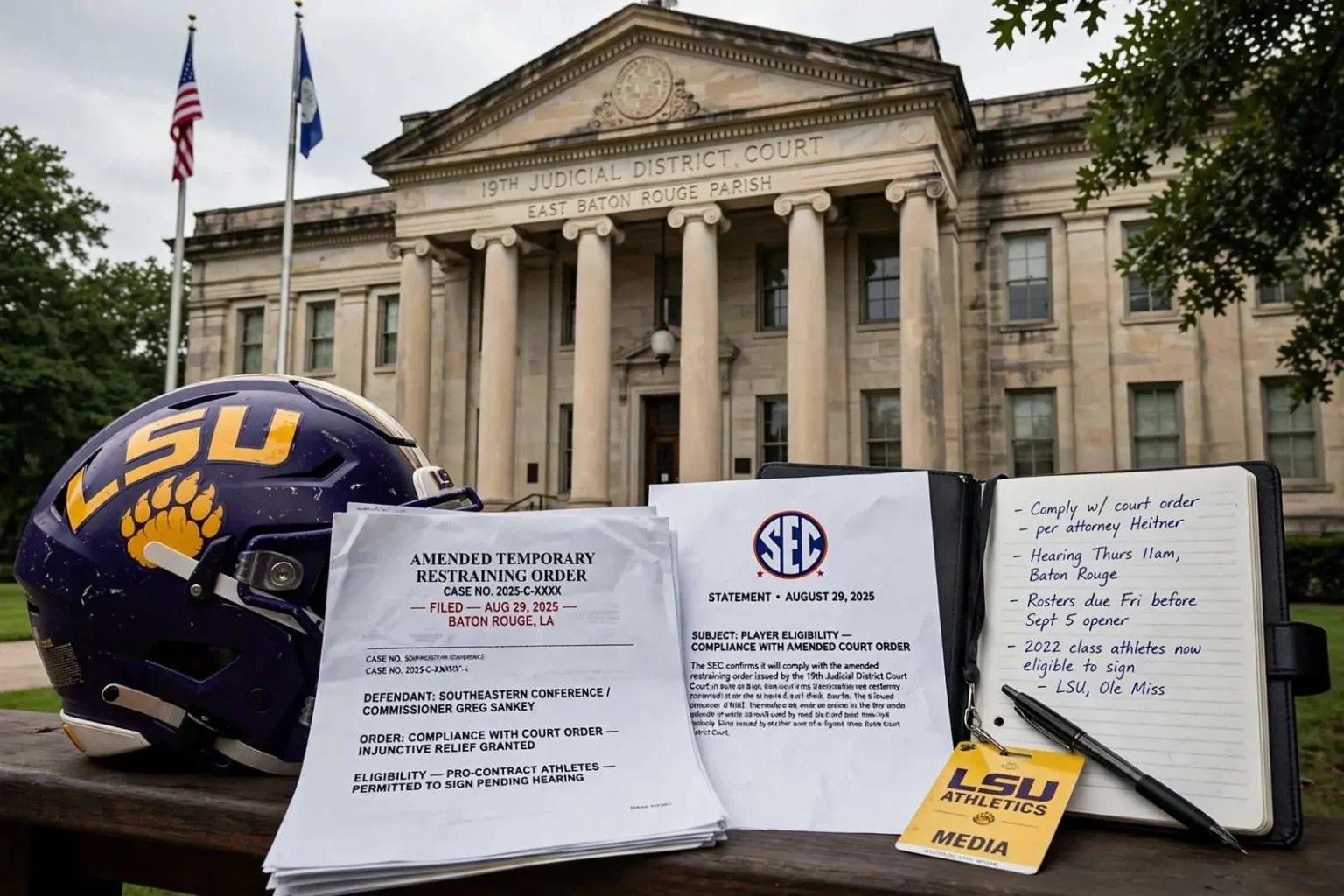
The Southeastern Conference and commissioner Greg Sankey will comply with all applicable new court orders regarding player eligibility, according to attorney Darren Heitner, with reporter Ross Dellenger adding that the league has communicated its intent to comply directly to attorneys involved in the case — a development that opens the door for a group of athletes with professional league ties to sign with SEC programs just days before the season’s opening weekend.
An Amended Restraining Order
The development follows action Friday by a Louisiana judge, who amended a temporary restraining order previously issued against the NCAA to also include the SEC and Sankey personally as parties. A hearing on the matter is scheduled for 11 a.m. Thursday in Baton Rouge, just two days before most SEC teams are set to play their first games of the season on Saturday, Sept. 5. Under conference rules, SEC teams must have their 105-man rosters finalized a day before that opening slate of games, adding real time pressure to a legal fight that has moved quickly since the original order was issued.
That original temporary restraining order was issued Aug. 19 and granted 2026 eligibility to more than 40 athletes, a group that includes several players who spent time in NFL training camps over the summer. Among those affected are former Ole Miss defensive lineman Zxavian Harris and tight end Dae’Quan Wright, both of whom have committed to LSU after being waived by NFL teams during roster cutdowns.
A Rule the SEC and Big Ten Enacted Together
The court fight comes just days after the SEC, following the Big Ten’s lead, announced a new rule barring its member schools from rostering players who had signed contracts with teams in the NFL, NBA, G League, or WNBA. That rule, enacted Tuesday, also included specific punishments for violations, including suspensions for coaches and fines reaching into the millions of dollars — a sign of how seriously the conference intended to enforce the new eligibility restriction before the court intervened.
Friday’s amended order effectively overrides that SEC rule for the time being, pending Thursday’s hearing in Baton Rouge. According to the court’s language, Sankey and the SEC are not currently being held in contempt of court, but were added as defendants specifically so that plaintiffs in the case can seek injunctive relief against them through a separate motion — a procedural step that keeps the conference squarely in the middle of the ongoing dispute even without a contempt finding against it.
A Fight Rooted in a Narrow Eligibility Gap
Friday’s court action is the latest chapter in an escalating legal battle between college sports conferences and a specific group of former — and potentially future — college athletes: those who graduated high school in 2022 and played as fourth-year seniors during the 2025-26 athletic year. That particular class of players was excluded from the NCAA’s “five to play five” eligibility rule, which is set to take effect beginning with the 2026-27 athletic year and would otherwise allow athletes five years of eligibility across five seasons.
Because that 2022 high school graduating class falls just outside the window covered by the new eligibility framework, its members have found themselves in a legal gray area — one that has produced a wave of litigation as individual athletes seek court intervention to preserve eligibility that conference rules would otherwise deny them, particularly after they had already been released or waived by professional teams.
Other Plaintiffs in the Case
Also named as plaintiffs in the Louisiana lawsuit against the NCAA — and now the SEC — are former Notre Dame defensive lineman Junior Tuihalamaka, who recently committed to LSU, and former Florida and LSU defensive end Jack Pyburn, currently a member of the NFL’s Tampa Bay Buccaneers. According to reports, Pyburn is expected to seek a return to LSU if he is waived by the Buccaneers prior to Sept. 1, adding another name to the list of players whose immediate football future hinges on the outcome of the ongoing litigation.
What Comes Next
With Thursday’s hearing in Baton Rouge set to take place just before the season’s opening weekend, SEC programs — LSU chief among them, given the number of plaintiffs tied to the Tigers — are working under significant time pressure to determine which players they can legally roster before facilities lock in their 105-man limits. The SEC’s stated willingness to comply with the amended court order suggests the conference is prioritizing avoiding a contempt finding over continuing to fight the eligibility question in court, at least in the short term, even as the broader legal dispute over the 2022 high school graduating class’s eligibility remains unresolved heading into the new season.
The outcome of Thursday’s hearing is expected to determine not only the immediate eligibility status of the athletes named in the suit, but also whether the SEC and Big Ten’s new rule restricting players with professional contracts can be enforced as written, or whether it will face continued legal challenges as similar cases work through courts in other states.
College Sports’ Rapidly Shifting Legal Landscape
The eligibility fight playing out between the SEC and a group of former college athletes reflects a broader legal transformation that has reshaped college sports over the past several years. Since the NCAA’s longstanding amateurism model began unwinding through a series of court rulings and settlements — including the landmark House v. NCAA settlement that opened the door to direct revenue sharing between schools and athletes — conferences have repeatedly found themselves defending eligibility rules in court that would have gone largely unchallenged under the sport’s earlier legal framework.
The specific dispute over the 2022 high school graduating class stems from the transition between two different eligibility regimes: the COVID-era rules that granted athletes an extra year of eligibility, and the newer “five to play five” framework set to govern eligibility going forward. Athletes caught in the narrow gap between those two systems have increasingly turned to antitrust and due process arguments in court, asserting that categorical eligibility bans deny them the ability to earn a living playing college football at a moment when the sport’s economic model increasingly resembles professional athletics in other respects.
\n
What’s at Stake for SEC Programs
\n
For programs like LSU, which has multiple plaintiffs from this case already committed to the roster, the outcome of Thursday’s hearing carries immediate practical consequences beyond the legal questions at issue. Roster construction decisions made in the days before a mandatory 105-man limit takes effect can shape depth at key positions for the entire season, making the timing of this legal dispute — landing just days before the opening weekend — particularly consequential for coaching staffs already finalizing their rosters under the assumption that the new professional-contract rule would be enforced as written.
The House Settlement’s Role in Reshaping Eligibility Fights
Much of the legal turbulence now surrounding SEC eligibility rules traces back to the landmark House v. NCAA settlement, a sweeping resolution of several consolidated antitrust cases that fundamentally altered the economic relationship between schools, conferences, and athletes. That settlement, approved by a federal judge, allowed Division I schools for the first time to share athletics revenue directly with their athletes, subject to an annual per-school cap, while also resolving damages claims from former athletes who argued they had been unfairly barred from earning name, image, and likeness compensation in earlier years. The settlement effectively completed a multi-year unwinding of the NCAA’s traditional amateurism model, a framework that for decades had restricted athlete compensation on the theory that amateur status was central to the character and appeal of college sports. With that foundational restriction gone, conferences like the SEC have been left to rewrite eligibility and roster rules in real time, often in reaction to court rulings rather than through the kind of unilateral rulemaking authority the NCAA and its conferences once exercised largely free from judicial interference. The current dispute over the 2022 high school graduating class is, in that sense, a direct byproduct of a legal landscape still being rebuilt piece by piece, with individual eligibility questions increasingly resolved through targeted litigation rather than settled conference policy.
How Antitrust Law Opened the Door to These Challenges
The legal theory underlying lawsuits like the one now ensnaring the SEC traces back most directly to NCAA v. Alston, a 2021 U.S. Supreme Court decision that unanimously rejected the NCAA’s argument that its compensation restrictions deserved special deference from antitrust law. While the Alston ruling itself concerned education-related benefits rather than eligibility rules directly, the decision’s broader significance lay in signaling that federal courts would no longer treat NCAA and conference rules as presumptively lawful simply because they governed amateur athletics. That shift emboldened a wave of subsequent litigation challenging nearly every remaining NCAA and conference restriction on athlete compensation and movement, from transfer eligibility rules to, now, categorical bans on rostering athletes who had signed professional contracts. Plaintiffs’ attorneys in cases like the one playing out in Baton Rouge have leaned heavily on that post-Alston legal environment, arguing that eligibility restrictions functioning as blanket bans on earning a living in professional sports — even briefly, before a return to college athletics — amount to the same kind of anticompetitive restraint on athlete labor markets that courts have already found unlawful in other contexts. Conferences, for their part, have continued asserting that some baseline eligibility structure remains necessary to preserve competitive balance and roster stability, a tension that courts across multiple jurisdictions are now being asked to resolve case by case rather than through a single definitive ruling.
Coaches Facing a Fast-Moving Rulebook
The compressed timeline between the SEC and Big Ten’s new professional-contract rule, the court’s amended restraining order, and Thursday’s hearing has left coaching staffs across the conference navigating roster decisions under conditions that would have been unthinkable in the sport’s pre-litigation era, when eligibility rules typically stayed fixed for an entire offseason rather than shifting week to week. Programs now must build contingency plans for multiple possible outcomes of a single hearing, since a ruling that goes against the SEC could immediately reopen roster spots the conference’s own rule had just closed off days earlier. That volatility has become an increasingly familiar feature of roster management across major college football programs, many of which now retain outside legal counsel specifically to track eligibility litigation alongside their traditional recruiting and personnel operations.