Revisiting the Crichton Leprechaun: Mobile’s Most Famous Urban Legend
Nearly a decade later, the man who first spotted the Crichton leprechaun in a Mobile tree reflects on the sighting that became a national sensation.
With St. Patrick’s Day approaching, longtime Mobile residents are once again recalling one of the city’s strangest moments of internet fame: the Crichton leprechaun sighting of 2006, a local phenomenon that briefly captured national attention. Nearly two decades later, the episode remains one of the most durable pieces of Mobile folklore, replayed every March as the city’s Irish-themed celebrations roll around. For those who lived through it, the story is equal parts neighborhood memory and early-internet history.
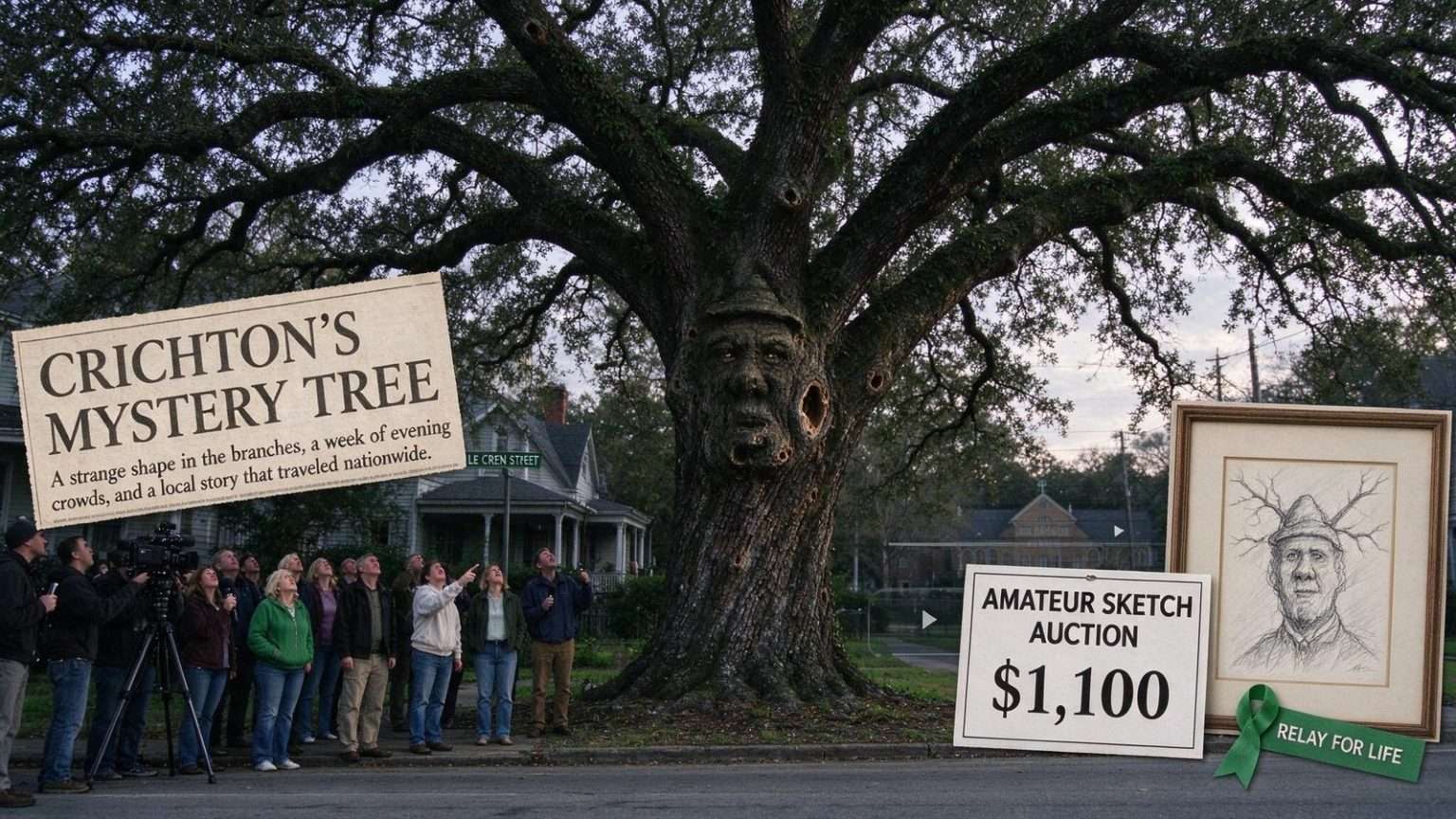
Nearly nine years ago, crowds began gathering along Le Cren Street near UMS-Wright in Mobile after word spread that residents could see the image of a leprechaun peering out from the branches of a tree. The gathering grew night after night as curiosity spread through the neighborhood and beyond, with onlookers pointing up into the gnarled limbs and debating what they were seeing. What had been an ordinary residential tree became, for a stretch of days, one of the most visited spots in the city.
A local television reporter visited the scene after fielding a flood of calls about the sightings, and the resulting news segment quickly went viral, eventually landing references on national late-night television. The segment captured interviews with residents, some of whom arrived with their own explanations, and it spread online at a moment when short, strange local news clips were just beginning to circulate widely. The clip’s reach grew far beyond Mobile, and for a season the city’s name was attached to a story told by talk-show hosts and commentators nationwide.
The Sketch That Sold for $1,100
An amateur sketch of the supposed leprechaun was later put up for auction online, fetching a winning bid of $1,100 from a bidder in New York City. The sale turned a doodle born on a Mobile street corner into a genuine piece of pop-culture memorabilia, and it added another chapter to a story that seemed to grow larger every time it was retold. The winning bidder was reportedly an art collector, and the auction itself drew coverage that extended the phenomenon’s life for another news cycle.
Proceeds from the sale went to the American Cancer Society’s Relay for Life fundraiser, tying the quirky local legend to a charitable cause. That detail is often lost in retellings that reduce the episode to a punchline, but for the neighborhood it mattered: the strange saga of a tree on Le Cren Street ended up contributing to cancer research and support programs. A story that began as a curiosity closed with a gesture that locals still cite with some pride.
Shun Thomas, a Crichton neighborhood resident, has long said he was the first to spot the now-famous image. His account has remained consistent through the years, and his role as the original witness has made him the person most associated with the legend, for better and worse. Thomas has returned to the same stretch of Le Cren Street many times since, including with visiting reporters marking anniversaries of the sighting.
Sitting in the same spot nearly a decade later, Thomas described the strange moment he first noticed a face-like shape emerging from the tree’s branches, first the outline of a mouth or nose, then gradually the rest of a face beneath what looked like a small hat. The description matches what dozens of others reported seeing in the tree that week, an image assembled from bark, shadow and suggestion. Pareidolia, the mind’s tendency to find faces in random patterns, has since been the standard explanation, but in the moment the effect was compelling enough to draw crowds.
Thomas said he called over family and friends who were with him that evening, and one by one, they reported seeing the same image. That corroboration was what turned a private observation into a shared neighborhood event, and word of mouth carried it outward from there. Within days, people who had no connection to the street were showing up to look for themselves.
The sighting reportedly recurred each evening for about a week before news crews descended on the quiet residential street, transforming a neighborhood curiosity into a media spectacle. By the time cameras arrived, the story had already taken on a life of its own, with residents offering competing interpretations and onlookers treating the tree as a destination. The weeklong run of sightings gave the story enough momentum that the eventual media attention felt almost inevitable.
The Witness Who Stayed
Looking back, Thomas said the attention that followed was often frustrating, turning what felt like a genuine shared experience among neighbors into an easy punchline. The neighborhood became a shorthand joke for gullibility in retellings around the country, a characterization residents resented. For Thomas, the gap between what he and his neighbors experienced and how the story was received elsewhere has been a recurring theme of his reflections in the years since.
He said the sketch that circulated widely online was actually drawn by his sister, a detail that corrects a common assumption that the drawing came from an outside observer. The sketch’s journey from a family member’s paper to a four-figure auction item is one of the stranger threads in the whole episode. Thomas has kept his own hand in the story as well, and his artwork has become part of how he tells it.
He has since painted his own rendering of what he saw in the tree that year, preserving the image as he experienced it rather than as the internet recycled it. The painting gives him a version of events he controls, in contrast to the viral clip that defined the story for everyone else. It has become a conversation piece in its own right for visitors curious about the neighborhood’s famous week.
Thomas told a visiting reporter that he glimpsed the image again only once more, in 2010, an experience he shared online at the time. That second sighting, four years after the original, gave longtime followers of the story a fresh ripple and Thomas a chance to restate his account on his own terms. By then the 2006 clip had already secured its place as a touchstone of the early viral video era.
He said the broader lesson from the whole ordeal is a simple one: people should look closely and draw their own conclusions rather than relying entirely on secondhand accounts. It is a fitting takeaway from a story in which thousands of people formed strong opinions based on a few minutes of television footage. Thomas’s own experience, standing in the same spot year after year, is the closest thing the legend has to a firsthand record.
A Neighborhood in the Spotlight
Crichton sits in Mobile’s north-central side, a residential area of modest homes and long-established families that had rarely made headlines before 2006. The leprechaun episode put the neighborhood’s name in front of audiences who had never heard of it, and not always in a flattering light. Residents have had to live with both the notoriety and the affection the story attracts, and many have learned to tell it themselves rather than let late-night comics tell it for them.
The tree’s location near UMS-Wright Preparatory School placed the spectacle on a corridor that locals know well, and students and families in the area got a front-row seat to the gatherings. The school’s presence also meant the story circulated quickly through the city’s close-knit network of parents and alumni. For a week or so, a quiet stretch of street best known for its daily routines became a place people drove across town to see.
The timing of the sighting, in the run-up to St. Patrick’s Day, gave the legend a natural annual hook. Mobile’s Irish community and the city’s broader parade culture gave the story a home on the calendar, and March has been the season when the clip resurfaces in social media feeds. The association has proved remarkably durable, outlasting most of the other viral curiosities of the mid-2000s.
The episode also arrived at a formative moment for internet culture. In 2006, video-sharing platforms were young, and a strange local news segment from a mid-sized Southern city could travel the country in a way that had been nearly impossible a few years earlier. The Crichton clip became an early example of a phenomenon that is now routine: a local story transformed by national attention into something the original community barely recognizes.
Mobile, a city with a rich tradition of folklore, festivals and centuries of layered history, proved an apt setting for the story. The city that hosts the oldest Mardi Gras celebration in the country has never lacked for spectacle, and residents are used to the idea that their hometown can surprise outsiders. The leprechaun was less a departure from that tradition than an unexpected entry in it.
Over the years, the story has been revisited by documentarians, podcasters and returning reporters, each generation of retelling adding layers to the original events. The tree itself remains on the street, a physical landmark for a legend that exists mostly in archives and memories. Visitors occasionally still stop by to look up into the branches, half in jest and half in curiosity.
Legend With Local Roots
The Crichton leprechaun remains one of Mobile’s most talked-about local legends, still surfacing in conversation whenever St. Patrick’s Day rolls around. Bars, social media pages and parade crowds all do their part to keep the reference alive, and newer residents learn the story soon after arriving. Few pieces of local lore have shown the same staying power across two decades of changing media.
The durability of the legend says something about how communities hold their memories. The 2006 sighting has been the subject of anniversary retrospectives, museum-adjacent exhibits on local history, and countless jokes, but in Crichton it is simply part of the neighborhood’s shared past. People who were there tell it with the particular authority of witnesses, and their versions tend to be more textured than the clip that made it famous.
Thomas’s persistence in telling his own version has shaped how the story is remembered in Mobile. Where the national retelling cast the neighborhood as the butt of a joke, the local retelling centers the people who actually stood under the tree: families, friends and neighbors who shared an odd experience on an ordinary evening. That distinction has grown sharper as the internet’s memory has faded and the neighborhood’s memory has held.
The story also serves as a case study in how quickly a local curiosity can escalate. A few phone calls to a television station, one news segment and an upload were all it took for a residential street to become briefly famous nationwide. In the years since, media scholars and local historians alike have pointed to the episode as an early, almost textbook example of the viral dynamics that now govern attention online.
For younger Mobilians, the leprechaun is a story inherited rather than witnessed, closer to folklore than news. They know the clip, the auction and the punchline, and they learn the neighborhood details later. The generational handoff has kept the story alive in a form that would be recognizable to the people who stood on Le Cren Street in 2006, even as the context around it has changed entirely.
For longtime residents of the neighborhood, the tale is less about the supernatural and more a reminder of the unpredictable ways a small Mobile street once found itself in the national spotlight. A tree, a shape in the branches and a week of evening gatherings were enough to put Crichton on screens across the country. Nearly a decade after the sightings, the story still earns a knowing smile from anyone in Mobile who remembers the week the whole city looked up into a tree.
As another St. Patrick’s Day approaches, the cycle begins again: the clip resurfaces, the jokes get retold, and Crichton’s strange gift to internet history takes its annual bow. The neighborhood has made its peace with the legend, and the legend, in turn, has made sure that one small Mobile street will not be forgotten.