Downtown Mobile Private Clubs Face Increased Alcohol Enforcement
In July 2008, Alabama alcohol-control officials stepped up enforcement at private clubs in downtown Mobile after receiving complaints about license compliance.
Originally reported July 10, 2008.
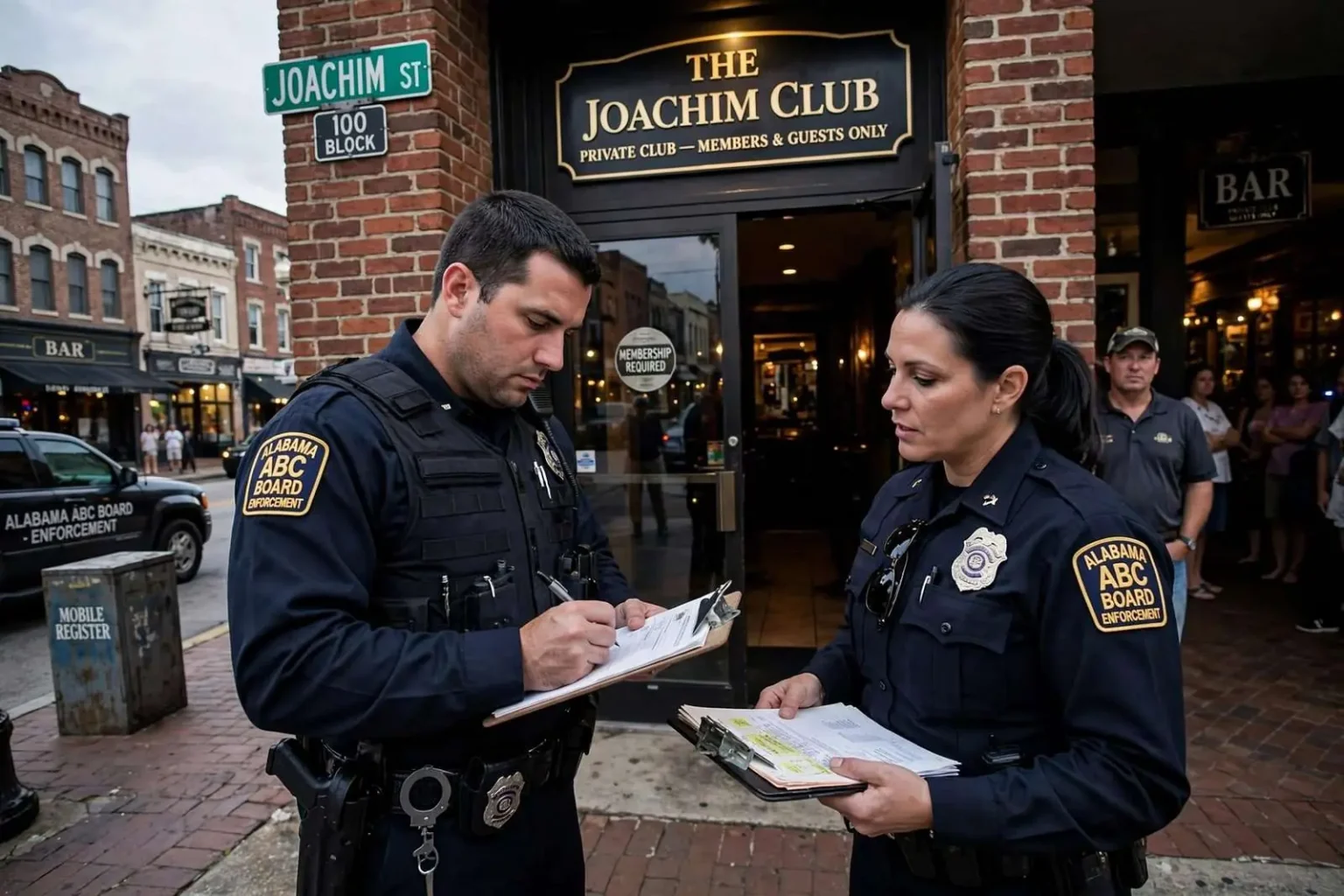
Alabama Alcoholic Beverage Control Board officials said they had increased enforcement at private clubs in downtown Mobile after receiving complaints from local officials and law enforcement, sending agents into a string of Joachim Street-area establishments to check licenses, membership rolls and operating practices.
ABC Lt. Michael Cook said many of the clubs initially inspected had license-related violations. The checks focused on whether the clubs were operating within the terms of their state licenses — a category that covers everything from membership documentation to the hours and manner in which alcohol could be served.
The legal framework mattered. Private clubs could serve alcohol between 2 a.m. and noon on Sundays, an exception carved into Alabama law for organizations that operate as bona fide membership clubs, but they were required to issue membership cards and limit admission to bona fide members and their guests. Clubs that operated as de facto open bars while holding private club licenses drew the kind of complaints that trigger enforcement.
The distinction is an old one in Alabama, where Sunday alcohol laws have long been stricter than the rest of the week. Private clubs occupy a specific niche in that system: they are not open to the general public, they charge memberships, and in exchange they can serve during hours when ordinary bars cannot — provided they actually operate as clubs.
Inspectors on Joachim Street
The stepped-up checks brought ABC agents into the downtown entertainment district in visible numbers, inspecting records and interviewing operators. For club owners, the inspections were hard to miss, and the sight of several enforcement officers working a single block drew immediate attention from patrons and neighboring businesses.
Mobile City Councilman William Carroll said the visible presence of several enforcement officers during a downtown visit concerned him and could be perceived as intimidating. His comments reflected a tension that runs through enforcement stories like this one — the difference between compliance checks residents welcome and a show of force that businesses read as pressure.
Club owners, who did not speak on camera, expressed concern that the enforcement effort could affect their ability to remain open during the Sunday-morning hours. The Sunday 2 a.m.-to-noon window is a meaningful slice of revenue for downtown clubs, particularly those serving the after-hours crowd that leaves ordinary bars at closing time, and any restriction on how they could operate during those hours threatened the business model directly.
Cook said the agency was not trying to put businesses out of operation, but to bring them into compliance. He framed the effort as regulatory housekeeping rather than a crackdown — the board’s job, in his telling, was to make sure licensed businesses operated within their licenses, not to close them down.
He said violations had declined in the weeks after the stepped-up checks and that officers could shift their attention once compliance improved. That trajectory — enforcement, improvement, redeployment — is the standard arc the ABC Board describes for such campaigns, aimed at changing behavior rather than accumulating citations.
How Alabama’s private club system works
Alabama licenses both on-premises retailers — bars and restaurants — and a separate class of private clubs, each with its own rules. A private club must maintain a genuine membership structure: dues or membership fees, membership cards issued to members in good standing, and admission limited to members and their bona fide guests. In return, the club gains privileges under state law, including the Sunday-morning serving window that ordinary bars do not enjoy.
The system exists because Alabama’s alcohol laws were written in a different era and amended piecemeal over the decades. Sunday restrictions, dry counties, municipal option elections and a patchwork of local rules mean that what a bar may legally do depends on its classification, its city and its county — a framework that makes the private club license valuable, and makes violations of its terms a real enforcement concern.
Downtown Mobile’s entertainment district gave the rules particular stakes in 2008. Joachim Street and the surrounding blocks anchor the city’s nightlife, and the clubs along those streets served the late-night crowd that spills out of regular bars after 2 a.m. on weekends. Whether that scene operated within its licenses was the question the inspections were designed to answer.
The council’s role in enforcement debates
Carroll’s concerns pointed to the layered governance of alcohol enforcement. The ABC Board is a state agency with authority over licensing and enforcement statewide, but the businesses it inspects sit in city council districts whose representatives hear directly from owners and constituents. When a state enforcement action lands visibly on a councilman’s block, the council is rarely silent.
The complaints that triggered the checks reportedly came from local officials and law enforcement — meaning the city itself asked for the state’s involvement. That dynamic, where local government requests state enforcement and then voices concern about its manner, is common in alcohol regulation, where calls for action and calls for restraint often come from the same body in the same season.
For the clubs, the practical consequence of the summer 2008 campaign was documentation. Owners who could produce membership cards, records and license paperwork passed their inspections; those who could not faced violations that could compound with repeated findings. Cook’s report that violations declined in subsequent weeks suggested the campaign achieved its stated purpose.
By the time the enforcement effort wound down, the episode stood as a snapshot of Alabama’s regulatory landscape: a state board enforcing membership requirements written generations ago, a city council weighing compliance against business climate, and a downtown nightlife district adapting to the rules that let it pour on Sunday mornings.
Sunday laws and their long history
Alabama’s Sunday restrictions trace to the blue-law tradition common across the South, where statutes once limited nearly all Sunday commerce. Alcohol provisions proved the most durable, and their partial liberalization over the decades — through local option elections and legislative amendments — created the complex map that operators navigate today. In Mobile County, voters and legislators had long since settled on Sunday sales for ordinary licensees beginning at noon, with private clubs enjoying the earlier window as part of their special classification.
The private club exemption itself dates to an era when drinking clubs were a recognized part of the social landscape, and the law’s requirement that they issue membership cards was intended to distinguish genuine clubs from businesses simply seeking longer hours. Enforcement campaigns like the 2008 effort in Mobile test exactly that distinction: a club with a full bar, no meaningful membership records and an open door is operating as a bar, whatever its paperwork says.
For downtown Mobile’s club operators, the distinction was more than legal theory. The Sunday-morning hours served a specific clientele — hospitality workers getting off shift, late-night diners, the after-hours crowd — and losing that window to compliance problems would have removed a competitive edge the private club license was supposed to provide.
What the checks left behind
The immediate legacy of the July 2008 campaign was the one Cook described: violations down, compliance up, and a framework for the future. Clubs that regularized their membership records could keep serving their Sunday window; those that did not faced the prospect of escalated action from the board, up to and including license sanctions.
The episode also illustrated the relationship between Mobile’s nightlife and its regulators. The entertainment district that grew along Dauphin and Joachim streets in the years after 2008 became a centerpiece of downtown revitalization, and the question of how state alcohol rules apply to its businesses has returned periodically — in hours debates, in licensing questions and in enforcement actions like the summer 2008 checks.
For residents researching the period, the report captures a moment when the state’s alcohol enforcement machinery and downtown Mobile’s club scene intersected: complaints from local officials and law enforcement, inspections by ABC agents led on the record by Lt. Michael Cook, concerns raised by Councilman William Carroll about the visible show of enforcement, and a state agency insisting its goal was compliance, not closure.
Enforcement by the numbers of practice
An ABC license check follows a routine that regulars in the bar business know well. Agents arrive, identify themselves, and ask for the establishment’s license and records; then they verify the membership rolls against who is actually in the building, check whether non-members are being served, and look at the other conditions — hours, purchases from licensed distributors, the physical layout — that the license requires. A club that keeps proper cards and limits its door can clear the inspection in minutes.
The violations Cook referenced fell in the license-related category, meaning the problems were documentary and operational rather than criminal in nature. That kind of finding typically leads to corrective action and follow-up visits rather than arrests, and it explains why the campaign ended with declining violations rather than a string of closures: most operators, once inspected, fixed what the agents found.
The visible nature of the checks was itself part of the strategy. Enforcement that spreads by word of mouth through a district’s operators achieves compliance at businesses the agents never entered, and the ABC Board has historically used that ripple effect deliberately — inspecting enough establishments in a district that every operator nearby gets the message.
For the councilman who raised concerns, the balance was between those two legitimate goals: a district that follows its licenses, and businesses that do not feel targeted while getting there. The weeks after the checks, with violations down and no closures announced, offered a version of both.
The July 10, 2008, report thus closed on the enforcement campaign’s early results — inspections complete at the first tier of clubs, license violations found at many of them, complaints from the business community on record, and the state board describing a compliance effort that would continue until the Sunday-morning window operated the way its rules intended.