Fairhope Museum of History Prepared for 2008 Opening
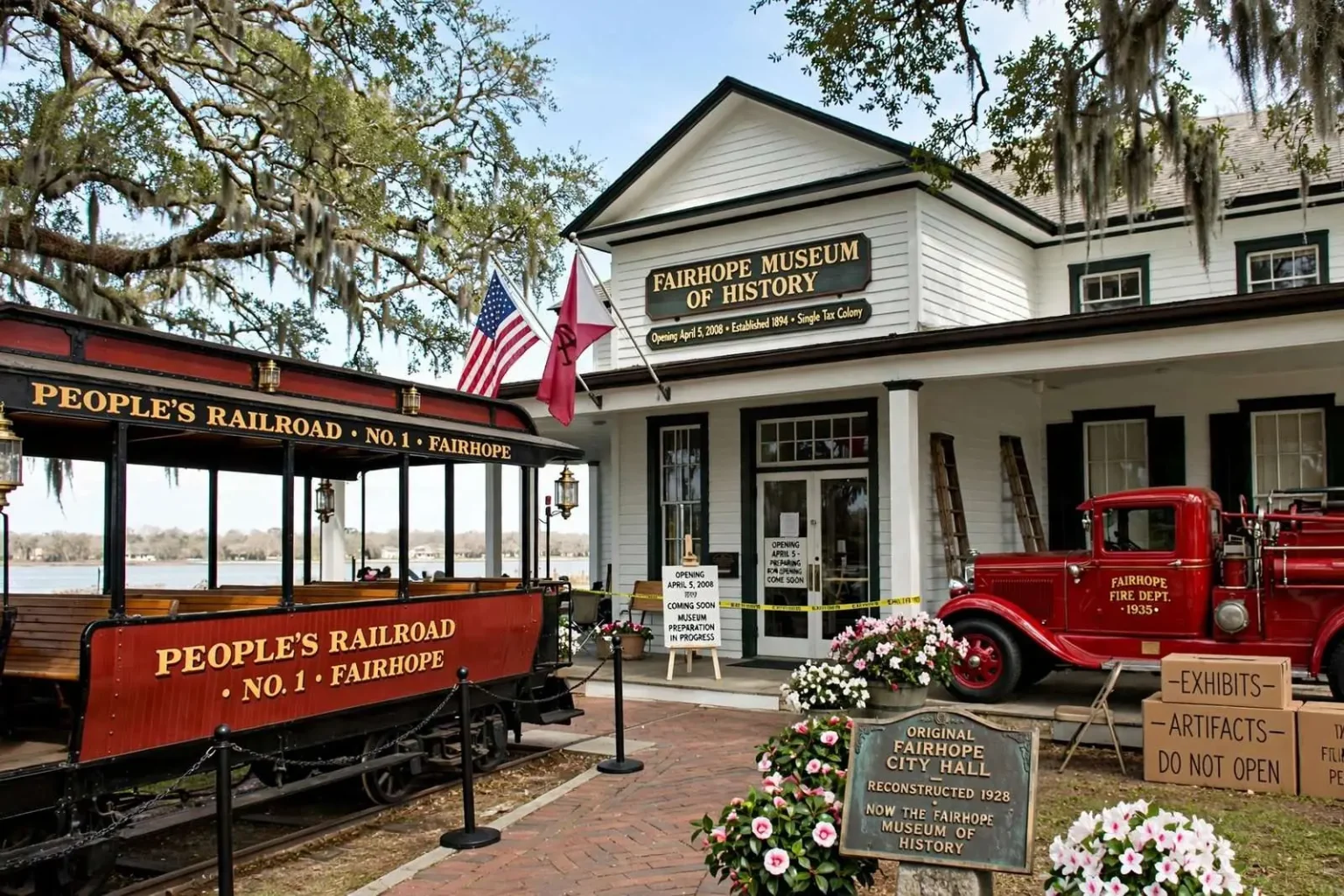
The Fairhope Museum of History prepared to open in April 2008 with exhibits in the original city hall, a People's Railroad car and a 1935 fire engine.
Originally reported February 22, 2008.
FAIRHOPE, Ala. — The Fairhope Museum of History was preparing to open on April 5, 2008, with exhibits spanning the city’s civic and cultural history, capping a years-long effort to give the Eastern Shore community a permanent home for its unusually rich past. Museum Director Donnie Barrett described the plans as the museum readied its building and displays for the public.
Among the artifacts planned to greet visitors was a car from the People’s Railroad, the little railway that carried Fairhope passengers between Mobile Bay and downtown from 1914 to 1923. The restored car was to stand as a centerpiece of the collection — a tangible piece of the era when Fairhope’s single-tax founders were still shaping the utopian settlement they had carved out on the bluff above the bay.
The museum also incorporated the original Fairhope City Hall, preserving and recreating the old municipal building as it appeared in 1928. The recreation included a mayor’s office, a fire-truck bay, and a jail, letting visitors walk through the rooms where the city’s business was conducted in its early decades. Original jail cells retained historic wall markings, while the museum’s newer section was organized as a chronological museum, carrying the story of Fairhope forward decade by decade.
A 1935 fire engine was planned for an interactive display next to the recreated mayor’s office, giving children and adults a hands-on encounter with the equipment that protected the growing town. The project was built with $1.5 million in funding from the city, the Fairhope Single Tax Corporation, and community groups — a partnership that reflected how deeply Fairhope’s civic institutions were tied to the story the museum set out to tell.
What the People’s Railroad Was
The People’s Railroad holds a place in Fairhope lore out of proportion to its size. In the early twentieth century, visitors and residents arriving by steamer from Mobile landed at the Fairhope wharf at the bottom of the bluff, facing a steep climb to the townsite above. The railroad — a modest operation by any standard — ferried passengers between the bay and downtown from 1914 to 1923, hauling tourists, summer visitors, and settlers up the hill during the years when Fairhope was transforming itself from a utopian experiment into a settled community.
For a museum, the car is an ideal anchor artifact: nearly every longtime Fairhope family has a story about it, and it physically embodies the town’s connection to the bay. Its restoration and placement at the museum entrance was designed to greet visitors the way the railroad once greeted arrivals to Fairhope — as the first thing they encountered on the way into town.
The Old City Hall as Exhibit
The decision to build the museum around the original City Hall gave the project a setting most small museums cannot offer: the genuine article. The old municipal building had housed the machinery of Fairhope’s government through the 1920s, and its recreation as it appeared in 1928 restored three signature spaces — the mayor’s office where the town’s affairs were conducted, the fire-truck bay where volunteers rolled out to fight blazes, and the jail where the occasional lawbreaker spent the night.
The original jail cells, with their historic wall markings intact, became among the museum’s most atmospheric features. Markings scratched and drawn into the walls by past occupants offer the kind of unmediated connection to the past that no recreated display can match, and museum planners made preserving them a priority. Beside the mayor’s office, the 1935 fire engine was planned as an interactive display — the kind of exhibit that gives younger visitors permission to engage with history physically rather than from behind a rope.
The chronological organization of the newer section was meant to carry visitors through Fairhope’s whole story in sequence: the founding of the Fairhope Industrial Association in 1894, the arrival of the single-tax colonists on the bluff, the growth of the town through the steamboat era and the arrival of the automobile, the evolution of the Fairhope Single Tax Corporation’s unusual land arrangement, and the city’s emergence as an Eastern Shore center for artists, writers, and free thinkers across the twentieth century.
Fairhope’s Unusual Founding
Any museum telling Fairhope’s story has to begin with the town’s singular origins. Fairhope was founded in 1894 by a group of Midwestern reformers who came to the Alabama coast to put into practice the economic ideas of Henry George — the single-tax philosophy holding that land should be held in common and taxed on its value alone, freeing labor and enterprise from speculative rent. The settlers purchased land on the bluff above Mobile Bay and named their experiment Fairhope, they said, because they had a fair hope of success.
The colony’s land was later held by the Fairhope Single Tax Corporation, which continues to lease land to residents and businesses under the founding arrangement — a structure that makes Fairhope one of the longest-running single-tax communities in American history. The town grew from that radical beginning into one of the Eastern Shore’s most distinctive communities, known for its flower-filled streets, its long tradition of attracting writers, artists, and intellectuals, and its park and pier overlooking the bay. Institutions from the school system to the library carried the colony’s civic idealism forward, and that layered history is precisely what the museum’s backers wanted to preserve while the people who remembered it firsthand were still alive to share it.
Building the Museum on Partnership
The $1.5 million project was funded by a combination that mirrored the town itself: an appropriation from the city, support from the Fairhope Single Tax Corporation — the successor to the founding colony and a natural partner for an institution dedicated to the town’s history — and contributions from community groups and residents. That mix of public money, colony heritage, and grassroots giving suited an institution whose subject was the interplay of all three.
For Director Donnie Barrett and the museum’s volunteers, the road to the April 5, 2008, opening meant years of gathering artifacts, restoring the People’s Railroad car, and rehabbing the old City Hall building into gallery space while preserving its historic character. Small-town history museums are typically built on exactly that kind of labor: donated hours, family attics emptied of heirlooms, and the patient work of turning a community’s stored memories into organized exhibits. The work also demanded the quieter disciplines of museumcraft — cataloging donations, guarding fragile textiles and photographs from Gulf Coast humidity, and deciding which of the thousands of candidate objects truly belonged in the story the galleries were built to tell.
Volunteers and donors gave the project its momentum at every stage. Local historical organizations combed their own collections for loans, families brought in photographs of the steamer era and the founding decades, and craftspeople took on the restoration jobs that returned the railroad car and fire engine to display condition. Community fundraising events kept the capital campaign moving toward its $1.5 million goal, and the city’s backing signaled that the museum would be a civic institution rather than a private club for history enthusiasts.
The museum also joined an Eastern Shore cultural corridor that was taking shape in the same era, alongside Fairhope’s art galleries, the neighboring communities’ own preservation efforts, and the attractions of Mobile Bay’s shoreline. For a city whose brand was built on charm and history, a dedicated museum gave visitors and new residents a single place to learn how the community came to be — and gave old families a repository for the photographs, documents, and objects that would otherwise scatter as generations passed.
What Visitors Found at the 2008 Opening
Visitors arriving on opening day were planned to encounter the museum’s story in layers: the People’s Railroad car at the threshold, the recreated 1928 City Hall rooms with the marked jail cells beyond, the 1935 fire engine beside the mayor’s office, and the chronological galleries carrying Fairhope from its founding decade through the modern era. The arrangement made the building itself part of the collection — a museum inside the very rooms where much of the history it tells was made.
For the community that funded it, the museum’s opening represented something beyond tourism. Fairhope had spent more than a century being written about — by colony enthusiasts, by the writers and artists who wintered there, and by the visitors who arrived by steamer and later by car across the bay. The Museum of History gave the city the chance to tell its own story in its own words, anchored by the artifacts — a railroad car, a fire engine, a jail with its walls still marked — that no outside account could reproduce.
The April 5, 2008, opening capped the effort with what the project’s partners had promised from the start: a permanent, public place where the history of one of Alabama’s most distinctive towns would be kept, interpreted, and passed on — in the old City Hall where much of that history had happened, on a bluff where it all began.