143 Sick in 2008 Outbreak on Mobile-Based Carnival Cruise
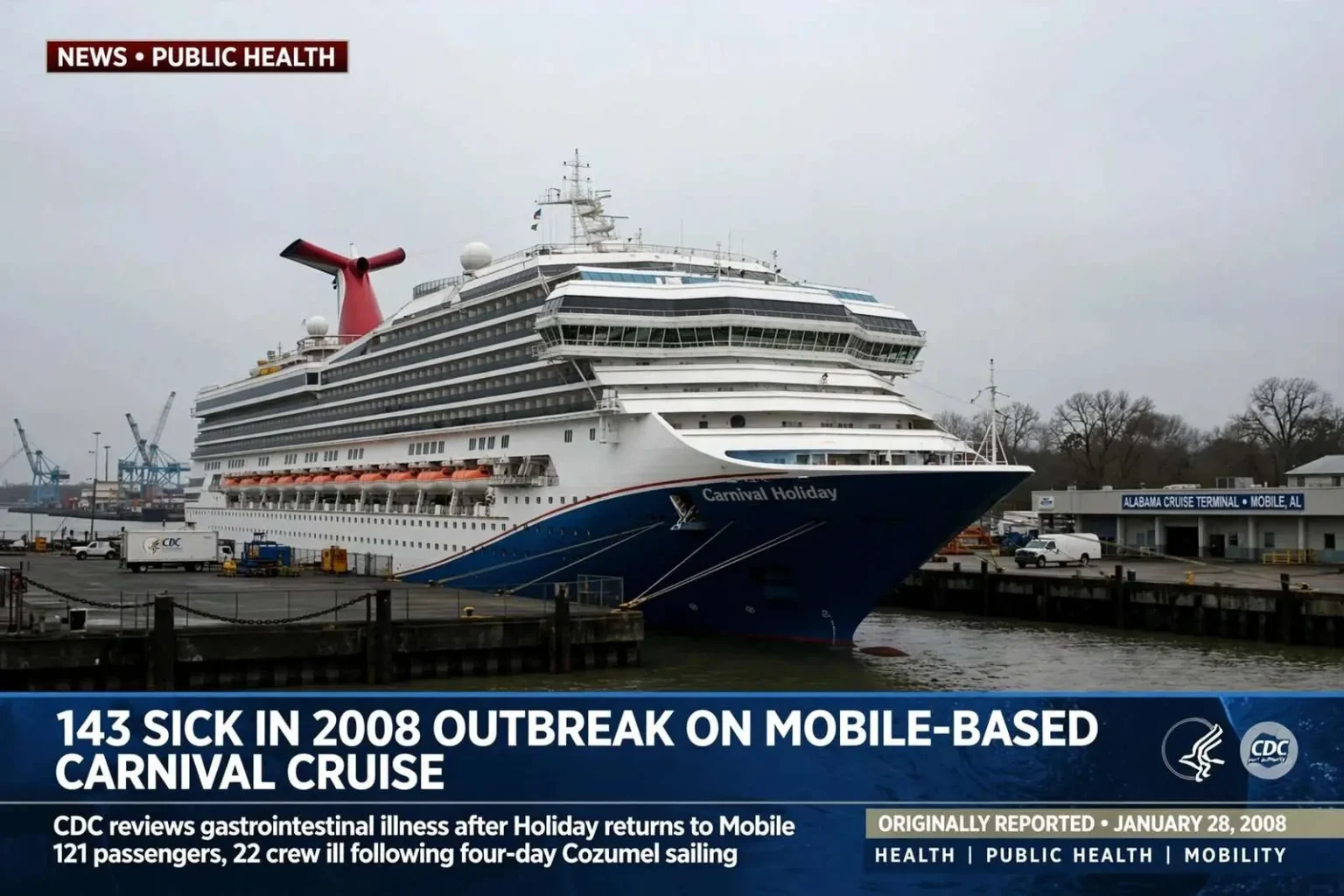
In January 2008, the CDC reviewed an outbreak of gastrointestinal illness among 143 passengers and crew members aboard Carnival's Holiday after it returned to Mobile.
Originally reported January 28, 2008.
The Centers for Disease Control and Prevention reviewed an outbreak of gastrointestinal illness involving 143 passengers and crew members aboard Carnival Cruise Lines’ Holiday after the ship returned to Mobile in January 2008. The vessel had completed a four-day cruise to Cozumel.
The station reported that 121 passengers and 22 crew members became ill with sudden nausea, vomiting and diarrhea. The CDC was analyzing laboratory specimens to identify the cause and had not confirmed whether norovirus was involved. Officials said shipboard outbreak reviews can include inspections of food storage and restroom sanitation.
The numbers made the episode notable but not extraordinary by cruise-industry standards. On a ship carrying roughly a thousand passengers plus crew, 143 cases represented a significant outbreak worth federal investigation, yet the industry’s most severe norovirus years have produced episodes with many times more cases. The swift onset of symptoms and the rapid spread through both passengers and crew — who live and work aboard the vessel between cruises — fit the profile of the highly contagious stomach bugs that periodically sweep through closed environments like ships, dormitories and nursing homes.
The Holiday’s route made it a familiar presence in Mobile. The ship sailed short cruises from the Alabama Cruise Terminal, offering four- and five-day itineraries to Cozumel that drew travelers from across Alabama, Mississippi and the Florida panhandle who wanted a cruise without the drive to a Florida port. The vessel was an older, mid-sized ship by industry standards, and its Mobile-based operation was an important piece of the city’s effort to build a cruise business around its downtown riverfront terminal.
How the Investigation Worked
The report said the Holiday had experienced a similar illness outbreak in 2003. Despite the 2008 incident, the manager of Mobile’s cruise terminal said the ship was scheduled to depart again that afternoon.
The CDC’s Vessel Sanitation Program is the federal office responsible for investigating outbreaks like this one. The program maintains inspectors who board cruise ships to examine food handling, water systems, kitchen sanitation and restroom facilities, and it publishes sanitation scores for every ship that calls at a U.S. port. When an outbreak occurs, the program’s epidemiologists collect stool specimens from ill passengers and crew, interview the sick about what they ate and where they went, and track the pattern of illness to distinguish a food-borne source from person-to-person spread.
Laboratory analysis of those specimens is what settles the question of causation. Norovirus — the most frequent culprit in shipboard outbreaks — cannot be diagnosed from symptoms alone, since other viruses and bacteria produce identical misery. In 2008, confirmation took days of testing, which is why the initial reports from Mobile could describe the illness in detail while explicitly leaving the cause unconfirmed. The CDC’s review of food storage and restroom sanitation ran in parallel, covering both the possibility of contaminated food and the environmental conditions that allow a virus to spread through shared surfaces.
That a similar outbreak had struck the same ship five years earlier was not unusual in the way it might seem. Large ships carry thousands of passengers in shared spaces, and norovirus in particular survives on surfaces for days, resists many common disinfectants and requires only a tiny dose to infect a new host. Once a ship’s environment is contaminated, an inadequate turnaround cleaning can seed the next cruise — the reason outbreak investigations pay close attention to how thoroughly a vessel is sanitized between voyages.
What Happened Next in Mobile
The decision to sail on schedule that same afternoon reflected both the assessment of the situation and the realities of cruise operations. The ill passengers had disembarked, the ship was being cleaned, and no finding of the ongoing investigation yet required the vessel to stay in port. Cruise lines generally conduct enhanced disinfection during turnaround days — the hours between one cruise’s disembarkation and the next cruise’s boarding — concentrating cleaning crews on cabins, public rooms and high-touch surfaces like railings, elevator buttons and buffet handles.
For passengers weighing whether to board, the calculus was theirs to make. Travelers concerned about illness could contact the cruise line about rescheduling, but the scheduled departure proceeded. The terminal manager’s public message — that the ship would sail as planned — aimed to project normalcy while the CDC’s work continued in the background.
The episode was also a moment in Mobile’s development as a home port. The Alabama Cruise Terminal on the Mobile River had opened its doors only a few years earlier, part of the city’s downtown waterfront revitalization, and the Holiday was its principal tenant. Cruise passengers eating in downtown restaurants and staying in city hotels before their voyages brought a measurable economic benefit, and an outbreak story on the evening news was exactly the kind of publicity the young operation did not want. The city’s interest in a quick, clean resolution aligned with the cruise line’s.
A Historical Public-Health Record
This article records a historical public-health event, not the current health status of any cruise line or vessel.
Readers coming across this account years later should understand its scope. The facts here — 143 sick aboard the Holiday after a January 2008 Cozumel cruise, 121 passengers and 22 crew among them, laboratory analysis under way, norovirus unconfirmed at the time of reporting — describe one January week in one port. They say nothing about the ship’s later service, the cruise line’s subsequent record or the outcomes of the investigation beyond what was reported at the time.
What the episode illustrates, nearly two decades on, remains instructive. Shipboard illness outbreaks are followed by some of the most systematic public health investigation in the travel industry, precisely because ships concentrate hundreds or thousands of people in closed shared spaces. The Vessel Sanitation Program’s inspections and outbreak reviews, developed over decades, turned cruising into one of the most closely monitored travel sectors — and episodes like the Holiday’s January 2008 return to Mobile are the case studies that shaped that system.
For Mobile, the incident passed without lasting damage to its cruise ambitions, and the Holiday continued sailing from the Alabama Cruise Terminal as scheduled that very afternoon. The 143 cases stood, in the local record, as an example of how a modern port and a federal health agency handle a disease outbreak: specimens collected, causes investigated, the vessel sanitized, and the next cruise — like it or not — departing on time.
Norovirus and the Closed-Ship Environment
Why do cruise ships keep producing these outbreaks? The answer lies in the nature of the virus rather than any failure of one line or vessel. Norovirus spreads through contaminated food and water, through contact with contaminated surfaces, and through the air when an ill person vomits — a spread pattern that turns a shared buffet, an elevator bank or a casino floor into a transmission network. Fewer than a few dozen virus particles are enough to infect a healthy adult, and an ill person remains contagious for days after symptoms stop.
Ships concentrate all of the conditions the virus needs: thousands of people sharing kitchens, bathrooms, dining rooms and entertainment spaces; crew members who live aboard continuously; and quick turnarounds that leave little slack in cleaning schedules. The same dynamics operate in hotels and resorts, but a hotel guest checks out and goes home, while a ship’s environment carries over from cruise to cruise. Hence the industry’s heavy emphasis on hand washing announcements, surface disinfection during voyages and the thorough terminal-day sanitations that followed the Holiday back into Mobile.
Passengers who fall ill on a modern cruise are asked to report symptoms to the ship’s medical staff, and ships isolate ill passengers in their cabins, sometimes for the remainder of the voyage. Those measures, inconvenient as they are, serve the collective interest: containing an outbreak early keeps a bad week from becoming a worse one, and it gives the ship’s sanitation crews a head start on the deep cleaning required before the next boarding.
The Mobile Cruise Terminal Context
The Holiday’s role in Mobile deserves its own note in this record. The ship — a veteran of Carnival’s fleet — was assigned to the Alabama Cruise Terminal to serve the Gulf Coast market, and its short itineraries made cruising accessible to families who might never book a seven-day voyage from Florida. Weekend escapes and four-day Cozumel runs built the local customer base, and the ship’s presence anchored the terminal’s early operations.
An outbreak aboard a home-ported ship hits that local operation directly, because the same passengers return to the same port and the same news market. The January 2008 reporting reflected that local stake: the story ran with details of the CDC review, the previous 2003 outbreak aboard the same vessel and the terminal manager’s assurance about the next departure, all within a day of the ship’s return.
Public health officials’ advice to travelers in such episodes has stayed consistent across the years: wash hands frequently and thoroughly aboard any ship, use the hand sanitizer stations placed at dining room and buffet entrances, report illness promptly rather than riding it out in public spaces, and consider travel insurance or flexible booking options during the height of the winter stomach-bug season. The 143 cases aboard the Holiday in January 2008 — 121 passengers and 22 crew, felled by sudden nausea, vomiting and diarrhea after a four-day run to Cozumel — became one more entry in the long record from which those habits were learned.