Mobile County Adopted Stronger Wind Standards for New Homes in 2008
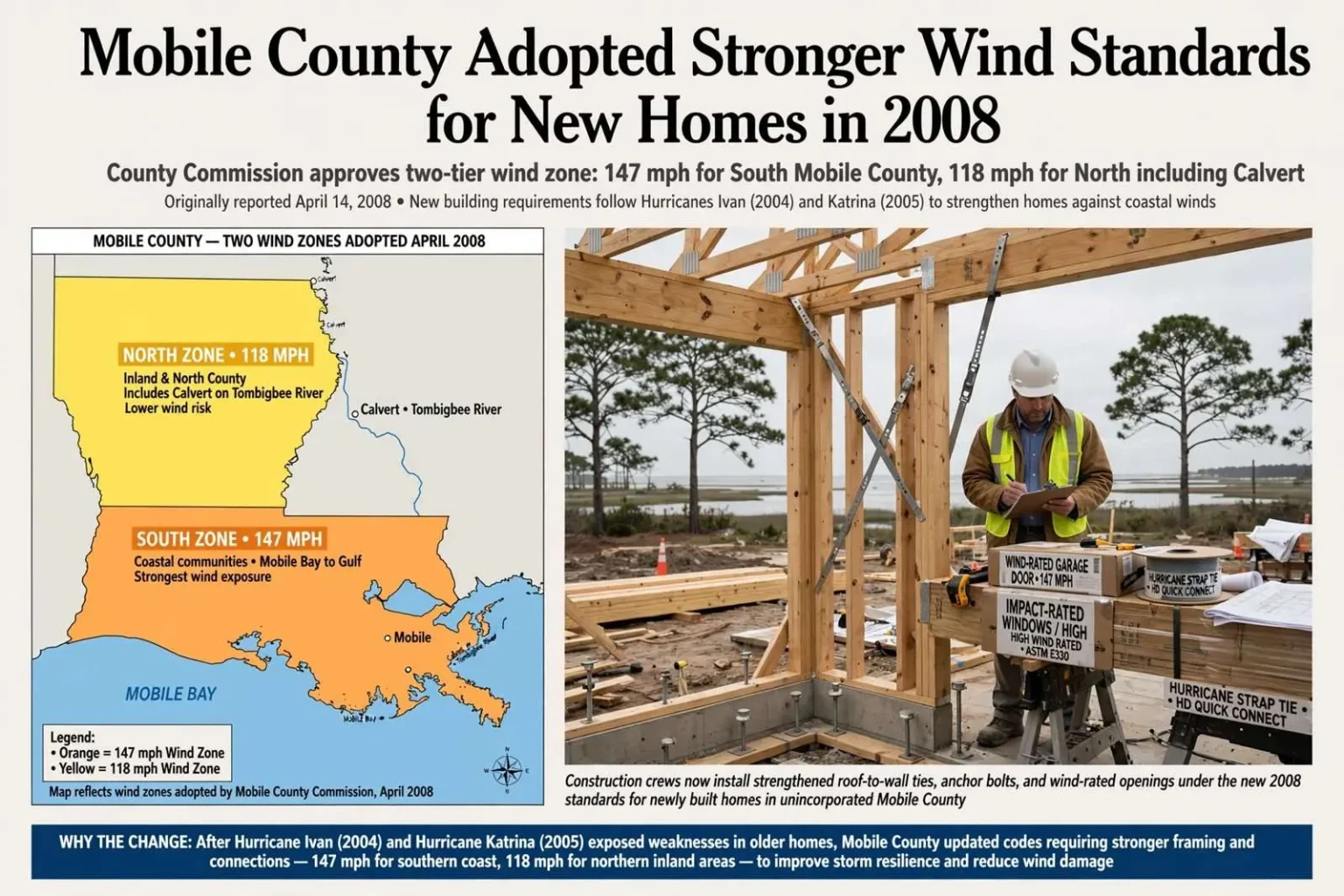
Mobile County approved new 2008 building standards requiring new homes in the south county to withstand winds up to 147 mph and homes in the north county up to 118 mph.
Originally reported April 14, 2008. The Mobile County Commission approved new building standards in April 2008 requiring newly built homes to meet higher wind-resistance thresholds. The move was part of a broader push along the Gulf Coast to harden new construction against hurricanes after the devastating seasons of 2004 and 2005, which had shown how vulnerable older homes were to wind damage.
The county’s director of inspection services said new homes in south Mobile County would have to withstand winds of up to 147 mph. New homes in north Mobile County, including Calvert, would need to withstand winds of up to 118 mph. The two-tier map reflected the way wind risk declines with distance from the Gulf: communities along Mobile Bay and the coastline south of the city face the strongest gusts during a landfalling hurricane, while areas toward the Mississippi and Washington county lines, including river towns like Calvert on the Tombigbee, sit in a lower wind zone.
Under the standards, builders in the higher-risk southern zone had to account for stronger shear walls, deeper anchor bolts and hold-down hardware connecting roof framing to walls and foundations, and window and door assemblies rated for higher wind pressures. Roof coverings, garage doors, and gable-end bracing were also key points of attention, since failures at those points allow wind to pressurize a house from the inside and lift the roof. In the 118 mph zone, the requirements were less demanding but still above what had been standard in earlier decades of residential construction.
The report said homes already under construction would not be affected, although most were already following the incoming standards. Builders typically design projects to the code in force at the time their permits are issued, and many contractors in the Mobile area had already shifted to the stricter wind provisions as suppliers stocked materials to meet the new requirements. That transition eased concerns from the building industry that projects in the permit pipeline would face costly redesigns mid-construction.
Why Mobile County Raised Its Wind Standards
The April 2008 decision did not come out of nowhere. Hurricane Frederic’s landfall in 1979 had already shown how much damage a major storm could do to the Mobile area, destroying thousands of buildings across the county and reshaping the local building industry for a generation. More recently, Hurricane Ivan came ashore near Gulf Shores in September 2004 and raked Mobile County with damaging winds, and Hurricane Katrina followed in August 2005, reminding residents that even a storm making landfall well west of the bay could strip roofs, topple trees, and knock out power for weeks across south Alabama.
Those storms exposed a consistent pattern: houses built to older, weaker standards failed at their most vulnerable connections, while newer homes engineered for high winds generally stayed intact. Engineering research after each landfall fed into the International Residential Code and related model codes, which pushed wind design speeds upward in coastal counties. Mobile County’s 2008 action aligned the county with that trend and with requirements many neighboring jurisdictions in Baldwin County and along the Florida Panhandle had already adopted.
Stronger construction standards carry practical benefits beyond storm survival. Homes that keep their roofs and openings intact during a hurricane suffer less water intrusion, which is often the difference between a repair and a total loss. Insurance considerations also enter the picture, since wind-rated construction can influence premiums and, in some programs, qualifies new homes for credits. For a county where a significant share of the housing stock dates to mid-century, raising the bar for new construction was seen as a way to gradually improve the community’s overall storm resilience with each new subdivision and infill house.
What the Two Wind Zones Covered
South Mobile County’s 147 mph requirement covered the area of greatest exposure, including communities around Mobile Bay and the county’s southern reaches where storm surge and the strongest sustained winds overlap. Design wind speed is not the speed of the worst gust a storm might produce; it is an engineering benchmark used to size structural elements so a house can resist the forces that a design-level storm is expected to generate at that location. Higher design speeds translate into stronger framing connections, more robust roof-to-wall attachments, and stricter standards for exterior openings.
North Mobile County, including Calvert, was placed in the 118 mph zone. Calvert sits along the Tombigbee River in the northern part of the county, well inland from the bay, and communities there historically experience lower gusts than the coast during Gulf landfalls. The lower zone still represented an upgrade over older construction practices, requiring engineered connections and wind-resistant detailing that many pre-1990s homes in the area never received.
How Enforcement Worked in Mobile County
Mobile County’s inspection services office reviews residential plans and inspects construction in unincorporated areas of the county, while the city of Mobile and the county’s smaller municipalities administer their own permitting within their corporate limits. That structure means builders working in different jurisdictions had to track which standards applied where, though the 2008 move brought the county’s unincorporated areas into line with the stricter wind provisions already spreading across the region. Inspectors verify critical stages of construction, from foundation anchorage to framing and final connections, so that the engineered details in the plans actually make it into the finished house.
The county commission’s approval in April 2008 followed public discussion with builders, developers, and homeowners about costs and implementation. Stronger hardware, rated windows and doors, and additional framing add expense to a new home, and builders in the region had argued for transition time to adjust designs and bidding. Allowing homes already under construction to proceed under earlier standards addressed that concern while the bulk of new work moved to the higher thresholds.
For homebuyers, the practical effect was that houses permitted after the change came with structural features that were rare in older Gulf Coast housing stock: continuous load paths tying the roof to the foundation, stronger garage doors, and window assemblies rated for coastal wind pressures. Realtors and insurers in hurricane-prone markets had increasingly highlighted those features, and the 2008 standards meant buyers in unincorporated Mobile County would see them as a baseline rather than an upgrade.
A Record of What Was Reported in 2008
This article records the standards reported in 2008 and is not a statement of current code requirements. Building codes are revised on a regular cycle, and wind design provisions for coastal counties have continued to evolve in the years since, alongside changes adopted after later Gulf hurricanes. Municipalities within Mobile County, the county government for unincorporated areas, and the state’s building code adoption process can each affect what rules apply to a particular lot.
Readers planning construction should verify current rules with the applicable local authority before designing or permitting a project. The inspection services office for unincorporated Mobile County, or the building department for the city or town where a lot sits, can confirm the wind zone, design speed, and structural requirements in force today, along with permit procedures and inspection requirements. Checking early in the planning process helps builders and homeowners avoid redesign costs and ensures that a new home is engineered for the wind environment of the Alabama Gulf Coast.
What Homeowners Could Do Beyond the Code
Local emergency managers and extension agents encouraged homeowners in Mobile County to think about wind resilience as an ongoing project rather than a one-time code requirement. While the 2008 standards bound only new construction, owners of existing homes could retrofit key weak points: replacing ordinary garage doors with wind-rated models, adding hurricane straps in attics where roof framing met walls, installing impact-rated or shuttered openings, and keeping mature pines and oaks trimmed away from rooflines. Those measures addressed the same failure patterns that the new codes were written to prevent in newer houses.
The two-tier map also gave south Mobile County buyers a useful way to compare homes. A house built after the April 2008 adoption in the 147 mph zone carried structural hardware and opening protections that an adjacent 1980s home likely lacked, and that difference showed up in both storm performance and repair bills after subsequent Gulf storms. Inspectors and appraisers in coastal Alabama had grown familiar with the visible markers of wind-rated construction, from strap plates in the attic to deeper anchor schedules at the sill.
For builders, the transition period in 2008 meant reworking standard plan sets, updating supplier orders for hardware and fasteners, and briefing crews on the stricter inspection checkpoints. Contractors who worked across jurisdictional lines, moving between unincorporated Mobile County and neighboring Baldwin County or the city of Mobile, had to keep the differing requirements straight, but most in the industry viewed the higher standards as the direction the entire Gulf Coast was heading. The 2008 vote placed Mobile County squarely in line with that regional trajectory, and it meant every new subdivision approved after that spring would be built to resist the hurricanes the coast has always had to plan for.