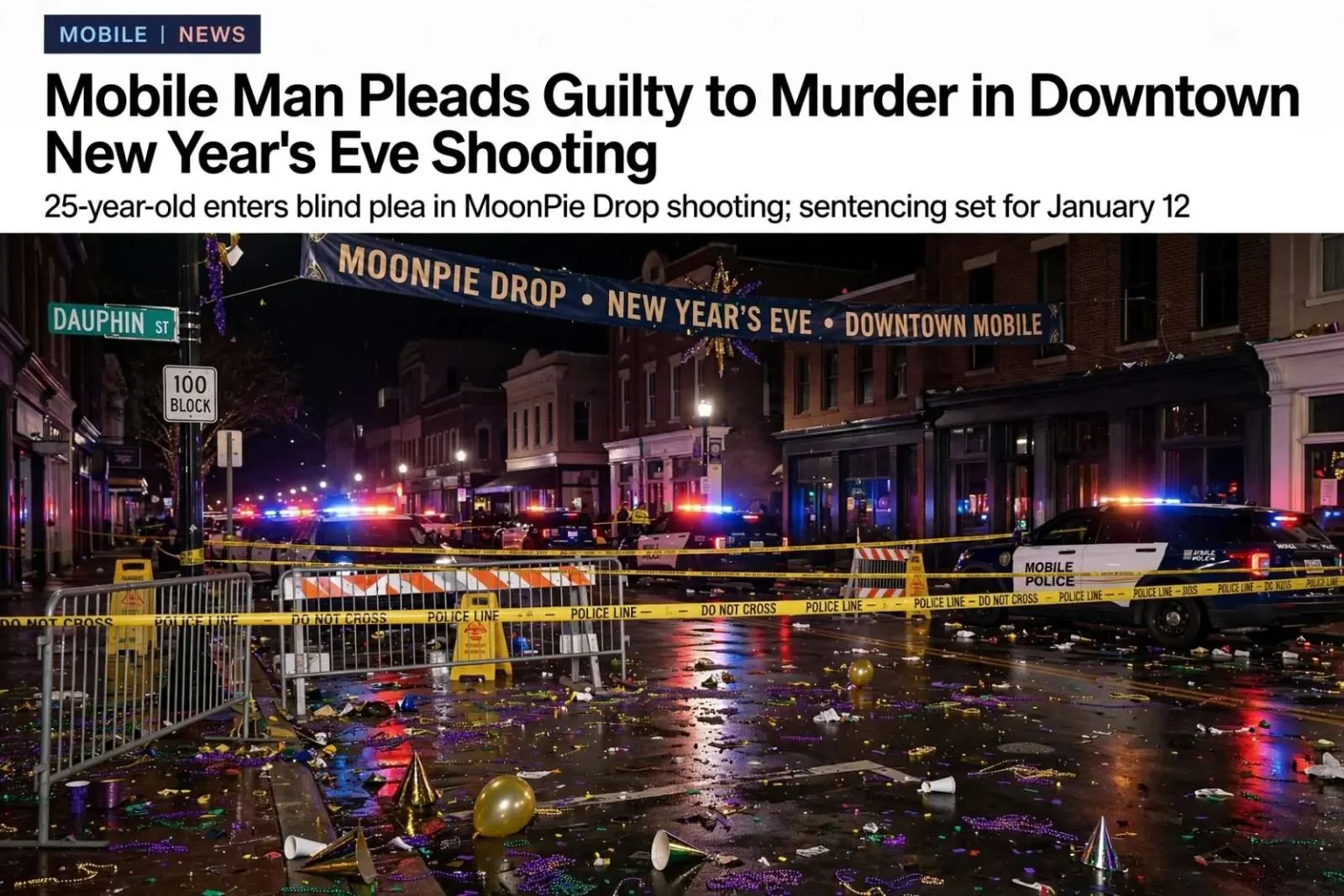
A Mobile man accused of touching off a chaotic gunfight during last year’s downtown New Year’s Eve celebration has pleaded guilty to murder rather than pursue a “Stand Your Ground” hearing that had been scheduled for the same day. Thomas Earl Thomas Jr., 25, of Mobile, entered what is known as a “blind plea” to murder and first-degree assault, meaning prosecutors made no promise to recommend a lighter sentence in exchange. Mobile County Circuit Judge Vicki Davis has set sentencing for January, and Thomas faces a range of 20 years to life in prison.
The plea removed the possibility of a dismissal hearing that could have ended the case before trial, and it committed Thomas to sentencing with no negotiated ceiling. In Alabama practice, a blind plea is the defendant’s wager that whatever a judge imposes will be no worse than the risks of trial — a wager defendants rarely make when they believe the evidence favors them.
What Happened on New Year’s Eve
The case stems from a shooting that broke out just before midnight on Dec. 31 on Dauphin Street, as thousands of revelers packed downtown Mobile to watch the MoonPie Drop. The annual celebration, Mobile’s signature holiday event, draws crowds measured in the tens of thousands to the lower Dauphin Street entertainment district, where bars, restaurants and blocked-off streets fill from Royal Street to the Bienville Square area as the countdown approaches.
According to investigators, Thomas opened fire using a Glock switch, an illegal device that converts a semi-automatic pistol into a fully automatic weapon, targeting a man identified as JaTerious Reives. A friend of Reives returned fire, and both men were wounded in the exchange. Seven bystanders who had no connection to the dispute were also struck by gunfire. In seconds, a celebration crowd became a field of falling victims and fleeing witnesses, with officers working the event reacting to gunfire inside a packed, closed-to-traffic corridor.
Thomas is already serving a 10-year federal sentence for illegally possessing the Glock switch used in the shooting. The federal conviction ran on a separate track from the state case, reflecting how machine-gun conversion devices — treated as machine guns under federal law — have become a priority for federal prosecutors in south Alabama.
Prosecutors and the Downtown Calendar
Mobile County Chief Assistant District Attorney Jennifer Susman said the plea reflects prosecutors’ commitment to keeping downtown Mobile safe during major public gatherings. “We are committed to making sure that downtown Mobile is a fun and safe place to celebrate Mardi Gras and New Year’s Eve,” Susman said. “Thomas Thomas will be off the streets when that comes around.”
The stakes for downtown extend beyond a single case. The MoonPie Drop anchors a winter calendar that also includes Mardi Gras, when Mobile — home of the oldest carnival celebration in America — fills its streets with parade crowds for weeks. Any shooting in the entertainment district threatens the sense of security on which that economy depends, which is why the district attorney’s office treated the case as a statement about the city’s biggest nights rather than an ordinary felony plea.
The Glock Switch Problem
Susman pointed to the proliferation of Glock switches as a growing danger in Mobile County and beyond. “Glock switches have really changed the game,” she said. “They’re incredibly dangerous, and there’s all sorts of different legislation that’s been popping up all over the country trying to regulate this issue. But so long as kids have Glock switches, there really is no controlling the output of bullets, and it creates an extreme danger every time someone pulls a trigger on one of those.”
A switch is a small piece of metal or plastic, often ordered online or made with a 3D printer, that snaps onto the back of a semi-automatic Glock pistol and converts its trigger mechanism to fire continuously with one pull. The devices cost little, arrive without background checks when bought illicitly, and turn a handgun carried for a dispute into a weapon that can empty a magazine in seconds — the difference between a gunfight with a defined target and a wall of rounds sweeping a crowd. New Year’s Eve was the demonstration case: ten people shot, seven of them bystanders, in an exchange measured in moments.
Law enforcement has responded on both the federal and state levels. The Bureau of Alcohol, Tobacco, Firearms and Explosives treats a conversion device as a machine gun, making possession a federal offense — the basis of the 10-year sentence Thomas was already serving. Earlier this year, the Alabama Legislature passed its own statewide ban on Glock switches, which carries a 10-year penalty for possession, closing a gap in state law that had left local prosecutors without a specific charge for the devices.
Mobile County District Attorney Keith Blackwood has cited the New Year’s Eve shooting directly as a reason the new law is necessary, though it was not immediately clear whether prosecutors used the new statute in Thomas’ case. The shooting gave the legislative debate in Montgomery a name, a date and a casualty list — the kind of example that tends to move a bill through the Statehouse.
Self-Defense Claim Abandoned
Thomas had long maintained that he fired in self-defense, and the hearing scheduled for this week would have given him the chance to argue for dismissal under Alabama’s Stand Your Ground law. That statute allows a defendant to avoid prosecution if he can show he was lawfully present in a public place and that the other party was the aggressor. The immunity hearing, held before a judge rather than a jury, would have tested that claim with the state’s evidence laid out — a high-stakes preview of trial that either side could lose.
Entering a blind plea forfeited the claim entirely, at least as a path to dismissal. Defense attorney Chase Dearman said he still intends to raise those same issues as mitigating factors when Thomas is sentenced. “You probably want to be there for the sentencing,” Dearman said. The distinction matters: self-defense is not a defense at sentencing in the way it is at trial, but circumstances surrounding the shooting — who fired first, what prompted it, Thomas’s own wounds — can influence where in the 20-to-life range Judge Davis sets the term.
The Families Left Counting
For the victims and their families, the plea closed one chapter of a case that has shadowed them since the first minutes of last New Year’s Day. Seven people who went downtown to celebrate were shot for no reason connected to them, and the questions that follow such wounds — surgeries, rehabilitation, medical bills, the psychological weight of being hit by a stray round at a public celebration — do not resolve with a guilty plea. A sentence is the only part of the process the courts control; the rest is left to the victims.
Natasha Reives, the mother of the man who died in the shooting, said she is now focused on the upcoming sentencing date of Jan. 12. “I just hope justice is done with sentencing,” she said. Her son, JaTerious Reives, was the intended target of the gunfire that night, and his death at a public celebration left a family measuring the case by a single date: the day the judge announces what the killings and wounds will cost.
The sentencing hearing in January will give the court the full picture for the first time — victim impact statements from the wounded bystanders and the Reives family, arguments from Dearman about the self-defense circumstances he wants weighed, and the state’s account of a night when a dispute between two men turned a public festival into a crime scene. Judge Davis’s range runs from 20 years to life, and nothing in a blind plea narrows it.
What the Case Changed in Mobile
The shooting’s aftermath reached into how Mobile protects its own celebrations. The city had already invested in event policing for the entertainment district, and the New Year’s Eve exchange of fire became the reference point for every discussion that followed about camera coverage, officer placement and weapons screening along Dauphin Street during Mardi Gras and the next MoonPie Drop. Prosecutors, meanwhile, acquired a case they could point to whenever gun crimes near packed crowds came before the courts.
The case also became the local emblem of a national problem. Cities across the country have reported surges in recoveries of machine-gun conversion devices, and the New Year’s Eve shooting showed in one incident why police chiefs and prosecutors describe them as a categorical change in street violence: a device worth a few hundred dollars turned a private dispute into mass casualties among strangers. Alabama’s new statute put the state’s weight behind that consensus, and Mobile County’s district attorney made clear he intended to use it.
Thomas will be sentenced on January 12 by the judge who accepted his plea, already serving a decade in federal custody before the state term begins. The blind plea guaranteed a conviction on murder and first-degree assault; everything else — how long, and what the sentence says about firing a converted Glock into a New Year’s crowd — will be answered in the January hearing that Natasha Reives and the seven wounded bystanders have been waiting for.