Historical report preserved from an archived 2008 local news story.
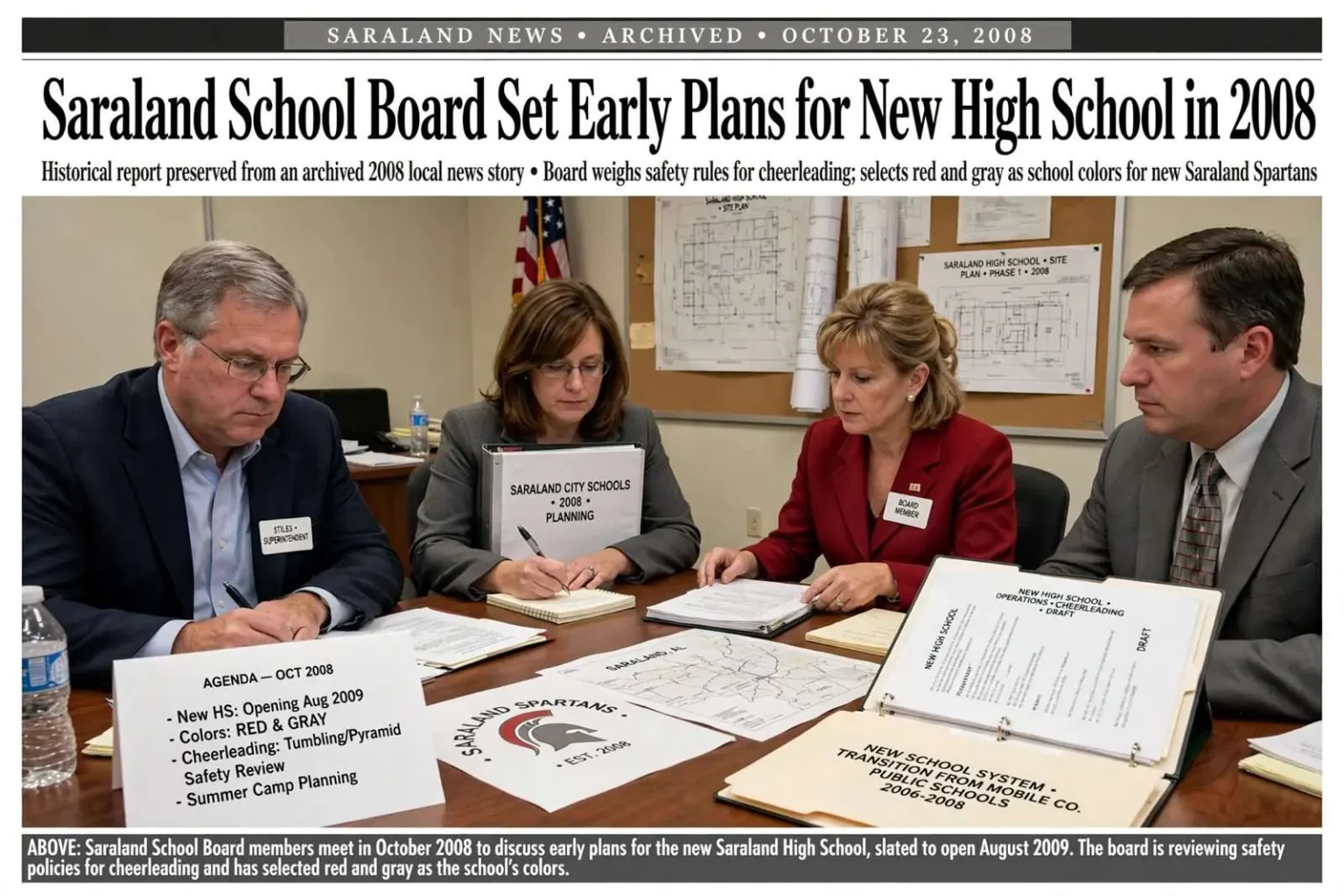
As Saraland prepared to open a new high school in August 2009, its school board was working through early operational decisions in 2008 that would shape the campus from its first day. Among the questions on the table was one that mattered a great deal to a small but visible group of students: whether cheerleaders at the new school would be permitted to tumble or build pyramids. An interim sponsor said the decision would affect summer-camp choices and competition planning for incoming freshmen, the students who would form the first classes at the new campus. School leader Stiles said officials needed to research the issue and its legal and safety history before deciding. The board also selected red and gray as the colors for the new Saraland High School, one of the most visible identity choices a new school makes.
The discussion was a small example of the much larger work facing the board that year. Opening a high school is not simply a matter of unlocking a building. A district must hire and assign staff, set attendance zones, plan transportation routes, organize athletics under the Alabama High School Athletic Association, order equipment, and make hundreds of decisions about programs, symbols, and traditions before a single student walks through the door. In 2008, Saraland’s leaders were doing exactly that, and the cheerleading policy question showed how granular the work could become. Every choice, from a color scheme to a safety rule, had to be made from scratch, because there was no existing school policy to inherit.
A New City School System
Saraland sits in Mobile County, just north of the city of Mobile along U.S. Highway 43 and Interstate 65, and for decades its students attended schools run by the Mobile County Public School System, the largest district in Alabama. In the years leading up to 2008, residents of the growing suburb pursued a split from the county system, a process that required local legislation, a citywide vote, and a financial settlement to acquire the school properties inside the city limits. The effort was part of a broader trend in Alabama, where several communities in the Mobile area and elsewhere in the state moved to form their own city systems in hopes of gaining local control over curriculum, spending, and school construction.
The separation made Saraland one of the first new city school systems created in Alabama in a generation, and it gave the board both an unusual amount of freedom and an unusual amount of responsibility. Everything about the district’s schools had to be decided locally: curriculum frameworks, employee contracts, bus fleets, lunch programs, and the identity of the new high school itself. That is why questions as specific as cheerleading safety rules came before the board rather than being handled by a long-standing district policy office. A brand-new system has no back catalog of precedent, so even routine matters require deliberate, documented decisions.
The timing mattered as well. The high school was slated to open in August 2009, which meant decisions made during 2008 and the 2008-09 school year would govern the campus on day one. Students who had attended county schools or Saraland’s intermediate grades would move into a brand-new building with new colors, new traditions, and new rules. For families, the transition was both an exciting prospect and a source of practical questions about everything from class offerings to extracurricular eligibility.
The Cheerleading Question
The question of whether Saraland High School cheerleaders would be allowed to tumble or build pyramids was more than a stylistic preference. Tumbling, which includes flips, handsprings, and aerial passes, and pyramid building, in which cheerleaders are lifted and stacked in formations, are the two elements of competitive cheerleading most closely tied to injury risk. National cheerleading organizations and safety researchers had spent years documenting sprains, fractures, and, in rare cases, catastrophic injuries connected to those skills, and several state associations had adopted progressively stricter rules about spotting, mats, and the certification of coaches.
For a new school, the decision carried immediate practical consequences. An interim sponsor explained that whether tumbling and pyramids were permitted would affect summer-camp choices for the incoming freshmen, because camps differ in what skills they teach and rehearse. It would also shape competition planning, since squads that cannot legally or safely perform the higher-risk elements enter different divisions and prepare different routines. A squad planning to compete needed to know the policy before the summer, when many programs attend camps and begin choreographing for the fall sports season and winter competitions.
School leader Stiles said officials needed to research the issue and its legal and safety history before deciding, a measured approach that reflected the environment of the time. Districts across the country faced questions about liability when students were injured in cheerleading activities, and any policy allowing or restricting specific skills would need to be defensible on both safety and legal grounds. The answer also had to fit within the rules of the Alabama High School Athletic Association, which governs cheerleading as an activity at member schools and sets its own safety standards for practices and competitions.
The episode illustrates how a new school builds its culture from the ground up. At an established school, a cheerleading policy would already exist, written years earlier and amended over time. At Saraland in 2008, the first sponsor, the first squad, and the first set of rules were all being created at once, and the board wanted to get them right rather than simply copy whatever neighboring schools did.
Choosing Red and Gray
Alongside the policy work, the board made one of the most symbolic decisions on its list, selecting red and gray as the colors for the new Saraland High School. School colors matter more than outsiders might expect. They appear on uniforms, letter jackets, gymnasium walls, marching band outfits, and decades of yearbooks, and they become part of how a community recognizes itself. For the first classes of students, the colors would be something entirely their own, not inherited from an older campus.
The choice of colors also had practical dimensions. Athletic uniforms for football, basketball, baseball, softball, and track had to be ordered before the school’s first seasons, and band instruments cases, flags, and spirit merchandise all followed the palette the board selected. Once a school’s first uniforms are bought and its first banners are hung, the colors effectively become permanent, which is one reason boards tend to settle the question early.
What Opening in 2009 Required
Behind the boardroom discussions stood an enormous logistical operation. A new high school needs a principal and assistant principals, a teaching staff across every subject, counselors, a librarian, coaches for each sport, and a support staff of custodians, cafeteria workers, and bus drivers. Course catalogs had to be written so that freshmen would graduate on schedule, and extracurricular programs from athletics to band to academic teams had to be organized under AHSAA guidelines, which govern everything from athlete eligibility to season calendars.
Facility readiness was another piece. New campuses in fast-growing Alabama suburbs typically open with capacity for expansion, because systems like Saraland’s were created specifically because residential growth was outpacing the existing schools. Planning in 2008 for an August 2009 opening meant coordinating construction schedules, furniture deliveries, technology installations, and safety inspections so that the building would be certified for occupancy before teachers reported.
The cheerleading decision and the color selection were small parts of this larger picture, but they capture the character of the period. Saraland’s school system was assembling itself piece by piece in public, with each choice discussed and documented by a board that knew residents were watching closely. Communities that form their own districts tend to hold high expectations for responsiveness, and the Saraland board operated with that awareness throughout its first years.
Context for Mobile County Readers
For readers across the Mobile area, Saraland’s move was closely watched. Other communities in the region had debated their own splits from the county system, and the success or difficulty of Saraland’s transition informed those conversations. A new city system that opened its high school on schedule, staffed it well, and built competitive programs would strengthen the argument that small city districts could thrive; stumbles would give pause to communities weighing the cost of separation.
The cheerleading question, small as it seems, was part of proving that a new district could handle the full range of school operations, from the classroom to the gymnasium. School boards that manage the mundane decisions well are the ones that earn trust for the harder ones, such as budgeting, personnel, and long-term construction planning. In that sense, the 2008 meeting notes preserved in this archived story are a snapshot of a community building an institution in real time.
This article records the preliminary decisions and discussion reported in 2008 and is not a description of current Saraland school policy. Policies on cheerleading safety, school colors, and every other topic covered here have had many years to evolve since the new high school opened, and readers seeking the district’s present-day rules should consult the Saraland City Schools system directly. What the 2008 record shows is a board deliberately working through the earliest, foundational choices of a brand-new high school: how its students would be kept safe, what its teams would wear, and what kind of traditions the first Spartans of Saraland High School would carry forward into the years that followed.