Satsuma High Added Security After 2007 Threat Investigation
Archived WKRG coverage reported that Satsuma High added temporary security after authorities investigated an alleged threat against the school in 2007.
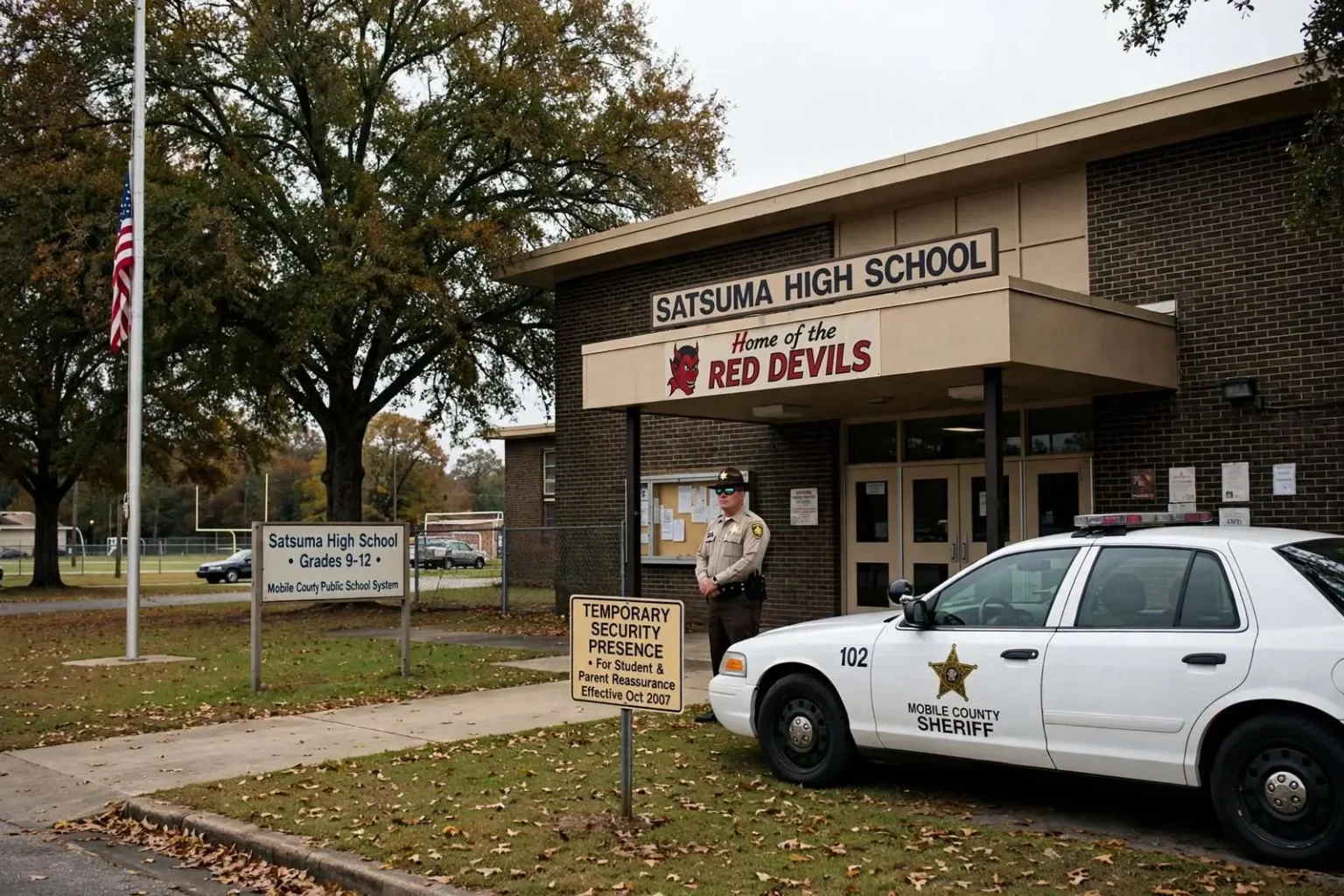
Historical school-safety report, published from archived local news coverage.
Satsuma High School added temporary security after authorities investigated an alleged threat against the school in 2007, according to an archived local news report. School officials said the additional presence was intended to reassure students and parents, not because they believed an incident was expected. The report said a student had been arrested on a terrorist-threat charge and that the principal recommended expulsion.
The episode placed Satsuma — a small, tight-knit community in northern Mobile County — squarely inside a conversation that American schools had been forced to have since the Columbine High School shooting in 1999. In the years after that tragedy, districts across the country adopted hardened responses to any reported threat of school violence: involving law enforcement immediately, adding visible security in the days that followed, and pursuing the strongest disciplinary consequences available. Satsuma High’s response in 2007 followed that national template, adapted to the scale of a small-town school where administrators knew every student and every family by name.
The community and its schools
Satsuma sits along U.S. Highway 43 north of Saraland and Chickasaw, one of the small communities strung between Mobile and the Washington County line. For decades the town’s schools were operated as part of the Mobile County Public School System, a common arrangement among the small municipalities north of the city, and the campuses served as gathering points for a community where generations of families had attended the same schools. Satsuma High School’s Red Devils competed against rival schools across north Mobile County, and Friday night football, school festivals and church youth groups made the high school the center of community life in a way that larger urban schools rarely are.
That closeness cut both ways in a threat investigation. In a small school, rumors travel through the student body within hours, and by the time an official announcement is made, most students already know something is happening. Administrators in such settings face the task of calming genuine fear without amplifying it — which is precisely what Satsuma officials said they were doing by adding security as a reassurance rather than a response to an expected incident. The distinction matters: the security presence was communicated to families as a confidence-building measure, while the investigation itself proceeded through the proper legal channels.
The arrest of a student on a terrorist-threat charge reflected how Alabama law treats threats against schools. In the years following Columbine, states including Alabama strengthened their statutes so that communicating a threat of violence against a school — even one the speaker claims was a joke — is a criminal matter rather than merely a disciplinary one. A charge of that kind moves a case out of the principal’s office and into the juvenile or district court system, where prosecutors evaluate the seriousness of the threat, the intent behind it, and the response it provoked.
How schools handle threats
Threat assessment in American schools had become a defined discipline by 2007, built on the principle that every threat deserves evaluation but not every threat deserves the same response. Administrators and school resource officers consider the specificity of the statement, whether the student had means and planning behind it, the reaction of other students, and any history that informs the risk. The results can range from a counseling intervention and parent conference to suspension, expulsion and criminal referral. In Satsuma’s case, the report said the principal recommended expulsion — the most severe disciplinary outcome a school can impose, reserved for conduct that endangers the school community.
Expulsion proceedings in Alabama public schools follow due-process requirements: the student and parents receive notice of the recommended consequence and the charges behind it, a hearing is held before school officials, and the outcome can be appealed to the county board. A student expelled for a threat typically loses access to the regular campus for a defined period, with educational services continuing through alternative arrangements. The process is deliberately formal, because the stakes — a student’s education and record — are high even when the conduct is serious.
Temporary security additions like the one at Satsuma High became a familiar sight in American schools during this era. Districts brought in extra officers, retired law enforcement or private security for a period of days or weeks after a threat, a disturbance or a national incident that prompted copycat concerns. The visible presence serves three purposes at once: it deters anyone who might act, it identifies and addresses problems quickly if they arise, and — as Satsuma officials emphasized — it gives frightened parents a reason to send their children to school the next morning.
The wider shift in school safety
Law enforcement’s role in school threats had also been formalized by then. Agencies across Alabama worked with districts on protocols covering who investigates a threat, how interviews with juveniles are conducted, when parents are notified and how information is shared between the school and the prosecutor’s office. The existence of those protocols is what allowed a case like Satsuma’s to move from a report to an arrest within a short period: the school recognized immediately that the matter belonged in law enforcement’s hands, and the agency that took the report knew what evidence it needed to support a charge. Schools that tried to handle serious threats internally, experts warned, risked both the safety of their students and the legal exposure that comes with an unreported danger.
By 2007, the architecture of American school safety had been rebuilt in the space of eight years. Where a 1990s school might have had a single unlocked entrance and an occasional sheriff’s deputy, the post-Columbine school had visitor sign-in procedures, badges, crisis plans, lockdown drills and, increasingly, school resource officers — sworn officers assigned to campuses full time. Mobile County’s school system, one of the largest in Alabama, had adopted many of these measures across its campuses, and smaller systems in the county’s incorporated cities worked with local police departments to provide coverage.
The term “terrorist threat” itself carried new weight in that decade. Before 2001, a threat against a school was likely charged as disorderly conduct or making a false report; after the attacks of September 11 and the school shootings of the late 1990s, legislatures created or strengthened statutes specifically covering threats of mass violence. The change communicated that society’s tolerance for even verbal threats against schools had dropped to zero — a message that educators and police hoped would deter students who might otherwise treat a threat as an edgy joke.
What the incident left behind
For the Satsuma community, the 2007 investigation and its aftermath were a reminder that even a small town’s schools are not insulated from the pressures facing education everywhere. Parents in communities like Satsuma often describe the school as an extension of family — teachers coached their children in youth league sports, attended their churches, lived down the street. An incident involving a threat against that school touched the whole town, and the officials’ decision to frame the added security as reassurance reflected a community where trust between families and the school was the primary asset to protect.
The student at the center of the case faced a two-track consequence that has become standard: the criminal charge worked through the courts while the expulsion recommendation worked through the school system. Neither track is automatic — prosecutors weigh the evidence and the student’s age, and school boards weigh the disciplinary record and the hearing’s findings — but together they illustrate how seriously schools and law enforcement had come to treat threats of school violence by the mid-2000s. For other students, the visibility of the consequences was itself part of the deterrence.
The episode also belongs to the history of Satsuma’s schools, which continued to evolve after 2007. The north Mobile County educational landscape shifted markedly in the years that followed, as the Saraland city school district — which had separated from the Mobile County system — grew, and as nearby communities reorganized their school arrangements. Those changes reshaped high school attendance for Satsuma families and are part of why the 2007 episode reads today like a document from another era of the community’s schools.
What remains most instructive about the 2007 report is the balance school officials struck. They investigated, involved law enforcement, pursued accountability through the proper channels and added a security presence — while explicitly telling parents that no incident was expected. That combination of seriousness without panic is the model threat-assessment experts still recommend: respond to every threat as if it is real, communicate honestly about the level of risk, and preserve the community’s confidence in its own school. This is a historical account of the investigation and response at the time. It is not a current safety alert, and no identifying details about the student or the specific threat are included in this record.