United Way of Southwest Alabama Kicks Off 2015 Campaign With $5.1 Million Goal
Community leaders gathered in Mobile to launch the United Way of Southwest Alabama's 2015 fundraising campaign, setting a goal topping $5.1 million.
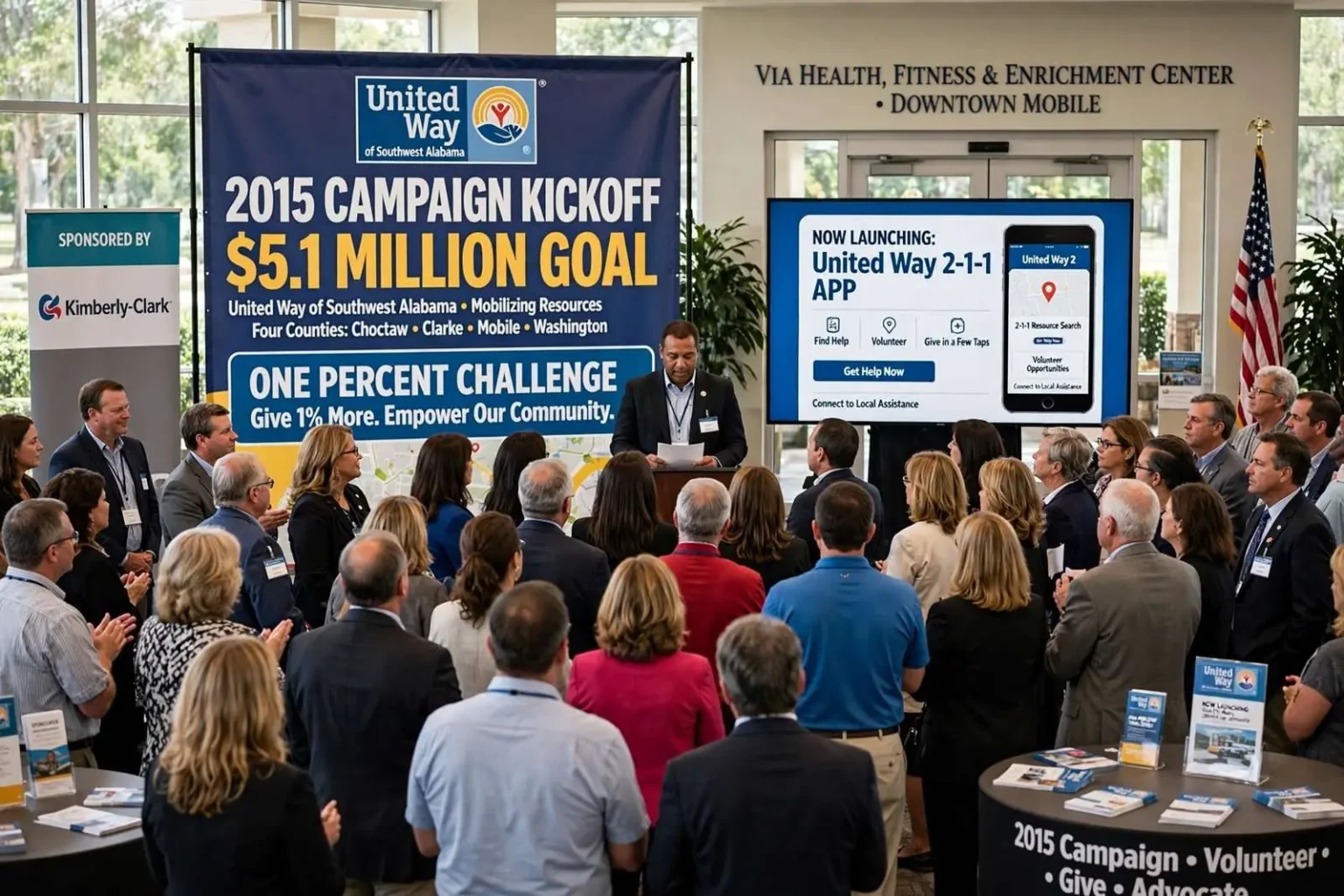
Hundreds of volunteers, business leaders and community partners gathered this week in Mobile to kick off the United Way of Southwest Alabama’s 2015 fundraising campaign, setting an ambitious goal of just over $5.1 million. The launch event drew roughly 275 attendees to the VIA Health, Fitness and Enrichment Center, where organization leaders outlined plans for the year ahead and unveiled a new mobile app designed to connect residents with volunteer opportunities and community resources. The setting itself carried meaning: the VIA center downtown has long served the region as a fitness and enrichment hub, and organizers hoped the venue would underscore the connection between healthy organizations and healthy communities.
The board chairman for this year’s campaign, a human resources executive at Austal USA, told the crowd that the new app would give users quick access to the United Way’s 2-1-1 database, a free service that links people in need with local assistance programs. He said the tool was built to make it easier for smartphone and tablet users to give, volunteer or find help in a few taps. The shift toward mobile technology reflects how residents increasingly expect to reach services, and the 2-1-1 line has become the region’s front door for families seeking help with utility bills, food, housing, child care and disaster recovery.
Austal USA, the shipbuilder whose aluminum vessel production has made it one of Mobile’s most prominent waterfront employers, has been a consistent participant in workplace giving across the region. Having a senior human resources executive from the company chair the board placed a corporate recruiting perspective at the head of the campaign, since HR leaders see firsthand how workplace giving programs and community services support the workforce they recruit and retain.
Campaign organizers pointed to a strong recent track record heading into this year’s push. The organization’s last three annual campaigns each exceeded their fundraising targets, and pledges have climbed by nearly 10 percent over that stretch. Last year’s effort brought in just over $5 million, and a summer pacesetter campaign this year, which typically involves early commitments from major employers, raised more than $1.3 million on its own. Pacesetter campaigns serve as the opening act of the fundraising year, letting the region’s largest workplaces run their employee drives early and establish momentum that smaller companies can follow into the fall.
The campaign’s chairman, a South Alabama banking executive, urged the audience to embrace what organizers are calling the “One Percent Challenge” — asking donors and workplace giving programs across the region to increase contributions by just one percent to help close the gap toward this year’s goal. The math behind the challenge is straightforward: with annual giving already above $5 million, a one percent bump across the donor base closes a meaningful share of the distance between last year’s total and this year’s higher target. He emphasized that money raised locally stays in the four-county service area rather than being redirected elsewhere, a point organizers return to often because donors sometimes assume contributions are routed to national headquarters.
United Way of Southwest Alabama funds a broad network of programs and partner agencies that together serve more than 600,000 residents across Choctaw, Clarke, Mobile and Washington counties. The service area stretches from the Gulf-facing population centers of Mobile County into the small towns and rural communities of southwest Alabama, where a single partner agency is often the only source of emergency assistance within a county. Services supported by the campaign span early childhood education, financial stability programs, health initiatives and crisis assistance, the four pillars around which United Way chapters nationally have organized their community impact work.
New Leadership and a Digital Push
This year’s kickoff event was sponsored by Kimberly-Clark, one of the region’s major employers with manufacturing operations in the Mobile area. Corporate sponsorship of the launch underwrites the cost of the event itself, ensuring that early campaign dollars go to partner agencies rather than venue and catering expenses. Kimberly-Clark’s involvement also signals the continuing importance of large manufacturers to the region’s philanthropic base, alongside the shipbuilding, aerospace and port-related employers that anchor Mobile’s economy.
The organization’s president and chief executive, who took the helm this year, told attendees that reaching the new goal would require the whole region working in concert, describing the campaign as a way to “unite and mobilize resources” behind long-term community improvement. A leadership transition in the middle of a campaign cycle is always a test for a nonprofit, and the new chief executive faces the dual task of maintaining the donor relationships that produced three straight years of record results while putting a personal stamp on the organization’s direction. The emphasis on uniting and mobilizing resources suggests continuity with the community-impact model rather than a dramatic pivot.
The mobile app unveiled at the launch represents the most visible piece of that digital strategy. Beyond connecting users to the 2-1-1 database, the app is designed to lower the barrier for the two actions that sustain the United Way model: giving and volunteering. Volunteers who can browse opportunities, sign up and log hours from a phone are more likely to return, and donors who can give in a few taps are more likely to respond when campaigns approach their deadlines. For the organization, the app also builds a direct communication channel with supporters that does not depend on annual workplace presentations.
How the Money Flows
Workplace campaigns, individual donations and employer matching gifts typically make up the bulk of the United Way’s annual haul in the region. Workplace giving remains the engine of the model: employees sign up for recurring payroll deductions, often during fall presentations at their companies, and employers frequently match a portion of what their workforce contributes. That structure spreads the burden across thousands of modest gifts rather than depending on a handful of large donations, which cushions the campaign against economic swings that might eliminate a single major donor’s capacity to give.
The funds are allocated through a volunteer review process in which community panels evaluate partner agencies each year, examining program outcomes, financial stewardship and demonstrated need before recommendations go to the board. That review cycle is one of the reasons the United Way’s role in the region extends beyond fundraising; local nonprofits that receive allocations must show measurable results to keep them, and the process gives donors a layer of diligence they could not easily perform on their own. Agencies funded through the campaign provide services ranging from early childhood literacy and after-school programs to emergency food, shelter and utility assistance, and crisis response.
Organizers said the campaign would run through the fall, with results tallied and shared with the community once the drive wraps up. The fall timeline tracks the school year and the holiday season, when workplace participation and public generosity historically peak, and it allows pacesetter results from the summer to be folded into the public total as the drive progresses.
Why the Four-County Model Matters
The four-county footprint of United Way of Southwest Alabama is central to how the organization frames its case to donors. Choctaw, Clarke, Mobile and Washington counties together cover a wide swath of the state’s southwestern corner, from the pine forests and mill towns of Clarke and Washington counties to the Gulf Coast economy of Mobile. More than 600,000 residents live within that footprint, and need looks different in each corner of it: urban neighborhoods in Mobile may struggle with housing stability and transportation, while rural counties often lack the service infrastructure that city residents can reach within a short drive.
Organizers’ insistence that locally raised money stays locally spent addresses a persistent skepticism that surveys of charitable giving have documented for years. When donors understand that a payroll deduction in Choctaw County funds a food pantry or youth program within driving distance of their home, participation rates tend to rise, which is why the chairman’s point about the four-county service area was woven through the kickoff program rather than left to fine print.
The Year Ahead
Reaching $5.1 million will require the campaign to exceed last year’s total by a measurable margin at a time when the region’s economy is still climbing back from the downturn, and organizers are betting that the combination of the One Percent Challenge, the pacesetter momentum and the new digital tools will carry the drive over the line. The challenge’s modest ask is a deliberate tactic: asking every donor for one percent more is easier to say yes to than asking a subset of donors to give dramatically more, and it spreads responsibility across the entire base rather than leaning on the largest contributors.
For the hundreds of volunteers in the room at the VIA Health, Fitness and Enrichment Center, the kickoff was also the start of their own season of work. United Way campaigns run on volunteer labor — loaned executives who visit workplaces, panels that review agency applications, and coordinators who organize drives inside their own companies. That network of volunteers is itself part of what the campaign builds each year, since participants who give their time during the fall drive frequently stay connected to partner agencies long after the totals are announced.
Residents interested in giving, volunteering or learning more about which local programs the United Way supports can find information through the organization’s website, and now through the new app as well. Whether the 2015 drive finishes above the $5.1 million mark will become clear when the totals are tallied after the fall push, but organizers leave the launch with what they believe is the strongest opening position the campaign has had: three consecutive years of exceeded goals, a pacesetter campaign already past $1.3 million, and a region whose major employers have once again put their names behind the effort.