Atmore Bank Robbery Suspect Arrested After Florida Manhunt in 2009
Authorities said a man accused in a 2009 Atmore bank robbery was arrested in Florida after an officer was stabbed during an early-morning encounter.
Authorities announced the arrest of a man accused in a 2009 Atmore bank robbery after a Florida manhunt that followed the stabbing of a police officer. The case stretched across state lines and multiple counties, connecting a quiet Alabama banking town to a marshy corner of the Florida Gulf Coast in one of the more dramatic multi-agency chases of that year.
Officials identified Chad Jeter as the person wanted in the robbery of First National Bank and Trust in Atmore two days earlier. Atmore, the larger of Escambia County, Alabama’s two municipalities, sits just north of the Florida line along the rail and highway corridors that run between Mobile and Pensacola, and its downtown bank had become the starting point of an investigation that would quickly turn violent hundreds of miles away.
According to police statements at the time, Jeter was found in Inglis, Florida, during the early hours of May 21. Inglis is a small town in Levy County, near the Withlacoochee River where the freshwater marshes meet the Gulf of Mexico, an area of boat ramps, fishing camps and thinly populated backroads that poses obvious challenges for a manhunt.
An Early-Morning Encounter
Inglis Police Chief Steve Dixon said an officer saw a man sleeping in a pickup truck at about 4 a.m. The discovery was routine police work of the most ordinary kind: a late-night patrol checking on a parked vehicle in a small town where an unfamiliar truck draws attention. When the officer approached to question him, authorities said the man stabbed the officer four times and fled toward a nearby marsh.
The injured officer, who was bleeding heavily from the neck, called for help. Despite the wounds, the officer managed to summon backup, launching a response that would grow to include local, county, state and federal resources before the morning was over. The officer’s condition and the attacker’s flight into the marsh converted a small-town encounter into a major search operation in the dark.
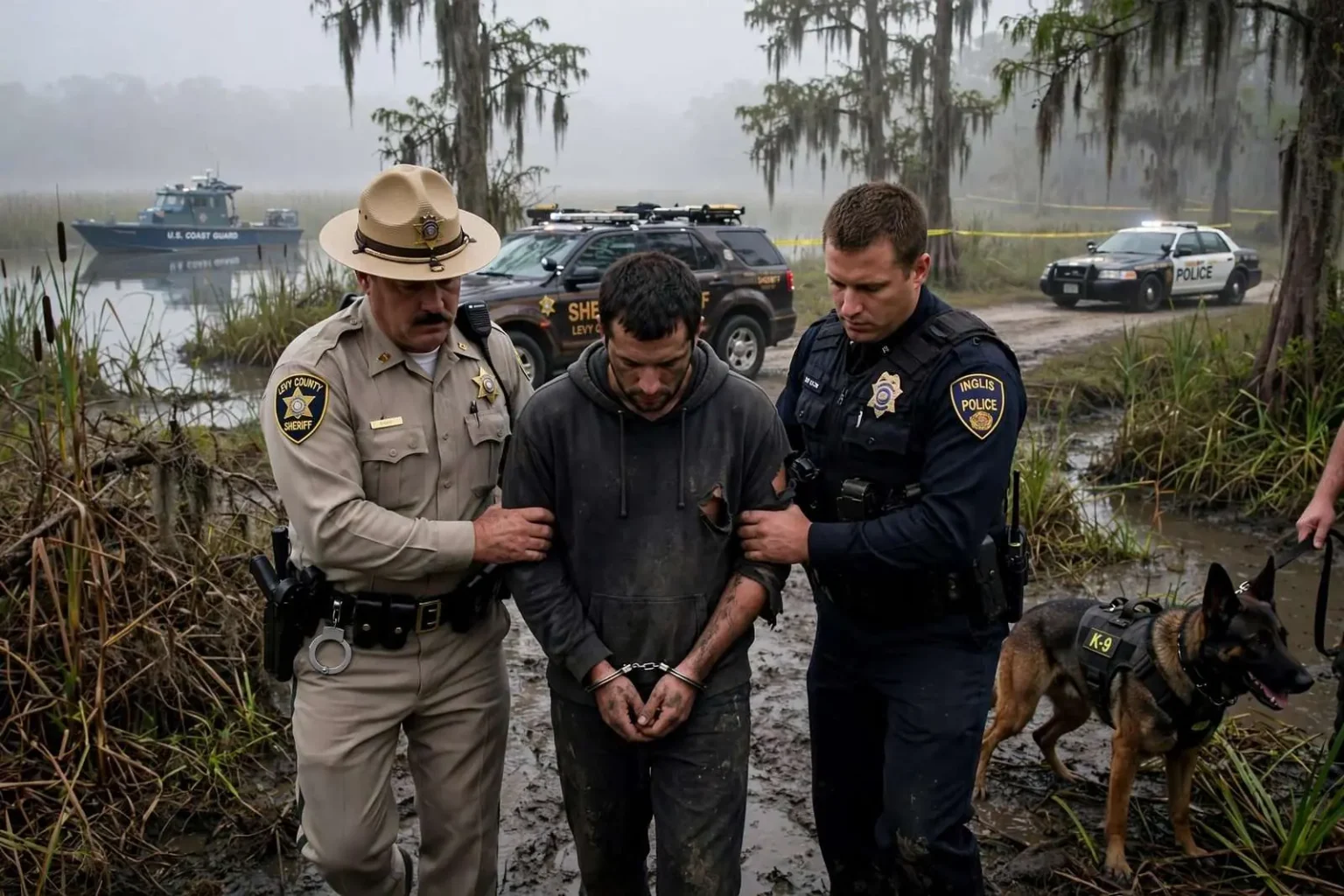
The Inglis Police Department, the Levy County Sheriff’s Office, the Citrus County Sheriff’s Office, a correctional K-9 team and the U.S. Coast Guard joined the search. The list of agencies illustrates how quickly a pursuit escalates in coastal Florida terrain, where a suspect moving through marshland can cross jurisdictional lines and waterways that ground units cannot easily cover. The Coast Guard’s presence brought boats and search capability on the water, while the K-9 team added the tracking skill the terrain demanded.
After an initial three-hour search, bloodhounds were brought in and tracked the suspect within about 20 minutes, Dixon said. The turnaround underscored the difference specialized tracking teams make in brush and marsh, where scent trails persist in the damp air and dogs can follow a path that human searchers pass over in the dark.
Authorities reported that the person taken into custody was carrying a substantial amount of money. The cash became a key link back to the Atmore robbery, tying the man found bleeding near the Florida marsh to the bank investigation that had begun two days earlier across state lines.
Charges Announced at the Time
In addition to the bank-robbery accusation from Atmore, officials said the arrest led to allegations of attempted murder of a police officer and resisting arrest in Florida. The stacked charges meant the case would unfold on two tracks at once: federal or state proceedings in Alabama for the bank robbery, and felony prosecutions in Florida for the violence against the Inglis officer.
The injured officer was treated and released, an outcome that could easily have gone the other way given the location and severity of the stab wounds. Officers wounded in isolated encounters miles from trauma centers face longer odds, and the fact that the officer could call for help and survive the attack shaped how the incident was remembered in the small Levy County community.
This account reflects law-enforcement statements and allegations reported at the time of the arrest. An arrest is not a conviction, and later court records would be required to establish the case’s final outcome. The charges announced in the days after May 21, 2009, represented the government’s allegations, and the full resolution of those proceedings played out afterward in courtrooms in two states.
Bank robberies in small Alabama towns draw intense attention precisely because they are rare. Atmore’s banking community had seen few such crimes, and the two-day window between the robbery and the Florida arrest moved the case from a local news item to a regional story followed in both states. Investigators worked the identification of Jeter quickly, distributing information that would connect the suspect to the Inglis encounter almost immediately after the stabbing.
How the Chase Connected Two States
The incident linked agencies in Alabama and Florida in a rapid search that began with an Atmore robbery investigation and ended after a multi-agency response in Levy County. Coordination across state lines in 2009 relied on fast information sharing between investigators, since the Inglis officer’s attacker was only identified as a fugitive from Alabama once word of the robbery suspect spread through law enforcement channels.
The geography of the chase tells its own story. Atmore sits along U.S. Highway 29 and the rail lines south of Interstate 65, a straight shot from the Mobile area to the Florida line and beyond into the Panhandle. Inglis lies several hundred miles to the southeast, down the Florida peninsula in Levy County between Tampa and Gainesville. The distance meant the suspect had time to put Alabama far behind him before the encounter that ended his run, and it explains why the search drew so many agencies once violence erupted.
Levy County’s coastal terrain is uniquely difficult for searches. The Withlacoochee River delta, salt marshes and tangled brush around Inglis can swallow a person on foot, and darkness compounds the danger for both suspects and officers. The decision to bring bloodhounds after the initial three-hour sweep reflected hard experience with that landscape, and the dogs’ twenty-minute success showed why rural Florida agencies lean on trained tracking teams for exactly this kind of fugitive.
The Coast Guard’s participation also reflected the stakes of a marsh-side manhunt. A suspect fleeing on foot through tidal marshland can wade toward open water, and search commanders could not rule out a move toward the Gulf. Station assets and boat crews gave the perimeter a water boundary that ground units could not maintain, closing off the most likely escape route while the dogs worked the brush.
Correctional K-9 teams, often drawn from prison systems with trained tracking dogs and handlers, are a familiar resource in rural manhunts across the Southeast. Their deployment to Levy County in the early hours of May 21 came alongside bloodhounds from other units, and the combination turned a stalled search into an arrest before dawn had fully broken.
For Atmore, the resolution brought relief to a community still processing the robbery of one of its principal banks. First National Bank and Trust had stood at the center of the city’s downtown business district, and the news that the suspect was in custody, carrying cash and facing charges in two states, closed the most urgent chapter of the case while the legal proceedings moved forward.
The episode remains a study in how quickly a property crime becomes a violent cross-state case. A bank robbery on a Tuesday, a sleeping suspect in a pickup truck before dawn on Thursday, a stabbed officer, a three-hour search, twenty minutes of dog tracking and a morning arrest: the sequence bound two communities several hundred miles apart into a single story that law enforcement in both states would remember.
The Investigation Back in Atmore
While the search unfolded in Florida, investigators in Atmore were working the robbery scene and building the identification that would travel ahead of the suspect. Bank robbery investigations move on surveillance images, witness accounts and money trails, and the Escambia County authorities pursuing the First National Bank and Trust case had two days of head start before the Inglis encounter gave them a name in custody. The speed with which the two investigations converged showed how regional law enforcement networks functioned when a fugitive crossed the state line.
Atmore’s position along the border made it a familiar waypoint for crime that moves between the states. The city sits on the historic corridor between Mobile and Pensacola, with rail lines, highways and years of mutual-aid relationships connecting its police department to agencies throughout the Panhandle and south Alabama. When the robbery suspect surfaced in Levy County, those relationships shortened the distance between an Alabama warrant and a Florida arrest.
The attempted murder allegation in Florida carried the heaviest weight of the charges announced after the arrest. Stabbing a police officer four times during a routine encounter is the kind of violence that transforms every subsequent proceeding, shaping bail decisions, prosecution priorities and the resources both states committed to the case. The resisting arrest charge, comparatively minor on paper, completed the picture of the encounter in the marsh and the flight that preceded the dogs’ arrival.
Money recovered at the arrest also gave prosecutors a tangible bridge between the two cases. Substantial currency in the possession of a man matching the robbery suspect’s description, two days and several hundred miles after the First National Bank and Trust holdup, formed the evidentiary thread that tied the Inglis stabbing scene to the Atmore bank investigation and justified the combined charging strategy officials announced.
Remembering the Manhunt
Small-town police work rarely produces headlines far from home, but the Inglis encounter became the pivot of the entire case. An officer’s late-night check of a pickup truck, the kind of stop repeated thousands of times a night across Florida, put a wanted man in handcuffs after violence that nearly cost the officer’s life. Chief Dixon’s account of the search, from the 4 a.m. discovery through the bloodhounds’ twenty-minute track, became the narrative spine that Alabama and Florida newsrooms used to explain how a two-state manhunt ended in the marshes of Levy County.
The case also became part of the working memory of the agencies involved. For the Inglis Police Department, a small force policing a river town of a few hundred residents, the night of May 21, 2009 stands as an example of how quickly routine patrol can escalate and how far mutual aid reaches when it does. For Escambia County investigators, the arrest closed a fast-moving robbery case with a suspect alive, in custody and facing the full weight of charges in two states.