Fairhope Deal Website Promoted Local Savings During 2009 Recession
A Fairhope resident launched FrugalFairhope.com in 2009 to connect consumers with coupons, discounted gift certificates and local deals during the recession.
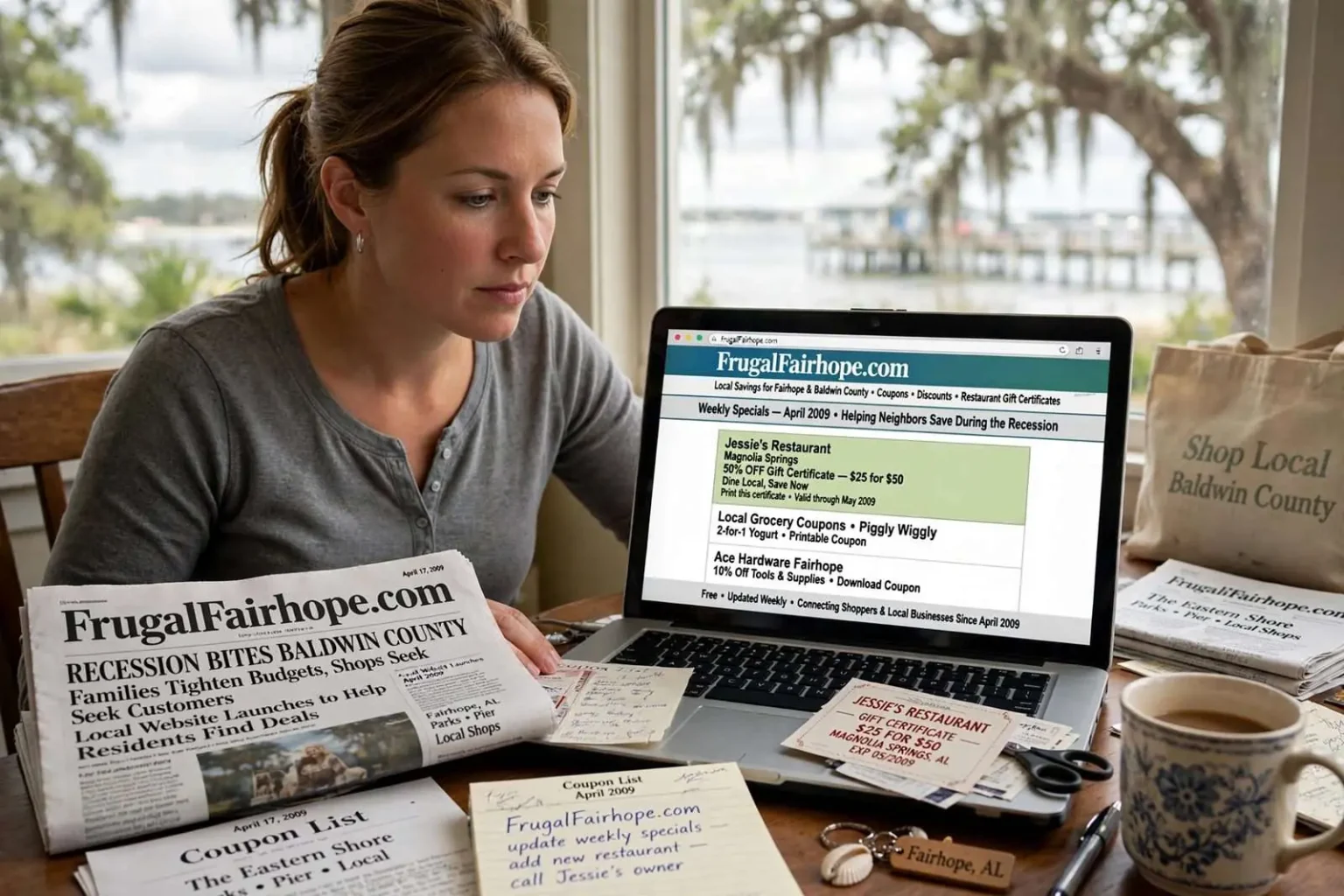
A Fairhope resident launched a money-saving website in April 2009 as many households and small businesses looked for ways to stretch their budgets during the recession. The free site, FrugalFairhope.com, offered saving tips, online bargains, coupons and discounted restaurant gift certificates, gathering in one place the kinds of deals that shoppers had previously chased across newspaper inserts, mailers and word of mouth. Its creator, Frances Chancery, said the goal was to help people locate deals without feeling they had to dramatically change their routines.
The timing was deliberate. By the spring of 2009, the national recession had reached deep into the Gulf Coast economy, and families in Baldwin County were cutting back in ways both large and small. At the same time, small businesses were fighting for every customer, and many had begun experimenting with the online promotions that national deal sites were popularizing. A local website that connected the two sides of that equation, bargain-hungry shoppers and merchants looking for exposure, fit the moment precisely.
Connecting Consumers and Local Businesses
The website linked users to both local and national companies with weekly specials. Among the offers highlighted at the time were discounted restaurant gift certificates, a format that gave diners a lower-cost meal and gave participating businesses another avenue to reach customers. The gift-certificate model, which national sites had begun scaling aggressively in the same period, worked by letting customers pay less up front for a certificate’s face value, guaranteeing the restaurant a customer and a measure of cash flow while passing the discount on as a marketing cost.
Jessie’s Restaurant in Magnolia Springs was among the local businesses mentioned in the report. Its owner said online deal listings could provide exposure and introduce restaurants to prospective new customers while offering shoppers a break on the price of a meal. For a small restaurant on the Fish River in southern Baldwin County, the calculus was straightforward: an empty table generates nothing, while a discounted table generates a customer who might return at full price, might bring friends, and might become the regular every local restaurant depends on.
The site’s aggregation of national offers alongside local ones reflected how deal-seeking had changed by 2009. Coupons had long been a newspaper habit, but the recession accelerated the shift toward online listings, printable coupons and promotional codes, and sites like FrugalFairhope.com served as local guides to that expanding universe, filtering the national noise for the offers that mattered to shoppers in one community.
A Recession-Era Local Tool
The story reflects the practical consumer response to the economic uncertainty of 2009. Coupon sites, gift-certificate promotions and locally focused savings pages offered a way for residents to keep dining and shopping while watching expenses more closely. Rather than cutting restaurants and local shops out of family budgets entirely, households used deals to keep those habits alive at lower cost, preserving both their routines and the businesses they relied on.
For local businesses, the approach also functioned as a low-cost marketing channel at a time when attracting new customers was especially important. Traditional advertising buys were among the first expenses small merchants cut in a downturn, and promotional partnerships like the ones FrugalFairhope.com highlighted offered an alternative that cost nothing unless a customer appeared. The report described a community-level effort to pair household savings with support for area merchants, each side of the bargain reinforcing the other.
Fairhope in the Recession Year
Fairhope, the Eastern Shore city where the site was born, entered 2009 with an economy built on small retail, restaurants, tourism and the steady flow of visitors drawn to its pier, parks and flower-lined streets. The recession touched that economy the way it touched small towns everywhere, in quieter sidewalks and more careful spending, and it pushed residents toward whatever tools helped them keep supporting the local merchants they knew by name. The discount restaurant certificates, grocery coupons and online bargains the site gathered were the small levers ordinary families had at hand.
The year 2009 stands, in hindsight, as a hinge point for how Americans shopped. The deep recession changed household behavior in lasting ways, normalizing deal-hunting across income levels and accelerating the move of coupons and promotions from print to screen. Communities like Fairhope felt that shift through their local businesses, which suddenly found customers arriving with printed certificates and asking whether weekly specials were listed online. A local deal site was both a product of that change and a small instrument for shaping how it played out in one town.
What the Record Shows
This account documents the website and offers described in April 2009. It does not indicate whether the site, the specific discounts or the participating businesses remained active after that period, a common limitation with community websites of the era, which appeared quickly during the recession and often changed shape or disappeared as their founders’ circumstances and the economy itself evolved. What the record does preserve is a snapshot of one resident’s response to hard times: build a free tool that helps neighbors save money and helps local businesses find customers.
The timeline referenced in this coverage spans 2009, a period that encompasses significant social, economic, and political transformations in Alabama and the broader Gulf Coast region. The recession’s effects on Baldwin County ran alongside the county’s continuing population growth, creating an unusual combination of new arrivals and tighter budgets that local businesses had to serve simultaneously. Deals and promotions were one of the ways those communities threaded that needle.
The Larger Lesson of the Deal-Site Moment
The national explosion of deal websites during and after the recession made Frances Chancery’s project part of a much larger pattern. Across the country, local entrepreneurs launched city-specific savings sites on the theory that national platforms would never capture the deals at the corner bakery or the seafood restaurant down the road, and that a trusted local voice curating offers could build an audience the national sites could not. Some of those sites grew into lasting businesses; many faded as the economy recovered and as national platforms moved into local markets. Their brief flourishing, however, changed how local merchants thought about online promotion permanently.
This coverage addresses themes of business and economic development, reflecting issues that directly impact residents’ daily lives and the long-term trajectory of their communities. A savings website is a modest thing, but it sits at the junction where household budgets meet small-business survival, and where a community’s habit of supporting its own merchants either strengthens or erodes. The April 2009 record of FrugalFairhope.com captures that junction in Fairhope at full pressure, in a season when saving a few dollars on dinner meant as much to a family as a new customer meant to a restaurant, and both sides of that trade had a name for the tool that connected them.
How Discounted Certificates Worked for Restaurants
The discounted gift-certificate format that FrugalFairhope.com promoted deserves a closer look because it became one of the defining marketing tools of the recession. A diner paying less than face value for a certificate feels the savings immediately, and the restaurant receives a customer who has already committed to a visit, along with the cash flow from the sale. The restaurant’s cost is the discount itself, a marketing expense incurred only when a customer actually appears, which compares favorably to newspaper advertising that may or may not produce a single diner. The gamble for the merchant is that the discounted visit turns into a full-price habit, and owners who participated in such programs generally judged them by that return rather than by the margin on the first meal.
That was essentially the case Jessie’s Restaurant’s owner made when explaining the value of online deal listings: exposure first, new customers second, a break for the shopper as the attraction that makes both possible. For a destination restaurant in Magnolia Springs, where much of the business depends on visitors willing to make the drive, appearing on a local deals page put the restaurant in front of Eastern Shore and county residents who might otherwise have saved the trip, and gave fence-sitters a reason to finally try it.
Saving Money as a Community Habit
Deal-seeking in a small town works differently than it does in a big city. In a community the size of Fairhope, the shoppers using coupons and certificates are the same people who serve on the chambers, the school foundations and the festival committees, and the merchants offering the deals are their neighbors. That social layer changes the meaning of a discount: it becomes a way of keeping a local business afloat rather than simply extracting a bargain, and shoppers in recession-era Baldwin County frequently talked about their deal-hunting in exactly those terms, as a way of holding the town together while money was tight.
FrugalFairhope.com’s free model reinforced that community framing. Charging visitors nothing broadened the audience to every household that needed help stretching a budget, including the ones least able to pay for savings advice, and it positioned the site as a public service in spirit even though it also served as a marketing channel. The weekly-specials format gave the site a rhythm, giving residents a reason to check back regularly and giving merchants a predictable place to rotate their offers.
Looking Back From a Changed Economy
Measured against what came after, the April 2009 launch of a local deal site marks the beginning of a transformation in how local commerce works in communities like Fairhope. The habits formed during the recession, checking for online specials, buying certificates ahead of a night out, treating coupons as research rather than an afterthought, outlasted the downturn itself and reshaped what local merchants expect from marketing. The specific site’s later history is not documented in the coverage, but its logic, connecting local spenders with local sellers online, became a permanent feature of small-town business everywhere.
For Fairhope and Baldwin County, the site is also a small piece of the region’s economic record from a hard year. Histories of the recession tend to be written in national statistics, but the daily experience of it lives in records like these: a woman building a free website in her spare time, a restaurant owner in Magnolia Springs explaining why a discounted meal is worth the margin, and families across the county printing certificates so they could keep Friday nights at local tables. The deals described lasted a season; the habits, and the community instinct behind them, lasted much longer.