High school football field in Robertsdale, AlabamaHistorical community coverage in Robertsdale.

Historical community report, published from archived local news coverage.

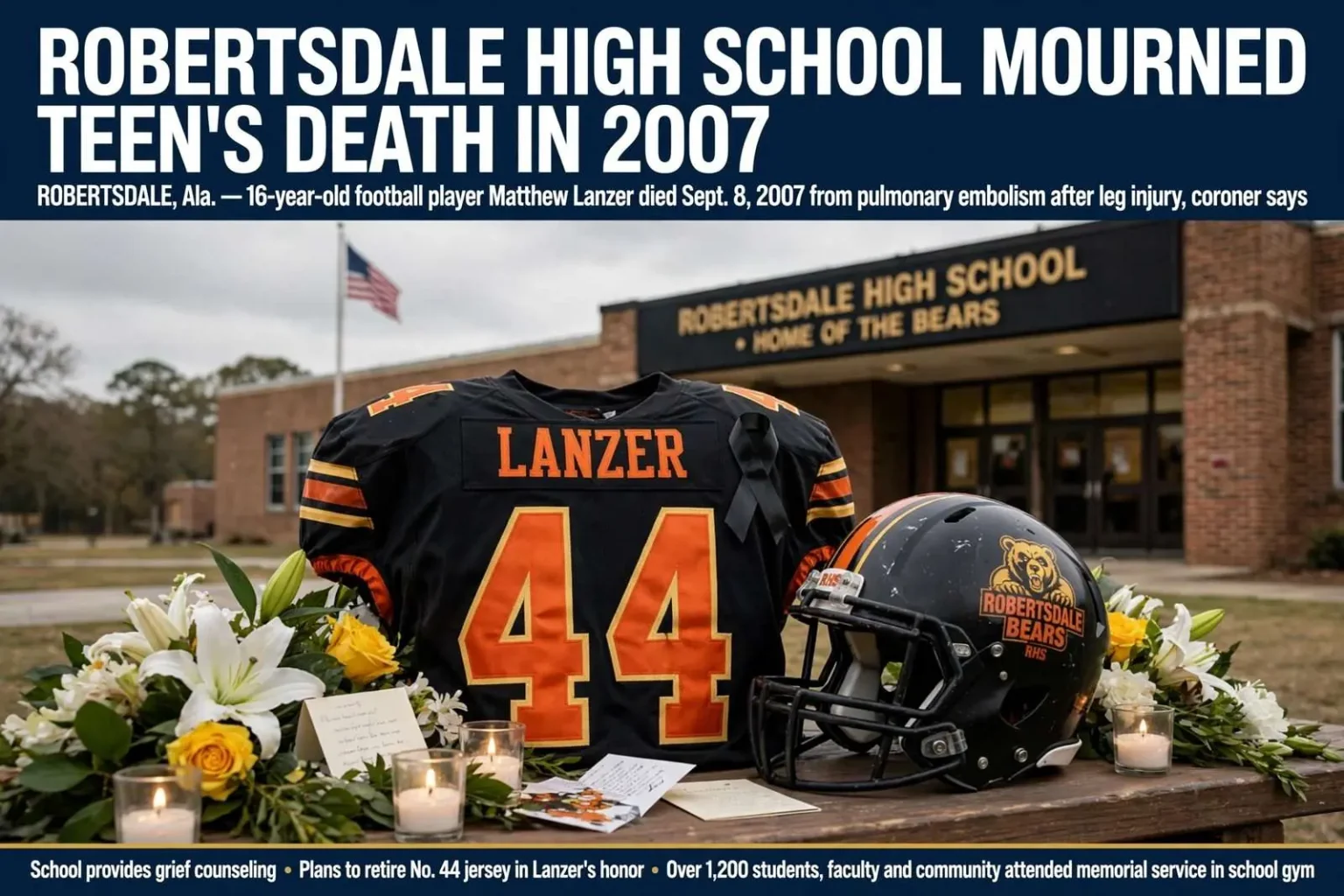
Robertsdale High School mourned the death of a teenage student and football player in 2007, according to an archived local news report. The loss of a young student-athlete sent grief through the school community in Robertsdale, a city in central Baldwin County where the high school serves families from the surrounding communities of southern Alabama’s fastest-growing county. According to the report, the Baldwin County coroner said autopsy results attributed the death to a blood clot that formed after a leg injury and later reached the teen’s lungs — a medical chain of events that turned an injury into a fatal emergency.

The details reported at the time were difficult for the community to absorb. Family members said the student had previously been treated after a spider bite, but the coroner said the bite was not the cause of death. In other words, the investigation separated the suspected earlier ailment from the actual cause, and the autopsy findings pointed instead to a clot arising after a leg injury. For the student’s family, teammates, and classmates, the official findings did little to soften the central fact: a healthy teenager with a place in the school’s football program was gone, suddenly and without warning.

How the school responded

In the days that followed, Robertsdale High School offered grief counseling to students and staff struggling with the loss. The availability of counseling after a student death has long been standard practice in Alabama schools, giving grieving teenagers a place to process the news with trained adults rather than alone or among rumors. For classmates who shared classrooms, hallways, and team practices with the student who died, the counseling services provided structure during a week when the ordinary rhythm of school life felt upended.

The school also planned to retire the student’s No. 44 football jersey — a gesture that placed the teen among the honored figures in the program’s history. Retiring a jersey is one of the highest tributes a football program can pay, reserving a number from future use so that its last wearer is remembered by every team that follows. In Alabama, where high school football occupies a central place in community identity, the gesture carried particular weight. Friday nights in Robertsdale would go on, as they always do, but the number 44 would not appear on the field again.

Understanding the medical findings

The mechanism described in the coroner’s findings — a blood clot that formed after a leg injury and traveled to the lungs — is known in medicine as a pulmonary embolism arising from deep vein thrombosis. Clots can form in the deep veins of the legs during periods of immobility or after trauma to a limb, and if a piece of the clot breaks free, it can travel through the bloodstream to the lungs, where it becomes a life-threatening emergency. Cases involving young people are rare, which is part of what made this loss so shocking to the community; the seriousness of a leg injury is not always apparent from the outside, and symptoms of a dangerous clot can be easy to mistake for ordinary soreness.

See also  Spanish Fort Settles Five-Year Bluff Erosion Lawsuit, Will Buy Threatened Homes

This historical article is not medical advice. It records what was reported in 2007 and the coroner’s findings at that time. Anyone with a health concern — including pain, swelling, or unusual symptoms after an injury — should seek guidance from a qualified clinician or contact emergency services as appropriate. The lesson communities have drawn from tragedies like this one is the importance of taking post-injury symptoms seriously and seeking prompt medical evaluation when something does not feel right.

Robertsdale and Baldwin County in 2007

Robertsdale sits at the heart of Baldwin County, along the corridor between Mobile Bay and the beaches that draw visitors to Alabama’s Gulf Coast. In 2007, the county was already among the fastest-growing in Alabama, its population swelling with families moving to the area for work, affordable living, and the school system’s reputation. Robertsdale High School, part of the Baldwin County Public Schools system, stood as a gathering point for the city and its surrounding communities — a place where generations of local families had attended classes and cheered for the Golden Bears on Friday nights.

In a community of that kind, a student death is felt everywhere at once. Teachers who had the student in class, coaches who had him on the practice field, and families whose children were his friends all experienced the loss together. Small and mid-sized Alabama towns have long shown a particular capacity for pulling together in these moments — organizing memorial services, supporting the grieving family, and honoring the student at games and school events. The plans to retire the No. 44 jersey fit squarely within that tradition, giving the community a focal point for remembrance.

How Alabama schools respond to a student death

When a student dies, schools across Alabama follow crisis-response practices developed with guidance from school counselors and mental health professionals. Administrators typically notify staff before students arrive, prepare a statement, and make counselors available in designated spaces. Teachers are briefed on how to talk with students about grief, and extra care is taken with teammates, close friends, and students with their own histories of loss. The goal is to keep the school functioning while acknowledging the grief rather than pretending classes can proceed as if nothing happened.

Grief support after a student death often extends beyond the first week. Anniversaries, memorial events, and the return of the team to competition can all reopen wounds, and schools frequently plan for those moments as deliberately as they do for the initial announcement. For athletic programs, honoring a lost teammate — through jersey retirements, memorial decals on helmets, or moments of silence — becomes part of how the program remembers and heals. Those tributes often remain part of a school’s identity for years, passed down to students who never knew the classmate they are honoring.

See also  Foley Plans Upgrades to Military Memorials in Two City Parks

Why the record matters

Accounts like this one, assembled from archived local news coverage, preserve the public record of a community’s loss. The essential facts remain what the 2007 reporting established: Robertsdale High School mourned a teenage student and football player; the Baldwin County coroner said autopsy results attributed the death to a blood clot that formed after a leg injury and later reached the teen’s lungs; family members recalled earlier treatment after a spider bite, while the coroner concluded the bite was not the cause; and the school responded with grief counseling and the planned retirement of the student’s No. 44 jersey.

More than the specific findings, what endures in the record is the shape of the community’s response. A Baldwin County high school lost one of its own, and the people around that student — classmates, coaches, teachers, and neighbors — responded the way Gulf Coast communities generally do: with support for the family, counseling for the grieving, and a permanent tribute on the football field. The story is remembered here as history, with care for the family and respect for the privacy of those who lived through it, and as a reminder to take post-injury symptoms seriously and to seek qualified medical guidance whenever a health concern arises.

The coroner’s role in Baldwin County

The Baldwin County coroner’s office plays an important and often overlooked role in the county’s public life. When a death occurs unexpectedly or outside medical care, the coroner is responsible for investigating the circumstances, ordering autopsies where needed, and determining the cause and manner of death for the official record. Those findings matter to grieving families seeking answers, to schools and employers making decisions, and to public health officials tracking patterns across the county. In a case like this one, the coroner’s autopsy findings were the authoritative account that separated speculation from fact — confirming that the death traced to a clot that formed after a leg injury, and ruling out the spider bite the family remembered from earlier treatment.

That investigative clarity served a second purpose in the community: it gave school officials and the family a foundation of fact at a time when rumors were inevitable. In any close-knit town, a sudden teenage death produces questions faster than answers can arrive. Official findings, reported through local news, allowed the community to understand what happened without turning the tragedy into a source of lasting speculation.

See also  Baldwin County Forum Examined Proposed School Sales Tax in 2010

High school football and community identity on the Gulf Coast

To understand the depth of the response at Robertsdale High, it helps to understand what high school football means in Baldwin County and across Alabama generally. Friday night games function as civic gatherings, drawing students, parents, alumni, and residents who have no direct connection to the roster. Players are known figures in their communities long before they graduate, and a jersey number can become attached to a player’s identity in the memories of everyone who watched him compete. When that player is lost, the grief is not confined to the team; it spreads through the stands, the booster clubs, and the businesses along the highways where the season’s results are discussed each Saturday morning.

That is the context in which the decision to retire No. 44 should be read. The tribute told the student’s family that their son would remain part of the program’s story permanently. It told his teammates that their shared experience would be honored rather than hurried past. And it told every player who came after that the number on the wall represented something more than a uniform assignment.

Carrying the memory forward

Nearly two decades have passed since the fall of 2007, and the students who walked the halls of Robertsdale High School with the teen who died are adults now, many with children of their own. Archival accounts like this one are how communities keep those memories intact across generations — recording what happened, what the officials found, and how the school responded, so that the story is not lost when the people who lived it move away or pass on.

The lasting takeaways remain twofold. First, the response of Robertsdale High School and the Robertsdale community reflected the pattern Gulf Coast towns have shown repeatedly in the face of sudden loss: counseling for the grieving, support for the family, and permanent tributes that keep a young life present in the life of the school. Second, the medical circumstances described in the coroner’s findings remain a sober reminder that complications after an ordinary injury can escalate quickly and without obvious warning. Swelling, pain, or unusual symptoms following trauma to a limb should be evaluated promptly by a qualified clinician, and anyone facing a possible emergency should contact emergency services immediately. This historical account is published from archived local news coverage and is not medical advice.