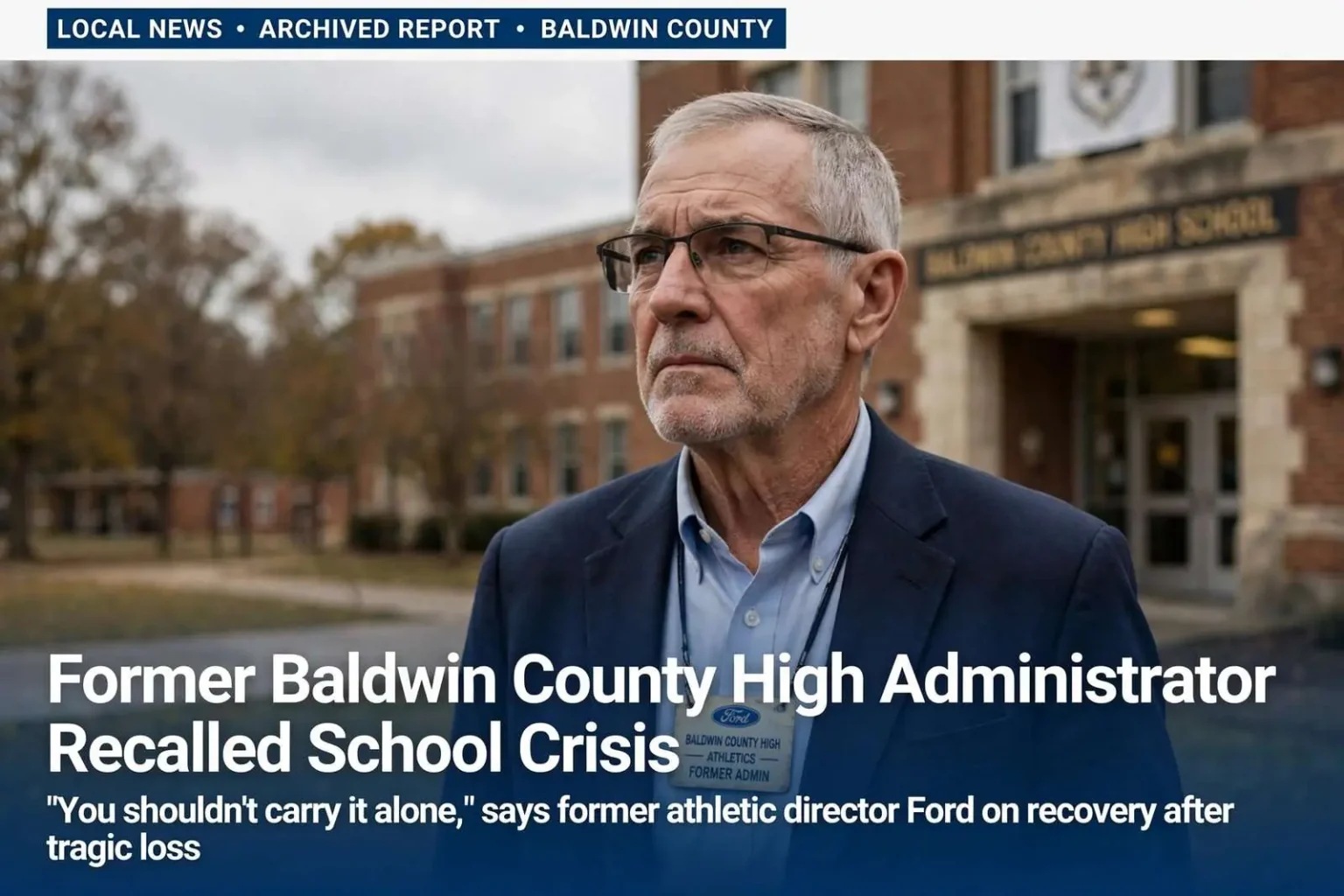
Exterior of a Baldwin County school buildingAn archived report considered support for communities after a school tragedy.

Historical report preserved from an archived 2008 local news story.

In an archived local news report, a former Baldwin County High School athletic director reflected on an earlier school crisis while discussing the difficult work of recovery after a tragedy. The administrator, identified as Ford in the report, described the lasting impact that an on-campus death had on staff and students years before. His remarks, offered as the Davidson High School community confronted a crisis of its own, drew a direct line between two Alabama school communities facing versions of the same grief — and made the case that recovery is shared work, not a private burden.

Ford said the community had been fortunate that students did not witness the incident, while recognizing that many still knew what had happened. That distinction — between what students see and what they carry — is one that school leaders and mental health professionals have long wrestled with in the aftermath of on-campus deaths. A student body that did not witness a tragedy still absorbs its shock through rumor, through empty desks, and through the visible grief of teachers and classmates. The absence of witnesses does not spare a school the aftermath; it only changes the shape of the healing that follows.

His advice to those coping with such an event was direct: people should not try to carry it alone. He encouraged speaking with trusted colleagues, family members, counselors, clergy or others who could provide support. The counsel applies as much to the adults in a school building as to the students in its classrooms — teachers, coaches, and administrators who are expected to be steady for young people while processing their own shock and loss. In the report, Ford’s reflections placed that support need squarely in the context of the Davidson High School community, which was then in need of exactly the kind of help he described.
When a School Community Grieves

Schools occupy a particular place in the life of a community’s grief. A high school is where a town’s teenagers spend their days, where friendships are dense and news travels instantly, and where the adults are responsible not only for teaching but for shepherding hundreds of young people through events no one is prepared for. When a death touches a school — whether a student, a teacher, or a member of the wider family — the building itself becomes the place where the community’s mourning happens, day after day, with bells and class schedules continuing around it.

The experiences of Baldwin County High School and Davidson High School, separated by Mobile Bay but connected by the networks of Gulf Coast education, illustrate how school crises echo across district lines. Administrators who have led a school through the loss of a student carry hard-won knowledge about what the weeks afterward require — extra counselors in the building, quiet rooms for students overcome during the school day, honest communication with families, and patience with the waves of grief that arrive on no schedule. When Davidson’s community faced its crisis, that accumulated experience became one of the resources available to it, offered by colleagues who had stood in the same position.

See also  Alma Bryant High School Student Critically Injured in Weekend Crash Near Irvington

The role of an athletic director in such moments is easy to underestimate. Coaches and athletic staff often know students in a different register than classroom teachers do — through years of practices, bus rides, and seasons that create bonds resembling family. In many schools the athletic community is also the emotional center of student life, which means a crisis anywhere in the building lands heavily in the field house. An athletic director who has guided a program through grief understands both the student side of that weight and the adult side, and Ford’s reflections carried the authority of that experience.

The Case for Not Carrying It Alone

The heart of Ford’s message — that no one should try to carry such an event alone — reflects a consensus among mental health professionals that has only strengthened in the years since the report was published. Grief and trauma respond poorly to isolation. The adults surrounding a school crisis — teachers and staff members who continue standing in front of classes while processing a colleague’s or a student’s death — are at particular risk of silent strain, because their roles demand composure. Counselors who work with school communities consistently emphasize that the caregivers need care too, and that seeking it is a professional responsibility rather than a weakness.

The list Ford offered — trusted colleagues, family members, counselors, clergy — maps the support network most people already have but may hesitate to use. Colleagues who shared the crisis understand it without explanation; family members know the person beneath the professional role; counselors bring training in the stages of grief and trauma response; clergy offer both counsel and, for many families, the rituals that help a community mark a loss. None of these conversations requires a crisis to be justified, but in the weeks after a tragedy they become essential — the difference between processing a trauma and burying it.

For students, the same principle applies with adjustments for age and development. School crisis response plans across Alabama and the nation now build in immediate counseling availability, classroom-based discussions led by trained staff, and watchfulness for the students most closely connected to the deceased. The goal in the days and weeks after a death is not to return the school to normal as quickly as possible, but to give students structured space to grieve while keeping the building’s routines — the schedules, the practices, the ordinary events — intact as anchors. Teachers and coaches are central to that balance, which is why their own support matters so much.

A Historical Record, Preserved With Care

This account preserves what the 2008 archived report recorded, without adding details beyond what was reported at the time. Historical reports of school tragedies serve a purpose even years later: they document how communities responded, preserve the advice of people who led through crisis, and offer later readers the reassurance that others have stood in similar places and found a way forward. The identities and circumstances in the original report are left as they appeared, and no new details are added here — both out of respect for the families involved and because the report’s value lies in what it actually said.

See also  Bonnethead Sharks: Social and Friendly Gulf Coast Residents

What remains useful a decade and more later is the substance of the guidance. Schools that face a crisis do better when their leaders acknowledge the loss plainly, when counseling resources arrive quickly and stay for the long term, and when the adults in the building model the help-seeking they encourage in students. Baldwin County and Mobile County school communities have both demonstrated, in different years and different circumstances, that a crisis can be met with organized compassion — and that the lessons learned in one community can be handed to another when it needs them.

If you or someone you know is in crisis or needs immediate support, call or text 988 in the United States to reach the Suicide & Crisis Lifeline. Help is available at any hour, and the line exists for exactly the kind of moments the archived report describes — for anyone, of any age, who finds themselves carrying more than they should carry alone. Ford’s advice in 2008 and the lifeline’s promise today say the same thing in different decades: grief and crisis are not meant to be carried in isolation, and reaching out — to a colleague, a family member, a counselor, a pastor, or a crisis line — is the step that begins recovery.

The structure of school crisis response that Ford’s reflections point toward has become standard practice in Alabama districts. When a death touches a school, districts typically activate a crisis team — counselors drawn from across the system, psychologists, and administrators trained in grief response — within hours. Parents receive letters that name the loss honestly while protecting the family’s privacy, and staff briefings precede the school day so that teachers hear the facts before their students do. In the days that follow, the focus shifts to identifying the students and staff most affected and keeping support in place long after the initial wave of attention passes.

That long-term view is among the most consistent lessons offered by administrators who have led through such events. Communities tend to rally in the first week, but grief in a school does not follow the news cycle. Anniversaries, graduation season, team milestones, and even ordinary classroom moments can reactivate grief months later, and the counselors who remain available through the year — not merely the week of the funeral — make the difference for the students who struggle most. An athletic director who watched a program move through a season shadowed by loss understands that timeline better than most.

The geographic and institutional connections between Baldwin County High School and Davidson High School reflect the wider reality of Alabama education: principals, coaches, and counselors move between districts, professional associations bring school leaders together, and the network of people who run high schools along the Gulf Coast is smaller and more interconnected than the public generally realizes. When crisis hits one school, the colleagues who answer the phone are frequently people who lived through something similar at another — which is precisely the dynamic the 2008 report captured in Ford’s willingness to share his school’s experience.

See also  Baldwin County's Senate District 32 Race Pits Pittman Against McCuiston

The Enduring Value of Shared Experience

Reflections like the ones preserved in the archived report do quiet but real work over time. For school leaders facing a crisis, the recorded experience of predecessors provides both practical guidance and something harder to measure: evidence that the aftermath is survivable, that a school community can absorb a terrible event and continue. The details of every crisis differ, but the patterns of response — honest communication, visible support, patience with the long arc of grief — repeat across cases, and the leaders who document their experience make the next community’s load lighter.

The report’s emphasis on the adults in the building remains one of its most important notes. Public attention after a school tragedy concentrates naturally on students, and appropriately so, but the teachers, coaches, aides, and administrators who stand in front of those students carry the same event. Schools that arrange counseling and check-ins for staff — treating the adults as grievers rather than only as responders — consistently report healthier recoveries, for the staff themselves and for the students who depend on their steadiness. Ford’s advice to speak with trusted colleagues speaks directly to that population.

Preserved in this form, the historical account also serves readers who were never part of either school community. The lesson travels: whatever the loss — in a school, a workplace, a congregation, or a family — the response that works is the one Ford described. Acknowledge what happened. Accept the fortune of what was spared without pretending no harm was done. And above all, refuse to carry it alone: reach for the colleagues, family members, counselors, and clergy positioned to help, and let them.

If you or someone you know is in crisis or needs immediate support, call or text 988 in the United States to reach the Suicide & Crisis Lifeline. The lifeline is free, confidential, and staffed around the clock, and it stands behind the same promise the 2008 report offered its readers: no one in a school community — student, teacher, coach, or parent — has to face the worst days without help.