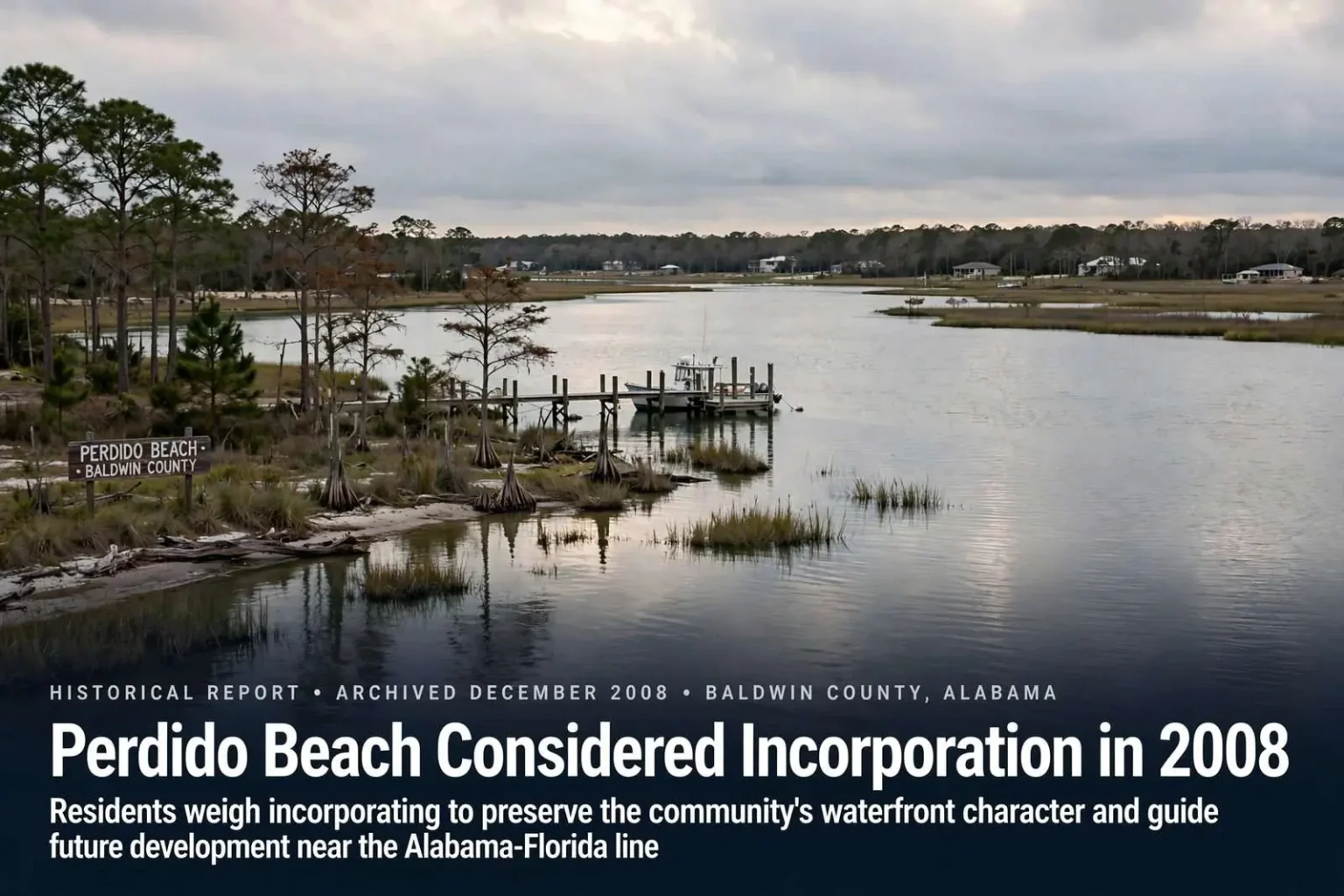
Waterfront at Perdido Beach, AlabamaPerdido Beach residents considered incorporation in 2008.

Historical report preserved from an archived 2008 local news story.

Residents of Perdido Beach in Baldwin County were considering incorporation in 2008 as a way to guide future development and preserve the community’s waterfront character. The discussion placed a small stretch of the county’s shoreline at the center of a question that Gulf Coast communities have faced for decades: whether a place is better off controlling its own zoning and services, or leaving its fate to the county government that has overseen it all along.

Perdido Beach sits on the western shore of Perdido Bay at the Alabama-Florida line, tucked between Palmetto Creek and Soldiers Creek. The community was described at the time as one of Baldwin County’s remaining relatively undeveloped waterfront areas, a place where modest homes and camps line the water rather than the condominium towers and resort strips that transformed other parts of the county’s coastline over the preceding two decades.

Residents said they wanted a greater voice in decisions affecting the community and did not want large-scale condominium or tourism development to reshape it. The concern was concrete: Baldwin County had watched waterfront land across the county rise in value as developers moved in, and communities that had not formed their own governments had little leverage over zoning decisions made at the county level. Incorporation would give Perdido Beach its own mayor and council, its own zoning authority and a formal seat in county and state affairs.

The economics of becoming a town

Community leaders estimated incorporation could cost about $230,000 and said the expense might be covered through sales tax and other revenue. The figure reflected the practical startup costs of a new municipality: election expenses, accounting and legal work, insurance, and the basic machinery of a town government operating on its own for the first time. For a community of Perdido Beach’s size, the price tag was the central question, and proponents argued that the town’s share of sales tax and other revenues would cover the cost over time.

The financial argument for incorporation rests on a simple mechanism. New towns in Alabama capture sales tax revenue collected within their limits that previously flowed to county and state coffers, and they become eligible for grants and shared revenues available only to municipalities. For a waterfront community with a tax base of waterfront property, those revenues, combined with the zoning control that comes with municipal status, form the standard case for incorporation.

The report said a vote could occur by the end of the year and that most of the community’s roughly 500 residents supported the idea. That level of support mattered, because incorporation in Alabama requires a petition process and a vote of the affected residents, and a community divided over the question can spend years in limbo. Perdido Beach’s proposal appeared to carry broad local backing, with residents who had watched neighboring communities change expressing the desire to set their own course before outside investment made the decision for them.

See also  Bayside Academy in Daphne Names Michael Papa New Headmaster

The community and its setting

Perdido Bay anchors life in the community. The bay, fed by the Perdido River and its tributaries, is quieter and less developed than Mobile Bay to the west, and its shoreline communities have historically attracted people seeking the water without the traffic and crowds of the resort beaches. Perdido Beach’s position between Palmetto Creek and Soldiers Creek places it among the bay’s tributary systems, where cypress and marsh shoreline give way to open water, and boating, fishing and the bay’s natural setting define the local way of life.

Baldwin County’s growth pressures formed the backdrop for the 2008 discussion. The county, Alabama’s largest by land area, was among the fastest-growing in the state, and its coastline and waterways had absorbed wave after wave of development, from the Gulf-front high-rises of Orange Beach and Gulf Shores to the subdivisions spreading along Mobile Bay’s eastern shore. Communities on the county’s quieter edges watched that growth move toward them and debated, community by community, whether to incorporate, and towns across the county had taken that step at various points in its history for exactly the reasons Perdido Beach residents cited.

The residents’ stated goals, a greater voice in decisions and protection of waterfront character, tracked the experience of communities that had incorporated elsewhere on the Gulf Coast. Municipal status brings a council that can write zoning rules, limit building heights, control subdivisions and set the pace of growth. It also brings responsibility: a town must fund its government, provide or contract for services, and defend its ordinances, and small towns live with the reality that a few hundred residents must supply the mayors, council members and volunteers who run it.

What incorporation would not change was the community’s exposure to the broader forces at work on the coast. Property values on Baldwin County waterways were rising regardless, and owners of waterfront land always hold the option to sell. Zoning can shape what gets built, but a town government is a tool for managing change, not a wall against it, a nuance that supporters and skeptics of the proposal both understood.

What the discussion decided, and what came after

As the archived report framed it, the 2008 discussion was a community deciding whether to take up the powers of a municipality before development pressures made the choice for it. The vote the report anticipated by the end of the year would settle the question through the ballot box, and the community’s broad support suggested the residents of Perdido Beach were prepared to become a town.

See also  National Shrimp Festival 2011: Fine Artists Steal the Show in Gulf Shores

This article records an early 2008 incorporation discussion, not the current legal status or governance of Perdido Beach. Readers should consult current municipal and county sources for the community’s present-day status. What the archived report preserves is a moment in the evolution of Baldwin County’s shoreline: a small waterfront community, roughly 500 residents strong, weighing the cost of self-government against the character of the place they wanted to keep.

The Perdido Beach discussion also belongs to a larger story about the Alabama Gulf Coast. Every community between the state line and Mobile Bay has faced some version of the same choice over the past half-century, and the ones that chose incorporation, from resort towns to fishing villages, did so with the same arguments Perdido Beach residents made in 2008: local control, local services and a local voice against the tides of growth. The archived report stands as a record of how one small community on Perdido Bay worked through that choice, and of the hopes its residents attached to the idea of becoming a town of their own.

How incorporation works in Alabama

The path from community to town in Alabama runs through the state legislature and the ballot. Residents of an unincorporated area petition for incorporation, the proposed boundaries are defined, and a judge reviews the petition before an election is scheduled. If a majority of the residents voting approve, the community becomes a municipality, and the new town then holds elections for a mayor and council. The process is deliberately demanding, because creating a new government permanently changes how an area is governed and taxed.

Once incorporated, a class-eight town in Alabama, the smallest municipal class, gains the powers of municipal government: the authority to levy the local sales taxes authorized for its class, to adopt zoning within its limits, to enforce ordinances through its own or contracted police services, and to receive municipal shares of state revenues. The town’s council becomes the community’s legislative body, meeting in public, adopting budgets and speaking for the town to the county commission, state agencies and federal programs.

For a community of a few hundred residents, those powers are transformative in practice. A county commission representing a sprawling, fast-growing county cannot weigh the preferences of one small shoreline community in every zoning decision; a five-member town council can. That proximity of government, the promise that decisions about the community will be made by people who live in it, was the heart of the case Perdido Beach residents made in 2008.

See also  Citronelle Woman Sentenced to 30 Years for Murdering Husband in 2016 Shooting

Growth pressures along Baldwin County’s shoreline

The 2008 discussion unfolded during one of the most transformative decades in Baldwin County’s history. The county’s population grew rapidly through the 1990s and 2000s, fed by coastal migration, resort development and the expansion of the Mobile metropolitan area across the bay. Land along the county’s waterways appreciated steeply, and agricultural and woodland tracts were subdivided into residential developments at a pace that reshaped the county’s eastern and central communities.

Waterfront communities felt the pressure first and hardest. Deep-water access, bay views and waterfront lots command premiums that make every shoreline parcel a candidate for redevelopment, and the county’s zoning framework offered rural areas limited protection against intensive development. Communities that wanted to preserve their character had to either organize politically at the county level or take on municipal powers of their own, and a wave of incorporations across Baldwin County over the decades reflected communities choosing the second path.

Perdido Beach’s situation was distinct in one respect: its relative remoteness had, until then, insulated it from the development wave. Tucked into the corner of the county on Perdido Bay, reached by roads that serve no through traffic, the community had remained one of the quiet places on Alabama’s coast. But residents watching their neighbors’ communities change understood that insulation can be temporary, and that rising land values eventually reach every waterfront. The 2008 proposal was, in essence, a bet that the community could build the tools of self-government before the pressure arrived in full.

That is the context in which the archived report should be read: not a dispute, but a community conversation about timing, cost and control. The residents’ estimate that incorporation could be funded through sales tax and other revenue reflected confidence that the town’s waterfront economy could carry its own government, and the reported support of most of the community’s roughly 500 residents suggested the question was when, not whether, Perdido Beach would take its place among Baldwin County’s municipalities.