Fairhope Debated Oak Tree’s Future During Hotel Project
A WKRG report covered concerns that hotel construction in Fairhope could damage a live oak tree despite plans to retain it on the property.
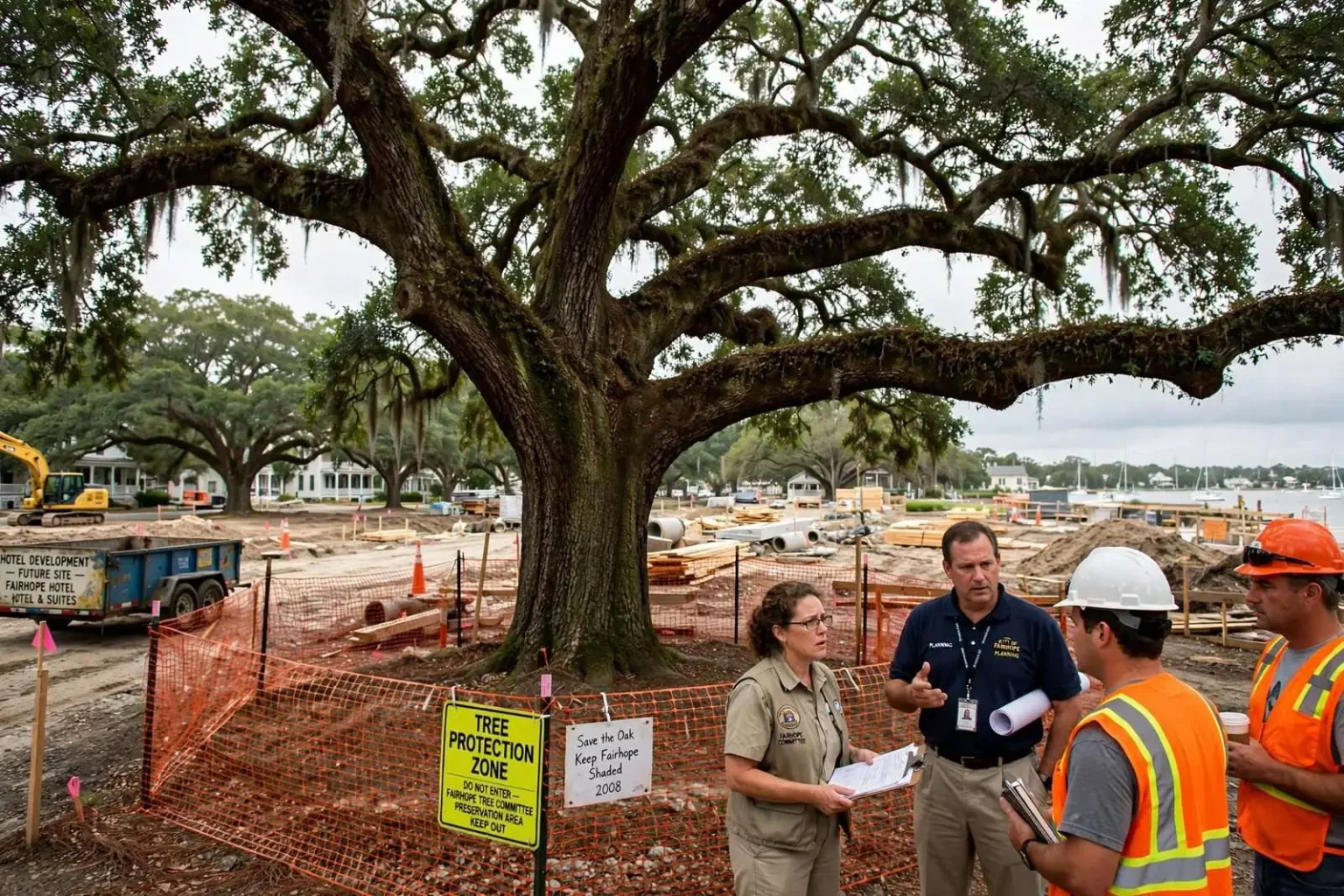
Fairhope residents and city officials spent the planning stages of a hotel project wrestling with the fate of a single live oak tree, according to a local news report from 2008. The tree stood on property slated for development, and its presence became a point of genuine contention rather than a footnote in the site plans. Members of the Fairhope Tree Committee warned that the oak could be harmed if limbs and roots were removed to make way for construction. City leaders and the project contractor ultimately agreed to keep the tree on the property, but arborists consulted on the matter differed on whether the tree could survive the surrounding work without damage. The developer maintained that a consultant had been hired and that the finished project would have little impact on the oak. The episode captured, in miniature, a tension that has followed growth along the Eastern Shore for decades: the desire for new development set against a community identity built around its trees.
Fairhope occupies a bluff above Mobile Bay on the county’s western edge, and its relationship with its tree canopy is unusually deep-rooted for a city its size. The community was founded in 1894 as a single-tax colony, and its founders deliberately planted and protected the oaks, pines, and flowering shrubs that line its streets today. Downtown avenues are shaded by mature live oaks whose limbs stretch across the roadway, and the city’s parks and public spaces have long been treated as civic treasures rather than undeveloped real estate. Residents regularly invoke that heritage when new construction threatens established trees, and city government has responded over the years with committees, review processes, and ordinances aimed at preserving the canopy. Against that backdrop, the future of one oak on a hotel site was never going to be an ordinary land-use question.
The hotel project itself reflected the broader growth pressures of the period. The Eastern Shore of Mobile Bay — Fairhope, Daphne, and Spanish Fort — had been among the fastest-growing parts of Alabama for years, drawing new residents, retirees, and visitors who came for the waterfront views, the walkable downtown, and the proximity to Mobile across the bay. Lodging demand followed the growth, and hotel proposals in and around Fairhope’s core were part of that pattern. But the same qualities that attract visitors and buyers also put development proposals under a particularly sharp microscope in Fairhope, where new buildings are judged not only on their economics but on how they fit into a townscape shaped over more than a century.
Why Live Oaks Draw Such Scrutiny
Live oaks — the southern live oak, Quercus virginiana — are the signature trees of the Gulf Coast, and they are unlike most other shade trees in ways that matter on a construction site. They are long-lived and enormously broad, with horizontal limbs that can span far beyond the trunk, and they hold their dark green leaves through the winter, which is where the “live” in their name comes from. Their root systems, however, are relatively shallow and spread widely through the upper layers of soil, which means they depend on ground conditions across a broad area. Soil compaction from heavy equipment, changes in grade that bury or expose roots, trenching for utilities, and the removal of pavement or addition of concrete can all stress a mature oak even when the trunk itself is never touched.
Arborists who work around development sites generally assess a tree’s prospects by looking at what is proposed for the entire root zone, not just the footprint of the building. Keeping the trunk standing is not the same as keeping the tree alive. A mature live oak can survive the loss of a few limbs, but the roots are the tree’s lifeline, and damage to them may not show in the canopy for a year or more. By the time a tree in decline is obviously in trouble, the cause is often years in the past. That lag between injury and symptoms is one reason preservation decisions are made under uncertainty, and it helps explain why reasonable experts can look at the same site plan and reach different conclusions about whether a tree will make it.
In the Fairhope case, the concerns raised during planning centered on exactly that kind of construction activity. Members of the Fairhope Tree Committee said the tree could be harmed if limbs and roots were removed for the project — a reference to the canopy and root pruning that site work around a mature oak typically involves. Limb removal changes the balance of a tree and opens wounds where decay can enter, while root removal along a building line or a parking area can cut away a significant share of the water- and nutrient-gathering capacity the tree depends on. The committee’s position reflected the experience that preserving a tree on paper, by leaving the trunk in place, does not guarantee the tree’s health once heavy machinery has worked the ground around it.
The public debate drew in residents as well as the committee. In a city where the canopy is a point of pride and older oaks are often treated as landmarks, proposals to remove or endanger a mature tree reliably generate comment at public meetings and in local conversation. Supporters of preservation argued that a hotel could be designed around an established oak and that the tree contributed value to the property and the streetscape that no new planting could replace for generations. Others pointed to the practical needs of the development — parking, access, and the building footprint — and to the property owner’s right to use land within the city’s rules. City officials found themselves weighing those arguments while the project moved through the planning process.
The disagreement was resolved, at least on the central question, before construction: city leaders and the project contractor agreed that the tree would remain on the property. That commitment answered the question of whether the oak would stand through the project, but it left open a second and more technical question — whether the tree could come through the construction period healthy. Preservation on the site plan still left decisions about protective fencing, root zones, grading, and the sequencing of work, and those decisions would determine how much stress the oak actually absorbed.
Arborists Disagreed on the Odds
On that technical question, the professionals did not speak with one voice. Arborists differed on whether the tree could survive the work without damage, a split that reflected the inherent uncertainty of predicting how a mature tree will respond to construction stress. Some assessments evidently weighed the oak’s vigor and the scope of the planned disturbance and found the risk manageable. Others looked at the same facts and saw a tree likely to be harmed by root loss, soil changes, or the pruning that had been contemplated. Neither position was unusual in cases like this one; tree risk assessment around construction is as much informed judgment as measurement, and practitioners differ in how conservative they are.
What made the disagreement public was the role it played in the debate over the project itself. Where arborists agree that a tree is at high risk, preservation arguments carry obvious weight; where they disagree, the dispute shifts to questions of process and precaution — who bears the risk, and what protections will actually be enforced on the site. In Fairhope, the split among experts meant the city could not simply point to a professional consensus in defense of either course, and the matter stayed contested even after the agreement to keep the tree was reached.
The developer, for its part, told the city that the risk had been addressed directly. The developer said a consultant had been hired for the project — bringing in specialist expertise on tree preservation rather than relying on the general contractor’s standard practices — and that the finished project would have little impact on the oak. Hiring a consulting arborist is the standard recommendation in preservation cases of this kind: the consultant can set a tree protection zone, specify where fencing goes, review grading and utility plans against the root zone, and supervise any pruning that is done so it follows accepted standards. The developer’s message was that the oak’s survival was a designed outcome of the project, not an afterthought.
For residents, the practical question after such an agreement is what to watch for in the years that follow. Trees stressed by construction rarely fail dramatically; they decline slowly. The usual signs are thinning foliage in the canopy, branches dying back from the tips, smaller or paler leaves than normal, and an overall failure of the tree to put on new growth in successive seasons. Because root damage and soil compaction reveal themselves over one to several growing seasons, a tree that looks acceptable when a building opens can be in measurable decline two or three years later. Monitoring by the city or by a consulting arborist after the work ends is how preservation commitments are actually checked, and in communities like Fairhope, residents and tree advocates tend to keep an eye on the trees themselves.
The stakes in any single-tree dispute are about more than one tree. In a coastal city, a mature oak’s canopy shades pavement, slows stormwater runoff, and moderates the heat of parking lots and streets in summer — functions that matter more as a city grows and more of its surface is built over. Large specimen trees also carry real, if harder to quantify, economic weight in a tourist-oriented town: they are part of what visitors photograph and part of why the downtown feels the way it does. Removing one and planting a replacement does not restore those benefits for decades, because the benefits accumulate with the tree’s size. That asymmetry is the underlying logic of preservation rules everywhere along the Gulf Coast, and it is why the fate of an individual oak can rise to the level of a citywide debate.
Fairhope’s handling of the hotel dispute also fits into a longer institutional history. The city has maintained a tree committee and adopted measures aimed at protecting its canopy, and disputes over development near landmark trees have recurred as the city has grown. Each case adds to the local understanding of how building and preservation can coexist — where protective measures have worked, and where they have not. For the participants in 2008, the immediate questions were narrower: whether the oak would stand, whether it would survive, and whether the consultant’s plans would hold on the ground.
A Look Back at a 2008 Dispute
The account of the debate comes from a local news report archived in 2008, and it survives as a historical summary of a development and preservation dispute rather than a description of the property today. Project status may have changed in the years since: the hotel may have been built as planned, altered, or abandoned, and the tree’s condition today cannot be determined from the original report. What the record does preserve is the shape of the disagreement — a tree committee raising specific technical concerns about limbs and roots, arborists divided on the outlook, a contractor and city government committing to keep the tree, and a developer answering with a hired consultant and a prediction of little impact.
That pattern has remained familiar across the Gulf Coast in the years since. Growing cities from Mobile Bay to the Florida panhandle continue to weigh hotel, retail, and residential proposals against mature trees, and the same arguments recur: the irreplaceability of a century of growth on one side, the realities of site design and property rights on the other, and technical experts who frequently disagree about the outcome. In Fairhope, a community that has always treated its oaks as part of its identity, the 2008 hotel dispute was a representative chapter in an ongoing conversation rather than an isolated incident. The record shows a city that took the question seriously, heard from its residents and its committee, secured a commitment to save the tree, and accepted that the final answer — whether the oak would thrive beside the project — could only be known in the seasons after the last piece of equipment left the site.