Prichard Announced Layoffs and Four-Day Workweeks in 2009
Prichard announced 17 layoffs, four-day workweeks for most city employees and limits on take-home vehicles in February 2009 to address municipal financial problems.
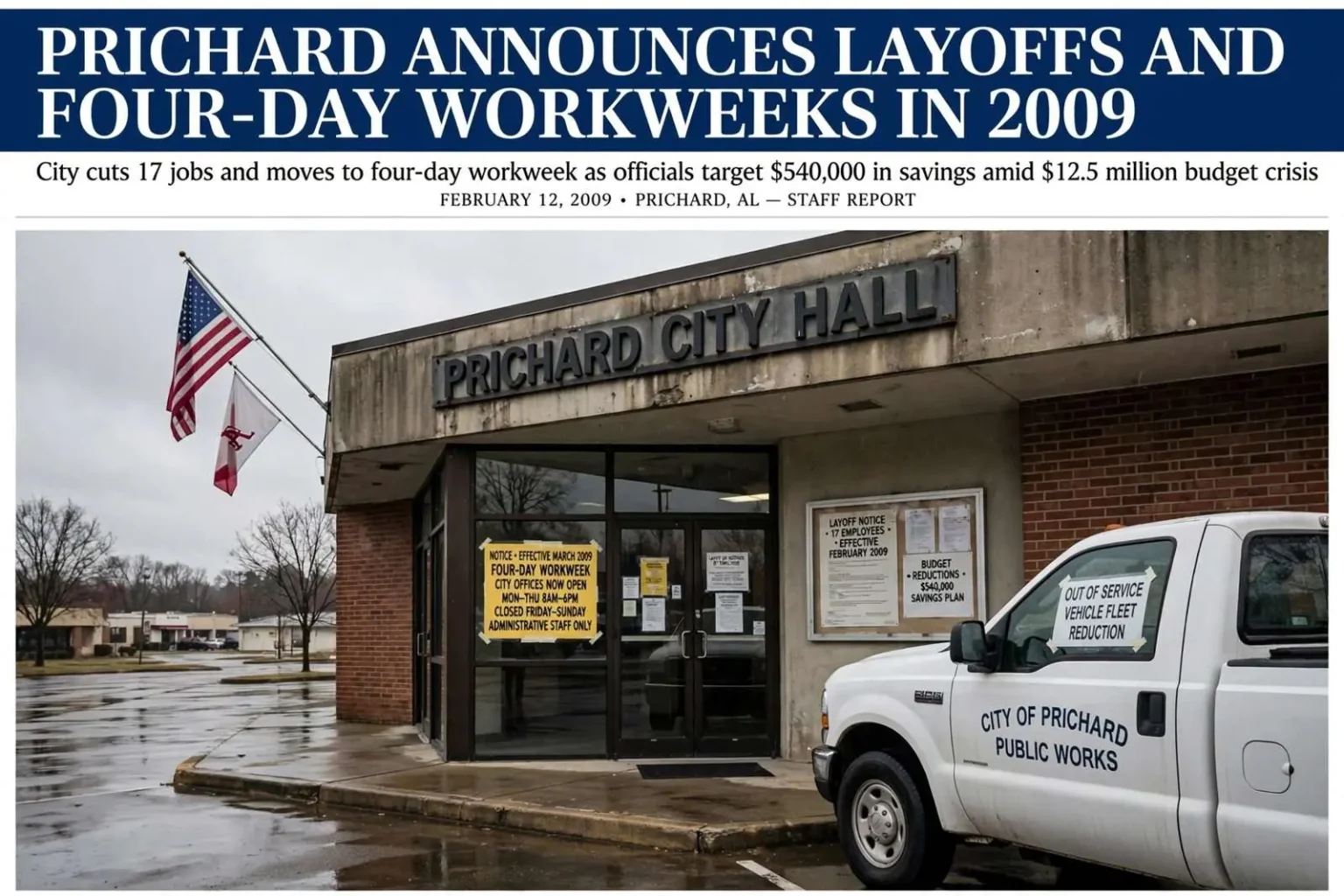
Prichard announced a broad set of city-government cutbacks in February 2009 as officials sought to reduce costs during a period of financial strain, moves that touched nearly every corner of a municipal workforce already operating one of the leaner budgets in Mobile County. Mayor Ron Davis said the city would lay off 17 employees, and beginning the following month, all city employees except police officers and firefighters would move to four-day workweeks.
The announcement landed in the worst stretch of the national recession, when cities across Alabama were watching sales tax receipts and property tax collections fall in real time. For Prichard, a city of about 27,000 residents that had struggled economically for decades, the strain arrived earlier and cut deeper than in wealthier suburbs. The city’s annual budget at the time was reported at $12.5 million — a fraction of what Mobile or Baldwin County’s larger cities spent — which meant every cut carried visible consequences in services residents touched daily.
Projected Savings and Operational Changes
The plan also called for limiting the number of take-home vehicles, a cost item that had drawn scrutiny in cities across the region. Take-home vehicles — city cars that employees drive home at night — carry fuel, maintenance and insurance costs beyond their sticker price, and restricting them is among the least painful cuts a cash-strapped government can make, since it does not eliminate a service so much as a perquisite. City officials projected that the changes would save $540,000 during the fiscal year, a sum equal to more than four percent of the city’s entire annual budget.
The four-day workweek, the largest single component of the plan, reshaped how city hall itself functioned. Moving administrative employees to four ten-hour days closed certain offices to the public three days a week, but it also cut building operating costs — lighting, heating and cooling — and reduced commuting costs for the workers who kept their jobs. Cities across the country experimented with the same model during the 2008-2010 downturn, and Gulf Coast municipalities watched one another’s results closely. Police officers and firefighters were exempted because public safety runs around the clock regardless of what the budget does; there is no version of a four-day patrol week that leaves the streets covered.
The 17 layoffs, by contrast, were permanent losses of income for the affected families, coming at a moment when the private-sector job market offered almost nothing to displaced municipal workers. Layoffs at a city Prichard’s size ripple visibly — 17 positions out of a small workforce touches departments from public works to administration, and the remaining employees absorb the duties of colleagues who are gone.
The City’s Fiscal Position
Prichard’s finances in that era were defined by a shrinking tax base and fixed costs that would not shrink with it. The city had lost population steadily since the 1960s, and the commercial corridors that once generated robust sales tax revenue had thinned as retail followed the population toward western Mobile County and the suburbs. Meanwhile, the obligations that a city must meet — pensions, debt service, basic infrastructure — stayed on the books. A $12.5 million budget leaves little slack for absorbing a recession, and municipal officials in Prichard spent the late 2000s repeatedly choosing between service cuts, fee increases and workforce reductions.
The February 2009 announcement was one of several fiscal developments affecting the city that year, a phrase that understates the pressure Prichard’s leadership faced. Within a short span the city confronted revenue shortfalls, rising costs and — in the period that followed — a pension crisis that would become one of the most closely watched municipal finance stories in Alabama. The layoffs and the four-day week were the visible edge of a much longer structural problem: a city whose revenue no longer matched the government its residents expected.
What the Announcement Did and Did Not Cover
This account records the measures proposed in the February 2009 announcement. It does not state the eventual implementation, duration or final financial effects of the cuts, and the distinction matters for anyone reading municipal history. Announced austerity measures and realized savings are rarely identical — positions get shifted, projections get revised, and some cutbacks get reversed when revenue recovers or when service losses prove unacceptable. What the announcement established is what the city’s leadership believed was necessary at that moment, and the scale of belief is measurable: $540,000 from a $12.5 million budget is a structural response, not a trim.
Context: the 2009 Municipal Crunch
The timing placed Prichard’s announcement squarely within a national wave of municipal retrenchment. Cities across Alabama and the Gulf South spent 2009 trimming workforces, freezing hiring, and compressing workweeks as the recession gutted the two revenue streams municipalities depend on most: sales taxes, which fall when consumers pull back, and property taxes, which fell as the housing collapse worked through assessments. Smaller cities had the least room to maneuver, since their administrative costs are nearly as fixed as larger cities’ but their revenue is far thinner.
For Prichard’s residents, the practical effects of the cuts were felt at city counters and in city services. A four-day administrative week meant planning which day to handle a permit, a utility question or a municipal court matter, and residents arriving on a closed day found themselves returning another time. The take-home vehicle restriction reduced the city’s visible fleet footprint and its fuel bills. The layoffs reduced the city’s capacity in ways less visible but more consequential, as remaining staff stretched to cover work previously divided among more hands.
The People Behind the Numbers
Seventeen layoffs in a city the size of Prichard meant seventeen households losing a paycheck in the worst job market in a generation, and dozens of coworkers watching to see whether their positions would be next. Municipal employment in small cities tends to be filled by people who live in the city itself, so the lost income was largely removed from the same local economy the city was trying to steady — one of the stubborn paradoxes of municipal austerity. The four-day week, whatever its savings, also functioned as a partial protection: workers who kept their jobs kept them at full hours compressed into four days, rather than seeing their pay reduced across a five-day schedule.
Mayor Ron Davis’s administration framed the package as shared sacrifice aimed at keeping the city solvent rather than at any single department, and the exemption of police and fire signaled where the city drew its line: public safety staffing would be maintained even while everything else contracted. That choice left public safety as the city’s dominant cost center and pushed the deepest percentage cuts onto administration, public works and community services.
Reading the Announcement Today
More than a decade later, the February 2009 announcement stands as a snapshot of a city managing decline under pressure, and it is useful to read it that way — as a record of what was proposed, when, and against what backdrop — rather than as a verdict on how the measures ultimately worked. The documents of that period show a leadership trying to stay ahead of a deficit with the tools available: personnel cuts, schedule compression and fleet restrictions. The larger story of Prichard’s finances in those years, including the pension dispute that followed, belongs to separate accounts with their own records.
What the announcement does establish is the arithmetic of small-city government under stress. A $12.5 million budget, a $540,000 savings target, 17 jobs and a compressed workweek add up to a government recalibrating itself to the revenue it actually had rather than the revenue it once collected. Residents of Prichard lived those changes at the counter and in the neighborhood, and the February 2009 announcement remains one of the clearest markers of how deeply the recession reached into Alabama’s smaller municipalities — all the way to the hours City Hall keeps its lights on.
The four-day week also aligned Prichard with a broader experiment sweeping through American local government in 2009. Municipalities from Utah to Georgia were compressing administrative schedules to cut energy costs and preserve jobs, and early adopters reported savings on utilities alongside mixed reviews on public convenience. Whether Prichard’s version lasted through the recovery is not recorded in the announcement itself, but the model it chose — protect sworn public safety staffing, compress everything else — became the recognizable playbook of the era for cities that could not raise revenue and could not print it either.
The take-home vehicle restriction, meanwhile, addressed one of the most commonly audited line items in city fleets. Every vehicle assigned to an employee’s driveway accumulates commuting miles, fuel burn and wear that have nothing to do with city business, and audits across the country have repeatedly found fleets where the number of take-home assignments outran any operational justification. Limiting them converts a politically sensitive benefit into measurable savings without touching a single public service schedule, which is why it so often appears in austerity packages alongside the harder personnel cuts that dominate the headlines.