Prichard Residents Pressed for Water-Board Changes in 2009
Prichard residents and Mayor Ron Davis discussed high water bills, water-board authority and public-record costs at a February 2009 City Council meeting.
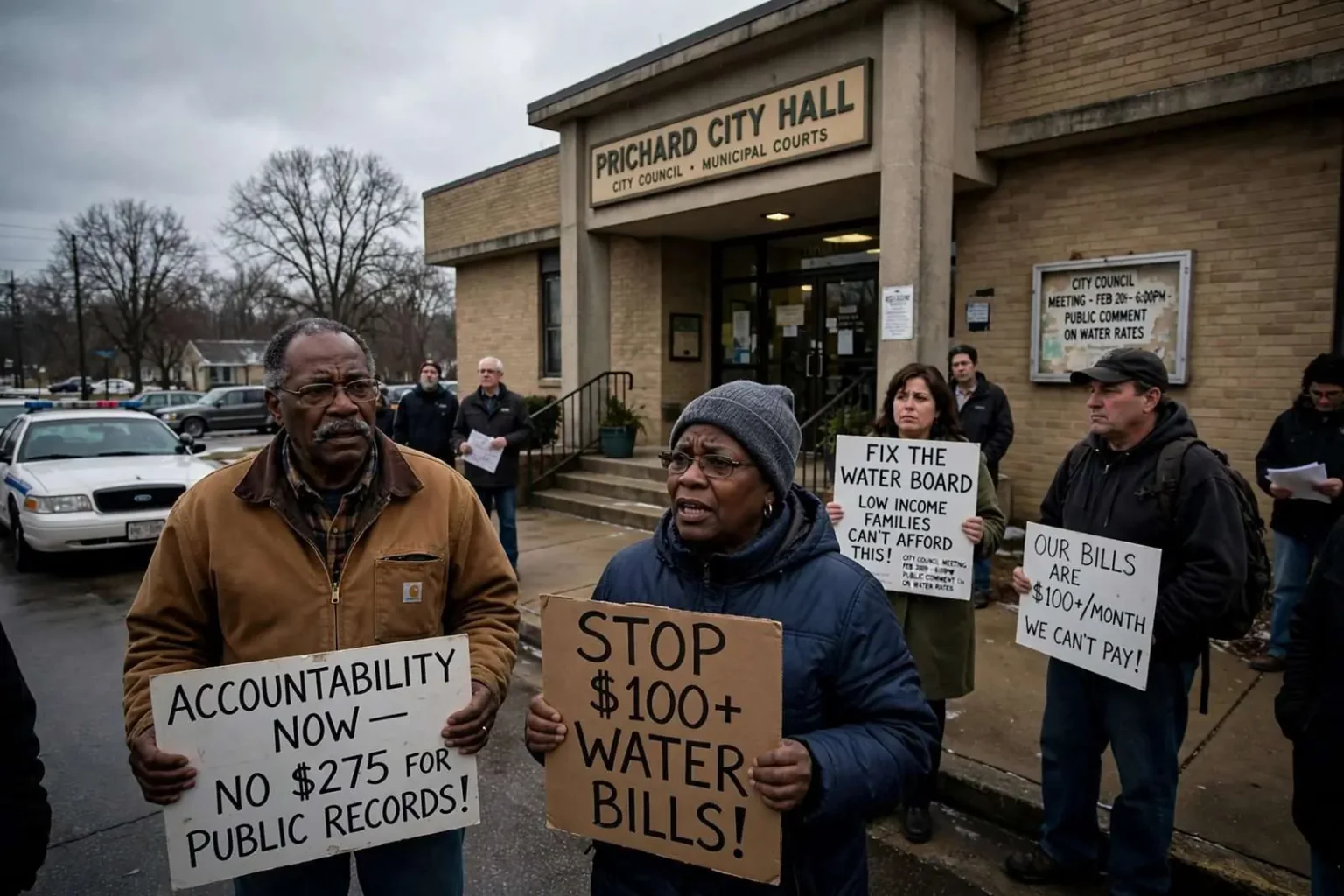
Prichard residents pressed city leaders for relief from high water rates during a February 2009 City Council meeting, raising the possibility of abolishing the Prichard Water Works and Sewer Board altogether. The exchange, aired in public before the council, captured a frustration that had been building in the city for years: households receiving water bills of $100 or more per month in one of the lowest-income municipalities in Mobile County.
Mayor Ron Davis said he was open to considering the idea but explained the structural obstacle: the board set its own rates and operated under state authority once City Council appointments were made. In other words, the city’s elected leaders could appoint board members, but they could not simply vote the board’s rates down. The distinction — common across Alabama’s municipal utilities — is exactly what residents were complaining about: the people paying the bills do not directly elect the people setting them.
What Residents Told the Council
Residents reported water bills of $100 or more per month and said the costs were difficult for people on fixed incomes and single-parent families. In a city where a large share of households live on retirement benefits, disability payments or a single paycheck, a three-figure monthly water bill competes directly with electricity, groceries and prescriptions. Speakers described the arithmetic in blunt terms: when water alone approaches what a family might expect to pay for the whole utility bill in neighboring communities, something in the structure, they argued, has to give.
The complaints were not merely about the size of the bills but about the accountability behind them. Prichard’s water board had been a recurring flashpoint for years, with residents questioning rates, service quality and the board’s responsiveness. The February 2009 meeting put those grievances on the record in front of the mayor and council, forcing city leaders to respond to frustrations that technically fell outside their direct control.
The mayor’s answer acknowledged both the frustration and the legal reality. Davis said city leaders would seek assistance from state officials and explore grants that might ease future increases — an implicit admission that the city’s leverage over the board was limited to persuasion, appointments and whatever help state government or federal grant programs could provide. For residents hoping the council could simply order rates cut, the message was that the path ran through Montgomery, not through a council vote.
How Alabama Water Boards Work
The structure the mayor described is standard in Alabama. Municipal water and sewer boards are created under state enabling law as separate public corporations, governed by their own boards of directors, with authority to set rates, issue debt and manage operations independently of the city council. Councils typically make the appointments — often with staggered terms — but once a board is seated, it answers to state law rather than to city hall. Defunding or abolishing such a board is not a matter of passing a resolution; it requires action at the state level and a legal successor to take over the system’s assets, debts and obligations.
That independence is defended as insulation from politics: rate-setting can reflect the true cost of pumping, treatment and debt service rather than election-year pressure. But in small, low-income cities, the arrangement has a well-known downside. Customers cannot vote rates down, council members cannot override them, and the board’s meetings often draw little public attention until a bill lands hard. Prichard’s February 2009 session was one of those moments when the gap between legal authority and public expectation was laid bare.
Prichard’s own system history amplified the tension. The city’s water works serves a compact, older city north of Mobile with aging infrastructure, and like many older systems it carries costs that newer suburban systems do not: legacy debt, maintenance on old lines and a customer base where unpaid bills and hardship cases weigh on the rate structure. Those pressures flow directly into the monthly bill, and residents in 2009 were telling their council they had reached the limit of what they could absorb.
The $275 Minutes Charge
The meeting also addressed a reported $275 charge for copies of Water Board meeting minutes — a figure that stunned the council and the public in equal measure. Residents and officials alike treated the price as a barrier to basic oversight: if it costs hundreds of dollars to simply read what the board has done, then the public’s ability to understand its own utility is effectively gated behind a paywall.
The board’s attorney said the public-record policy was under review and that action was expected at a future meeting. That commitment mattered beyond the single charge. Alabama’s open-records law guarantees citizens access to public records, and public bodies across the state have long wrestled with how to charge for copies without creating de facto secrecy. A $275 fee for meeting minutes sat on the extreme end of that spectrum, and the council’s willingness to confront it publicly reflected the broader impatience with the board’s posture toward its own customers.
The transparency dispute and the rate dispute were, at bottom, the same dispute. Residents who felt overcharged also felt they could not see how their money was being spent — and a utility that charges steeply for its own minutes deepens exactly that suspicion. City leaders pressing the board on both fronts in the same meeting framed the problem as one of governance as much as economics.
The Economics of a $100 Water Bill
To understand why the February 2009 meeting grew heated, it helps to look at what a $100 monthly water bill means in Prichard specifically. The city’s median household income has long ranked among the lowest in the Mobile County metro area, and its population — which peaked in the 1960s — had been declining for decades as residents and businesses moved out. A shrinking, lower-income customer base spreads a system’s fixed costs across fewer payers, which pushes rates up, which in turn drives more hardship and more delinquency in a cycle that older cities around the country know well.
For customers on Social Security or a fixed pension, a bill that high can consume a meaningful share of monthly income, and there is little room to absorb a spike. Single-parent families juggling childcare costs described the same squeeze from the other direction. Unlike electricity or groceries, water has no cheap substitute, and falling behind on a municipal utility bill in Alabama can ultimately threaten liens and cut-offs — which is why residents came to the council not merely to vent but to demand structural relief.
Comparisons with neighboring systems sharpened the grievance. Mobile-area suburban systems with newer infrastructure and broader tax or growth bases could hold typical residential bills far lower than what Prichard households reported paying. Whether the gap reflected mismanagement, legacy debt, deferred maintenance or simple economics was exactly the question residents wanted answered — and the board’s distance from the council made that answer hard to extract in a public meeting.
The mayor’s proposed remedies matched the tools actually available to a city in that position. State assistance and grant funding — the kinds of programs that help small and mid-size utilities fund infrastructure repairs, meter replacements and system upgrades — can reduce the pressure that drives rate increases, without requiring the board’s legal structure to change. Davis’s message to residents was effectively that relief would come, if it came, through state channels and grant applications rather than through any vote the council could take that night.
Transparency as a Second Front
The $275 charge for meeting minutes gave the meeting a second, sharper edge. Residents who cannot afford their water bills were now being told that reviewing the board’s own record of decisions carried a hefty price tag. Council members pressed the point, and the board’s attorney’s response — that the public-record policy was under review, with action expected at a future meeting — became the meeting’s only concrete commitment.
The episode fits a broader pattern that advocates of open government have documented across Alabama: access to public records often depends on fees set by the very agencies being asked to disclose, with no uniform statewide schedule and little recourse beyond negotiation or lawsuit. When the agency is a water board already under fire for rates, a steep copying charge reads less like cost recovery and more like obstruction, whatever the intent behind it.
For Prichard residents, the demand was never complicated: publish the minutes at a reasonable cost, or better yet post them where anyone can read them, and show the arithmetic behind the rates. A utility that operates with visible books — rates tied to documented costs, minutes freely available, budgets presented in public — earns a measure of patience from customers even when bills are high. The frustration aired in February 2009 was as much about the missing visibility as the missing money.
Historic Civic Debate
This article records the issues and positions raised in February 2009. It does not state whether the board was later reorganized, whether rates changed or the outcome of the records-policy review — and that gap is itself instructive. The questions raised that night, from rate relief to board structure to copying fees, are the standing questions of municipal water governance in Alabama, and they have a way of resurfacing in Prichard and cities like it whenever bills spike or trust erodes.
What the February 2009 meeting documented is a city government and its residents wrestling, in public, with the limits of local control: a mayor conceding the legal boundaries of his authority, a council fielding complaints it could not directly resolve, a utility board facing calls for its own abolition, and customers asking to see the records behind their bills. Those positions — the residents’ demand for relief, the mayor’s pursuit of state help and grants, the board’s promised review of its records policy — stand as the record of where the debate stood at that moment in the city’s history.
For current Prichard residents, the February 2009 record remains a useful benchmark. The issues on the table that night — bills of $100 or more per month, a board that sets its own rates under state authority, a $275 charge for public minutes, promises of state assistance and grant exploration — define what accountability looked like when it was demanded. Anyone weighing today’s water rates, or today’s board governance, can measure them against the commitments made and the questions left unanswered in that council chamber.
The February 2009 meeting ended with those threads hanging: no vote taken, no board abolished, no rate change ordered, and a records-policy review promised for a future meeting. What remained was the record itself — residents’ testimony about unaffordable bills, the mayor’s explanation of where authority actually lay, and a city left to pursue relief through the state officials and grant programs its mayor said he would ask for.