Three Brewton Residents Killed in Highway 31 Collision North of Town
Three Brewton residents died Sunday when their car collided with a pickup truck on U.S. Highway 31 north of town, according to Alabama State Troopers.
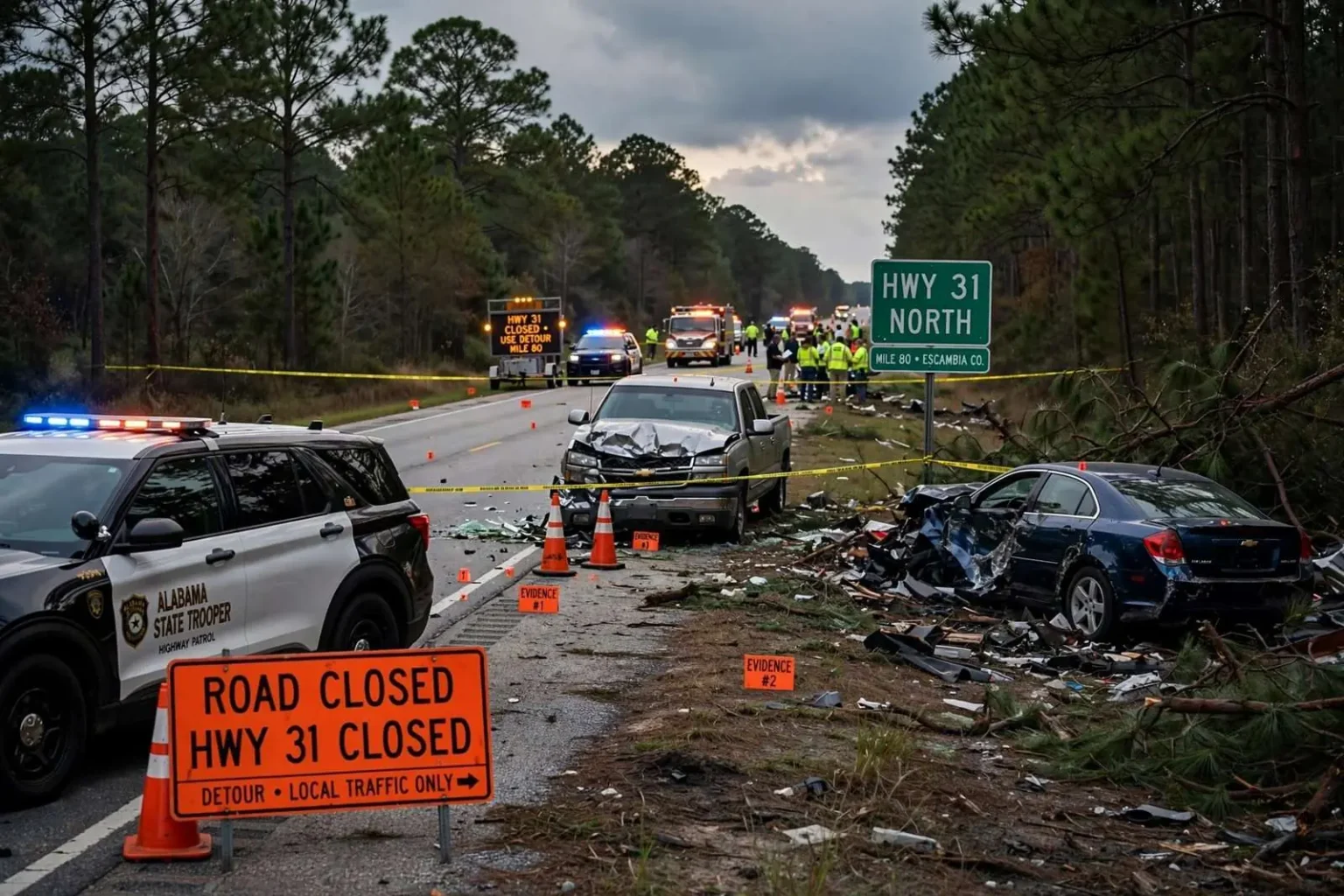
Three Brewton residents were killed Sunday afternoon when the car they were riding in collided with a pickup truck on U.S. Highway 31 north of town, according to Alabama State Troopers. The crash added three names to the toll on a rural two-lane highway that local officials have worried about for years, and it shut down the road through the Sunday evening hours while investigators worked the scene.
The crash occurred just before 4 p.m. at the 80 mile marker on Highway 31, roughly seven miles north of Brewton in Escambia County. Troopers said a 2008 Chevrolet Malibu carrying the three Brewton residents collided with a 2003 Chevrolet Silverado pickup truck driven by a 51-year-old Greenville man, in a collision violent enough to claim the lives of everyone in the smaller car.
The driver of the pickup and one of his passengers were transported to Sacred Heart Medical Center in Pensacola, Florida, for treatment following the crash. The hospital, located across the state line less than an hour’s drive from the crash site, serves as the primary trauma destination for serious injuries in the western Panhandle and southern Alabama border region.
Investigators with the Alabama State Troopers said they had not yet determined what caused the collision as of the initial investigation. The agency said its Highway Patrol Division was continuing to examine the crash scene and gather evidence to determine a cause — a process that in serious rural crashes can stretch over days, as investigators reconstruct speeds, points of impact and roadway factors.
The scene and the closure
News of the crash moved quickly through Brewton and the surrounding communities, where connections between families run deep and a three-victim collision touches more than one neighborhood. Local officials and residents alike have learned to await the details — names, ages, circumstances — that follow the initial report of a fatal crash on the highway north of town.
The collision closed a stretch of Highway 31 north of Brewton for several hours Sunday evening as troopers investigated and cleared the scene, a common procedure following serious crashes on the rural highway corridor connecting Escambia County to neighboring Conecuh County. Motorists found themselves routed onto detours through country roads as the highway’s two lanes sat blocked by wrecked vehicles and investigation equipment.
For a rural highway, the closure carried real consequences. Highway 31 is the spine road for the small communities between Brewton and the Conecuh County line, and with no divided four-lane alternative along the same route, a several-hour shutdown leaves residents, churchgoers and Sunday travelers with long detours. Emergency responders, meanwhile, must plan around the same closure when the injured need transport.
The 80 mile marker sits in a stretch of highway typical of the rural South’s older routes: two lanes, undivided, bordered by pine forest and scattered driveways. Traffic on such roads mixes local drivers who know every curve with through travelers and heavy vehicles, and the passing zones that dot the route invite the kind of maneuvers that turn small mistakes into head-on collisions.
Troopers worked into the evening documenting the scene, a task that grows more detailed with each fatality. Reconstruction teams photograph and measure everything from final resting positions to debris fields, and in a crash that killed three people, the investigation’s findings will matter to families, insurers and possibly prosecutors depending on what the evidence shows.
A highway with a history
Highway 31 is a heavily traveled two-lane route linking Brewton to areas further north in Alabama, and local officials have periodically raised concerns about safety along stretches of the corridor as traffic volumes have grown over the years. The road was once a principal highway of the state — the old north-south route that predates the interstate system — and segments like the one north of Brewton retain the character of that earlier era: undivided lanes, limited shoulders and intersections that open directly onto the through traffic.
The interstate era bypassed most of rural Highway 31, but the road never stopped carrying traffic. Timber trucks, farm equipment, commuters and school buses all share its lanes, and the communities along it depend on it for their connection to hospitals, schools and jobs. Growth in traffic without growth in roadway design is the pattern that rural safety advocates repeatedly flag, and Escambia County’s stretch has drawn its share of that attention.
Escambia County has seen its share of serious crashes on rural highways in recent years, prompting occasional calls from residents and local leaders for additional traffic safety measures, including turn lanes and improved lighting at high-risk intersections. Those requests run into the arithmetic of rural road funding: turn lanes, shoulders and lighting projects cost money that small counties and the state must split across thousands of miles of similar road.
Safety engineers rank undivided two-lane highways among the most dangerous road types per mile traveled, largely because of the head-on and opposing-direction crashes that occur when passing attempts or distractions carry a vehicle across the centerline. Striping, rumble strips and passing-lane additions are the standard countermeasures, and each requires investment decisions made long before any particular Sunday afternoon crash.
What troopers ask of drivers
Brewton itself sits in the timber country of south Alabama, where logging trucks are a daily presence on every highway in the county. Sharing two lanes with loaded log trucks changes the arithmetic of every passing decision, and troopers’ warnings about undivided highways are aimed squarely at the habits — impatience with slow traffic, marginal passing attempts — that this mix rewards until the day it does not.
The timing of the crash — mid-afternoon on a Sunday, when church is out and families are on the move — put peak weekend traffic on the corridor. Rural highways see their heaviest use at precisely these hours, with slower recreational vehicles mixed among the faster through traffic, and the mix is a recurring factor in the crashes troopers work on routes like this one.
Alabama State Troopers routinely investigate fatal crashes across rural Escambia County roadways and remind drivers to exercise caution on undivided highways, particularly during afternoon and evening hours when traffic and visibility conditions can change quickly. The reminders are practical rather than formal: allow passing distances, watch for vehicles entering from side roads and driveways, and reduce speed where sight lines narrow.
Sunday’s closure also gave the detour traffic a tour of the county’s back roads, which are themselves narrow, often unpaved and unfamiliar to through drivers. Residents along the detour routes are used to the drill — the closure signs, the cut-through traffic, the long wait for the highway to reopen — but the disruption never becomes routine for the families involved in the crash itself.
The agency continues to encourage drivers and passengers to buckle up on every trip, a message that carries particular weight on rural routes where the nearest trauma care is a county away. Seat belts do not prevent collisions, but they determine, more than any other single factor, whether occupants of a crashed vehicle walk away or do not — and in crashes like Sunday’s, the difference between the fates of those in the two vehicles often comes down to restraint use and the physics of the impact.
For Brewton, a city of roughly 5,000 that serves as the seat of Escambia County, the loss of three residents in a single afternoon crash reverberates through a community where such news travels by word of mouth faster than any official release. The victims’ names, once released by authorities, will bring the usual accumulation of grief: school connections, church memberships, workplaces and neighbors who knew them.
The pickup’s driver and injured passenger, treated at Sacred Heart in Pensacola, face their own recovery and their own role in the investigation’s eventual account of what happened. Troopers had not released the extent of their injuries, and the agency’s findings on cause — speed, impairment, distraction, mechanical failure or a combination — await the completion of the reconstruction work.
Troopers typically ask anyone who witnessed a crash like Sunday’s to come forward during the investigation, since witness accounts of speed and movement in the seconds before impact often settle questions that physical evidence alone cannot. Details from travelers on the highway that afternoon could prove decisive in the final report.
The crash’s place in the corridor’s record will depend on what the investigation shows, but the pattern it fits is familiar to everyone who travels Highway 31 regularly. Until the road’s design catches up with its traffic, the county’s stretch of two-lane blacktop will keep generating the kinds of Sunday evening closures that residents read about, sigh over, and drive through the next morning on their way north.